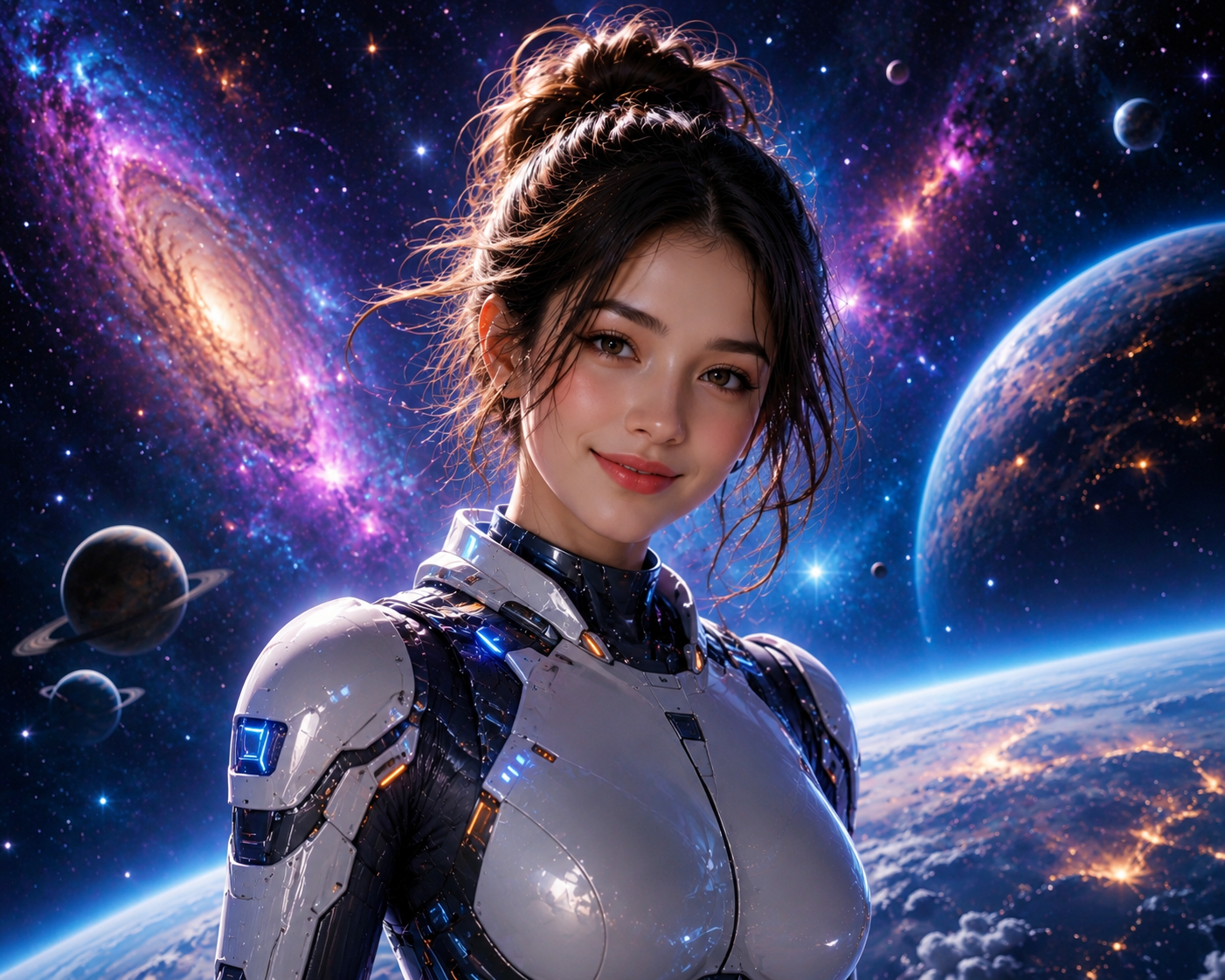
Have you ever typed a simple sentence like “a castle floating among the clouds at sunset” and watched a computer create a breathtaking image in just a few seconds? It can feel almost magical. A few words become a detailed painting, a realistic photograph, or an imaginative digital artwork that never existed before.
This ability has transformed the creative world. Artists use it to explore new ideas. Designers use it to speed up their work. Businesses create marketing materials more efficiently. Students visualize concepts for learning, and storytellers bring fictional worlds to life.
But behind this apparent magic lies an extraordinary combination of computer science, mathematics, and artificial intelligence. AI does not imagine images the way humans do. It does not possess creativity, emotions, or personal experiences. Instead, it learns statistical patterns from enormous collections of images and their associated text, allowing it to generate entirely new pictures that resemble what it has learned.
Understanding how AI creates images reveals one of the most fascinating achievements of modern artificial intelligence.
What Is AI Image Generation?
AI image generation is the process of creating entirely new images using artificial intelligence based on a user’s instructions, known as a prompt.
A prompt may be as simple as “a snowy mountain at sunrise” or as detailed as “a realistic golden eagle flying over a misty forest during autumn, cinematic lighting, ultra-high detail.”
The AI analyzes the meaning of the words and generates an image that matches the description as closely as possible.
Unlike traditional graphic design software, where a person manually draws or edits every element, AI automatically creates the picture from scratch. Every generated image consists of millions of tiny colored pixels carefully arranged according to patterns the AI has learned during training.
AI Does Not Search for Existing Images
One of the biggest misconceptions about AI image generators is that they simply search the internet and combine existing pictures.
Modern AI image generators do not work this way.
Instead of copying complete images, the AI learns statistical relationships between visual features and language during training. It studies countless examples of objects, colors, textures, lighting, shapes, and compositions.
For example, after seeing many images labeled as “cat,” the AI gradually learns common characteristics of cats, such as ears, whiskers, eyes, fur, paws, and body proportions. It does not memorize a single cat image. Instead, it builds an internal mathematical understanding of what cats generally look like.
When someone later requests an image of a cat, the AI generates a new image based on those learned patterns rather than retrieving an existing photograph.
The Importance of Training Data
Like humans, AI learns by observing examples.
During training, researchers provide the AI with an enormous dataset containing images paired with descriptive text.
These datasets may include photographs, paintings, illustrations, landscapes, animals, architecture, people, vehicles, plants, scientific diagrams, everyday objects, and many other visual subjects.
The AI repeatedly analyzes these image-text pairs.
Over time, it begins recognizing patterns.
It learns that birds usually have wings.
Cars generally have wheels.
Trees often have trunks and leaves.
Snow is commonly white.
The sky often appears blue during the day.
Sunsets frequently contain orange, pink, and purple colors.
The more diverse and carefully prepared the training data, the better the AI becomes at understanding visual concepts.
Learning Patterns Instead of Memorizing Pictures
Human memory often stores specific experiences.
Artificial intelligence learns differently.
Instead of remembering complete images, modern AI systems adjust billions of mathematical values called parameters.
These parameters gradually capture statistical relationships between words and visual patterns.
For example, the AI may learn that the word “apple” often corresponds to round objects with smooth surfaces, stems, and colors like red, green, or yellow.
Similarly, the word “ocean” becomes associated with blue water, waves, reflections, and distant horizons.
These learned relationships allow the AI to generate entirely new combinations that may never have existed before.
Understanding Language
Before creating an image, the AI must first understand what the user wants.
This process begins with natural language processing.
The AI reads every word in the prompt and converts it into mathematical representations called embeddings.
Embeddings capture the meaning and relationships between words.
For example, the AI recognizes that “puppy” and “dog” are closely related concepts.
It understands that “small elephant” differs from “large elephant.”
It also recognizes descriptive terms like “watercolor,” “photorealistic,” “oil painting,” “night,” “winter,” or “underwater.”
This language understanding helps guide the image generation process.
Building an Image from Random Noise
One of the most remarkable techniques used in many modern AI image generators is called a diffusion model.
Rather than starting with a blank canvas, the AI begins with what looks like random visual noise, similar to the static seen on an old television.
At first glance, this noisy image appears completely meaningless.
The AI then gradually removes the noise step by step.
With every step, recognizable structures begin to emerge.
Simple shapes appear first.
Then larger objects become visible.
Next come textures, lighting, shadows, reflections, and fine details.
After many iterations, the random noise transforms into a coherent image that matches the user’s prompt.
This gradual refinement process is one of the key innovations behind many state-of-the-art image generation systems.
Why Diffusion Models Work So Well
Diffusion models are based on a surprisingly elegant idea.
During training, researchers intentionally add increasing amounts of random noise to real images until they become completely unrecognizable.
The AI learns how to reverse this process.
Instead of only learning how images become noisy, it learns how to remove the noise correctly.
Eventually, the AI becomes so skilled that it can begin with pure random noise and repeatedly predict what the next cleaner version should look like.
Each prediction moves the image closer to the desired result.
Although the mathematics behind diffusion models is highly complex, the overall concept resembles slowly revealing a hidden picture from beneath layers of visual static.
Understanding Shapes, Colors, and Textures
Generating realistic images requires much more than identifying objects.
The AI must also learn countless visual details.
It learns how shadows behave under different lighting conditions.
It learns how glass reflects light.
It learns how clouds scatter sunlight.
It learns the texture of tree bark, animal fur, water, metal, stone, fabric, skin, and countless other materials.
It also learns perspective, depth, distance, and relative object sizes.
These learned visual relationships help create images that appear natural and believable.
Creating Faces
Human faces are among the most challenging subjects for AI.
Faces contain extremely subtle details.
Small changes in eye spacing, nose shape, or facial proportions can make a face appear unrealistic.
Modern AI systems become better at generating faces by studying enormous numbers of facial images during training.
They learn common facial structures, expressions, lighting conditions, hairstyles, skin textures, and viewing angles.
Today’s image generators can often create highly realistic fictional people who have never existed.
These are not photographs of real individuals but newly generated faces based on learned statistical patterns.
Understanding Artistic Styles
AI image generators can create images in many artistic styles because they learn visual characteristics associated with different forms of art.
They recognize features commonly found in watercolor paintings, pencil sketches, oil paintings, digital illustrations, comic books, anime-inspired artwork, pixel art, and many other visual styles.
When a user requests a particular artistic style, the AI adjusts colors, textures, brushstroke-like effects, lighting, and composition to resemble those characteristics.
The result is not a human artist making creative decisions but a mathematical system producing images based on learned visual patterns.
How AI Understands Composition
Beautiful images are not simply collections of objects.
Composition plays a major role.
AI gradually learns common visual arrangements.
For example, it learns that landscapes often contain a horizon.
Portraits usually place faces near the center.
Buildings typically stand vertically.
Roads often narrow toward the distance because of perspective.
By recognizing these patterns, the AI creates images that appear balanced and visually appealing.
The Role of Neural Networks
At the heart of modern AI image generation are artificial neural networks.
These computer systems are loosely inspired by the interconnected structure of neurons in the human brain.
Artificial neural networks consist of many computational layers that process information step by step.
Each layer identifies increasingly complex visual features.
Early layers detect simple edges and colors.
Later layers recognize shapes.
Even deeper layers identify complete objects like flowers, animals, cars, or buildings.
Together, these layers allow the AI to understand highly complex visual information.
Mathematics Behind Every Pixel
Every generated image is ultimately built through mathematics.
Each pixel has numerical values representing color and brightness.
The AI continuously calculates how these values should change during image generation.
Millions or even billions of mathematical operations occur while producing a single picture.
Although users simply see an image appear within seconds, the computer performs enormous numbers of calculations behind the scenes.
Modern graphics processing units, or GPUs, make these calculations possible by performing many operations simultaneously.
Why AI Sometimes Makes Mistakes
Although AI image generators have become remarkably powerful, they are not perfect.
Sometimes they generate extra fingers.
Occasionally objects blend together unnaturally.
Text inside images may appear distorted or unreadable.
Complex scenes containing many interacting objects can confuse the AI.
These mistakes occur because AI predicts visual patterns statistically rather than understanding the world in the same way humans do.
Researchers continue improving models to reduce these errors, but no current system is flawless.
The Importance of Prompts
The quality of an AI-generated image depends greatly on the prompt.
A vague prompt gives the AI relatively little guidance.
A detailed prompt provides more information about subjects, lighting, camera angles, colors, artistic style, weather, mood, background, and composition.
For example, requesting “a bird” produces a broad interpretation.
Requesting “a colorful kingfisher perched on a moss-covered branch beside a clear forest stream during golden morning sunlight, highly realistic” gives the AI much richer instructions.
Clearer prompts generally lead to more predictable results.
AI Can Also Edit Images
Modern image-generation systems are not limited to creating pictures from scratch.
They can also modify existing images.
Users may remove unwanted objects, replace backgrounds, change lighting, extend image borders, improve resolution, restore damaged photographs, or alter artistic styles.
The AI analyzes both the original image and the user’s instructions before generating updated content.
This ability has become valuable in photography, graphic design, filmmaking, architecture, and advertising.
Scientific Applications
AI image generation extends far beyond entertainment.
Scientists use similar techniques to visualize complex data, simulate biological structures, reconstruct incomplete archaeological artifacts, improve medical imaging, and assist astronomical research.
Researchers also use generative AI to create synthetic datasets that help train other machine learning systems while protecting sensitive information in some applications.
These scientific uses demonstrate that AI image generation can support research as well as creative expression.
Ethical Challenges
As AI-generated images become increasingly realistic, they also introduce important ethical questions.
People may mistake AI-generated images for genuine photographs.
Images can be created that depict events that never occurred.
Some generated content may imitate recognizable artistic styles or public figures, raising questions about intellectual property, consent, authenticity, and responsible use.
For these reasons, researchers, technology companies, policymakers, and creative professionals continue developing guidelines, technical safeguards, and detection methods to encourage responsible use of AI-generated media.
Scientific progress is most beneficial when paired with ethical responsibility.
How AI Continues to Improve
AI image generation evolves rapidly.
Researchers continue developing models that produce higher-quality images, better understand complex prompts, generate more accurate anatomy, improve text rendering, and create more consistent scenes.
Training methods become more efficient.
Computers become more powerful.
Algorithms become more sophisticated.
Each new generation of AI learns from advances in computer science, mathematics, and machine learning research.
As these technologies improve, AI-generated images become increasingly detailed, realistic, and controllable.
AI Is a Tool, Not an Artist
Although AI can create visually stunning images, it is important to understand what it truly does.
AI does not experience imagination, emotions, curiosity, or inspiration.
It does not understand beauty in the human sense.
Instead, it identifies statistical relationships learned from vast amounts of training data and uses those relationships to predict what an image matching a prompt should look like.
The creativity in an AI-generated image often comes from the collaboration between the human user, who provides the idea and direction, and the AI system, which transforms that guidance into visual form through advanced computation.
The Future of AI Image Generation
The future of AI image generation promises even greater possibilities. Researchers are working on systems that better understand natural language, generate images with greater consistency across multiple scenes, create accurate three-dimensional objects, and seamlessly combine text, images, video, and audio into unified creative workflows.
These advances could reshape education, scientific visualization, entertainment, architecture, engineering, medicine, product design, and many other fields. At the same time, they will require continued attention to transparency, fairness, copyright, privacy, and responsible use.
AI image generation is not magic. It is the result of decades of scientific research in artificial intelligence, computer vision, machine learning, mathematics, and high-performance computing. Every image begins as numbers, patterns, and probabilities, gradually transformed through sophisticated algorithms into something people can see and understand.
As this technology continues to evolve, it offers a powerful reminder of what modern science and engineering can achieve. By learning from vast collections of visual information and applying advanced mathematical models, artificial intelligence has opened an entirely new way for humans to turn ideas into images—making imagination more accessible while continuing to challenge our understanding of creativity itself.