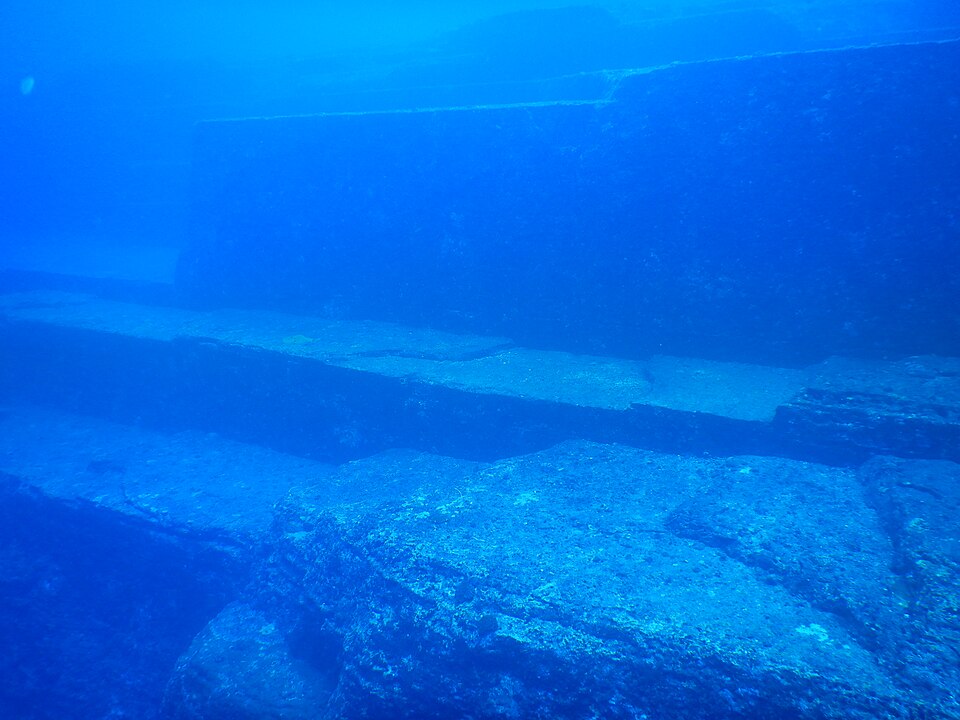
About 25 meters (82 feet) beneath the crystal-clear waters off the coast of Japan’s westernmost inhabited island lies one of the most fascinating underwater mysteries in the world. Divers descending into the deep blue sea suddenly find themselves facing something that seems almost impossible to believe. Massive stone terraces stretch into the darkness. Sharp right angles appear carved into enormous rock faces. Broad stair-like formations rise from the seabed, while long flat surfaces resemble plazas or platforms. In some places, the rocks even seem to form roads, walls, and giant steps.
At first glance, many people are convinced they are looking at the ruins of an ancient lost city.
This remarkable underwater structure is known as the Yonaguni Monument.
Ever since its discovery in 1986, the Yonaguni Monument has sparked one of archaeology’s most heated debates. Is it evidence of an advanced civilization that existed thousands of years before recorded history? Could it be the remains of a city swallowed by rising seas after the last Ice Age? Or is the entire structure simply an extraordinary geological formation shaped by natural forces over millions of years?
Unlike many ancient mysteries that can be answered through written records or archaeological excavations, the Yonaguni Monument offers few clear clues. There are no inscriptions, no pottery scattered across the site, no confirmed tools, and no unmistakable evidence of human construction. Yet some features appear so geometric and carefully arranged that they seem difficult to explain through nature alone.
Scientists, archaeologists, geologists, and divers continue to examine every corner of this mysterious underwater landscape. Some believe the evidence strongly favors natural geological processes. Others argue that at least part of the monument may have been modified by prehistoric people.
The debate has continued for nearly four decades, and it remains unresolved.
What makes the Yonaguni Monument especially fascinating is that it sits at the intersection of science, history, geology, archaeology, and human imagination. It reminds us that our planet still holds mysteries waiting to be explored, and that careful scientific investigation is often the only way to separate extraordinary possibilities from extraordinary appearances.
Where Is the Yonaguni Monument?
The Yonaguni Monument lies beneath the ocean near Yonaguni Island, the westernmost inhabited island of Japan.
Yonaguni belongs to Okinawa Prefecture and is located close to Taiwan, at the edge of the East China Sea.
The monument rests only a short distance from the island’s southern coast.
The surrounding waters are famous for their exceptional visibility, making the site one of Japan’s most popular diving destinations.
Strong ocean currents flow through the area, attracting experienced divers from around the world.
Besides the mysterious rock formation itself, the waters are known for schools of colorful fish, sea turtles, hammerhead sharks during certain seasons, and rich coral ecosystems.
Today, the monument has become both a scientific curiosity and a major tourist attraction.
The Discovery That Started the Mystery
The Yonaguni Monument remained unknown to the wider world until 1986.
Local diver Kihachiro Aratake was searching for good places to observe hammerhead sharks when he encountered something unexpected beneath the waves.
Instead of simply finding marine life, he came across enormous stone formations unlike anything he had seen before.
The rocks featured broad flat surfaces, steep walls, and sharp edges that appeared surprisingly geometric.
Word of the discovery spread quickly.
Soon divers, journalists, photographers, geologists, and archaeologists began visiting the site.
Underwater photographs created worldwide fascination.
Many viewers immediately compared the monument to ancient pyramids, temples, or cities.
The debate began almost immediately and continues today.
What Does the Monument Look Like?
The main structure resembles a giant stepped platform carved into solid rock.
Its largest section measures roughly 150 meters long and about 40 meters wide, although exact measurements vary depending on how researchers define its boundaries.
Some surfaces appear almost perfectly flat.
Other sections form broad terraces.
Several areas resemble giant staircases descending toward the sea floor.
Long vertical walls rise dramatically from the ocean bottom.
Certain corners appear remarkably close to right angles.
Divers have also identified features sometimes described as roads, plazas, pillars, channels, arches, and even what some interpret as carved faces or animal figures.
These visually striking shapes explain why the site attracts so much attention.
To many visitors, the monument simply looks too orderly to be entirely natural.
Why Some Believe It Is Man-Made
Supporters of the human-construction theory point to several observations.
The monument contains numerous straight lines.
Some walls appear nearly vertical.
Certain corners approach ninety degrees.
Several terraces seem evenly spaced.
The overall appearance reminds many people of ancient stone architecture.
Marine geologist Masaaki Kimura, one of the monument’s strongest supporters, has spent decades studying the site.
He argues that some features cannot easily be explained through natural geological processes alone.
Kimura has suggested that ancient people may have shaped or modified an existing rock formation.
He has also proposed that additional nearby underwater structures may represent roads, walls, ceremonial areas, or other human-made features.
Some supporters even speculate that the monument belonged to a civilization predating known history.
The Ice Age Connection
One argument favoring human involvement concerns sea levels.
During the last Ice Age, enormous quantities of Earth’s water were locked inside glaciers.
As a result, global sea levels were much lower than they are today.
Around 20,000 years ago, sea level may have been more than 100 meters lower than today in many parts of the world.
If the Yonaguni Monument existed above water during that period, prehistoric people could theoretically have reached it.
As glaciers melted, rising oceans gradually flooded coastal regions around the world.
Many ancient shorelines now lie underwater.
This fact has inspired speculation that Yonaguni might preserve part of a submerged prehistoric landscape.
However, being above sea level during the Ice Age does not automatically prove human construction.
Natural rock formations also existed on dry land before later becoming submerged.
The Geological Explanation
Most geologists favor a natural explanation.
The rocks making up the Yonaguni Monument consist primarily of sandstone and mudstone deposited millions of years ago.
These sedimentary rocks naturally develop layers.
Over time, geological forces such as tectonic movement create fractures.
These fractures often occur at nearly right angles.
When waves, currents, earthquakes, and erosion act upon fractured rock over long periods, surprisingly geometric shapes can emerge.
Nature frequently produces straight cliffs, flat surfaces, rectangular blocks, and step-like formations.
Similar geological patterns appear elsewhere around the world without any human involvement.
According to many geologists, Yonaguni represents an exceptional—but entirely natural—example of these processes.
How Nature Creates Straight Lines
Many people assume that straight lines indicate human construction.
In reality, geology often produces remarkably straight features.
Sedimentary rocks break along natural planes of weakness.
These fractures can extend for many meters.
Earthquakes increase cracking.
Ocean waves gradually remove loose material.
Over thousands or millions of years, erosion exposes broad flat surfaces while preserving sharp edges.
The result can resemble enormous staircases or walls.
Basalt columns, hexagonal rock formations, and layered cliffs demonstrate that nature frequently creates surprisingly regular geometric patterns.
The famous Giant’s Causeway in Northern Ireland is another example where natural geology produces shapes many people initially assume were built by humans.
The “Steps”
One of the monument’s most famous features is its enormous staircase-like appearance.
Supporters of human construction argue that the steps appear unusually regular.
Critics disagree.
Geologists explain that horizontal sedimentary layers naturally weather into terraces.
Where vertical fractures intersect these layers, step-like formations result.
This process occurs in many coastal environments around the world.
The steps therefore do not necessarily require human engineering.
Instead, they may reflect the natural structure of the underlying rock.
The Sharp Corners
Photographs often highlight impressive right-angle corners.
At first glance, these seem almost architectural.
However, geology again offers an explanation.
Rock fractures commonly intersect at approximately ninety degrees because of regional stress patterns within Earth’s crust.
When erosion follows these fracture lines, remarkably square corners can develop.
Although visually striking, such corners are not considered unusual by many geologists familiar with fractured sedimentary rock.
Alleged Carvings
Some researchers claim certain surfaces display carvings or symbols.
Others believe they see animal shapes or human faces.
These interpretations remain controversial.
No widely accepted evidence demonstrates intentional artistic carving.
Many scientists argue that these apparent images result from natural weathering combined with pareidolia.
Pareidolia is the human tendency to recognize familiar patterns, especially faces, in random objects.
Clouds often resemble animals.
Rock formations sometimes appear human.
The brain naturally searches for recognizable shapes.
This psychological effect may explain many claimed sculptures at Yonaguni.
Are There Ancient Tools?
One of archaeology’s strongest methods for identifying ancient human activity involves associated artifacts.
When people build structures, they usually leave behind evidence.
Stone tools.
Pottery.
Bones.
Charcoal.
Metal objects.
Food remains.
Human burials.
At Yonaguni, no widely accepted archaeological excavation has uncovered convincing artifacts directly demonstrating large-scale construction.
Without supporting evidence, most archaeologists remain skeptical that the monument represents an ancient city.
The Importance of Context
Archaeologists rarely identify ancient sites based solely on appearance.
Context matters enormously.
A stone wall becomes much more convincing when accompanied by pottery, tools, buildings, roads, and human remains.
Without context, natural formations can easily resemble architecture.
Many archaeologists argue that Yonaguni lacks the broader archaeological evidence expected from a large prehistoric settlement.
If an advanced civilization had constructed such a monument, researchers would normally expect additional evidence nearby.
Could Humans Have Modified a Natural Formation?
Some scientists suggest a middle-ground explanation.
Rather than viewing the monument as entirely natural or entirely artificial, they propose that prehistoric people may have modified an existing rock formation.
Natural terraces could have been enlarged.
Flat surfaces might have been smoothed.
Certain pathways may have been adapted for ceremonial use.
This possibility cannot be completely ruled out.
Throughout history, humans have frequently modified natural landscapes instead of creating structures entirely from scratch.
However, direct evidence for such modifications at Yonaguni remains limited.
Ancient Sea Levels
Understanding ancient sea levels is essential to this debate.
At the height of the last Ice Age, much of today’s continental shelf stood above water.
As glaciers melted between approximately 20,000 and 7,000 years ago, sea levels gradually rose.
Many prehistoric coastlines disappeared beneath expanding oceans.
Scientists know that numerous archaeological sites worldwide now lie underwater.
Therefore, the possibility of submerged prehistoric settlements is scientifically reasonable.
The question is whether Yonaguni is one of them.
At present, available evidence has not convinced most archaeologists.
Earthquakes and Tectonic Activity
Japan lies within one of Earth’s most geologically active regions.
Earthquakes occur frequently.
Powerful tectonic forces constantly reshape the landscape.
These forces fracture rocks, uplift coastlines, and sometimes lower sections of land beneath the sea.
Over millions of years, repeated earthquakes may have contributed significantly to the monument’s present appearance.
Geologists consider tectonic activity an important part of Yonaguni’s geological history.
Marine Erosion
The ocean is an extraordinarily powerful sculptor.
Waves strike coastlines continuously.
Currents transport sand that gradually grinds rock surfaces.
Chemical weathering slowly weakens minerals.
Storms remove fractured blocks.
Over immense periods, these processes transform coastlines dramatically.
The Yonaguni Monument has experienced countless years of marine erosion.
Many researchers believe this erosion explains much of its unusual appearance.
Similar Natural Formations
Supporters of the natural explanation point to similar geological formations elsewhere.
Stepped sandstone cliffs appear in many coastal regions.
Rectangular rock platforms occur naturally.
Vertical walls and flat terraces commonly develop in layered sedimentary rocks.
These comparisons suggest Yonaguni, although spectacular, may not be unique.
Instead, it represents an unusually impressive example of natural geological architecture.
Popular Culture and Atlantis
The mystery surrounding Yonaguni has inspired countless documentaries, television programs, books, and online discussions.
Some writers compare it to the legendary lost city of Atlantis.
Others speculate about forgotten civilizations with advanced technology.
While these ideas capture public imagination, they remain speculative.
There is currently no scientific evidence linking Yonaguni to Atlantis or any similarly described legendary civilization.
Most historians regard such connections as fictional.
Scientific Debate
One reason Yonaguni remains so fascinating is that genuine scientific disagreement exists.
The debate is not simply between scientists and conspiracy theorists.
Rather, specialists from different fields sometimes interpret evidence differently.
Geologists generally emphasize natural processes.
Some marine researchers believe partial human modification remains possible.
Archaeologists typically require stronger evidence before accepting claims of ancient construction.
Healthy scientific debate encourages careful investigation rather than quick conclusions.
How Scientists Investigate the Monument
Modern technology allows increasingly detailed study.
Divers photograph the site extensively.
Three-dimensional mapping creates accurate digital models.
Geological sampling identifies rock composition.
Sonar surveys reveal underwater topography.
Computer simulations help researchers understand erosion.
Every new investigation contributes additional evidence.
Science progresses gradually.
Instead of relying on dramatic claims, researchers collect observations, test hypotheses, and compare explanations.
Why Extraordinary Claims Require Extraordinary Evidence
The idea of discovering an unknown prehistoric civilization is exciting.
Such a discovery would transform our understanding of history.
Because the implications are so significant, scientists require exceptionally strong evidence before accepting such conclusions.
Extraordinary discoveries demand extraordinary proof.
At present, the available evidence does not satisfy most archaeologists that Yonaguni represents a lost city.
This cautious approach protects scientific accuracy.
Many ideas initially seem convincing until examined carefully through detailed research.
Tourism and Diving
Regardless of its origin, the Yonaguni Monument has become one of the world’s most famous dive sites.
Experienced divers travel from around the globe to explore its massive stone terraces.
The combination of clear water, dramatic geology, abundant marine life, and historical mystery creates an unforgettable experience.
Divers often describe swimming alongside towering underwater walls as both peaceful and awe-inspiring.
The monument continues attracting visitors precisely because its true nature remains uncertain.
Why the Mystery Endures
Perhaps the greatest reason Yonaguni continues capturing imaginations is that it sits near the boundary between certainty and possibility.
The monument undeniably looks unusual.
Some features resemble architecture.
Others closely match known geological processes.
No decisive evidence settles the debate completely.
Human curiosity naturally fills these gaps with questions.
Could ancient people have visited the site?
Did they modify natural rock?
Is there still undiscovered archaeological evidence beneath surrounding sediments?
Future research may answer some of these questions.
Others may remain mysteries for generations.
Conclusion
The Yonaguni Monument is one of the most intriguing underwater sites ever discovered. Hidden beneath the sea near Japan’s Yonaguni Island, its enormous terraces, flat platforms, steep walls, and striking geometric shapes have inspired decades of debate among scientists, archaeologists, geologists, and explorers. To some observers, it resembles the ruins of an ancient city lost beneath rising seas. To others, it is a spectacular but entirely natural geological formation shaped over millions of years by tectonic forces, fractured sedimentary rock, ocean currents, and erosion.
Current scientific evidence favors the natural explanation. Most geologists believe the monument’s straight lines, stair-like terraces, and sharp corners can be explained through well-understood geological processes. Archaeologists also note the absence of convincing artifacts, inscriptions, tools, pottery, or other evidence normally associated with large human-built structures. At the same time, a small number of researchers continue exploring whether prehistoric people may have modified parts of an already existing natural formation. This possibility has not been conclusively proven or completely ruled out.
What makes the Yonaguni Monument truly remarkable is not only its appearance but also the scientific process it inspires. It reminds us that extraordinary-looking discoveries require careful investigation rather than immediate conclusions. Nature is capable of producing astonishing shapes, while human curiosity constantly pushes us to search for deeper explanations.
Whether Yonaguni ultimately proves to be an entirely natural masterpiece or a landscape that ancient people once adapted in some way, it remains one of Earth’s most captivating underwater mysteries. It challenges us to keep exploring, keep questioning, and keep respecting the evidence wherever it leads. In that sense, the monument is valuable not because all of its secrets have been solved, but because it continues to inspire wonder about both our planet and humanity’s distant past.