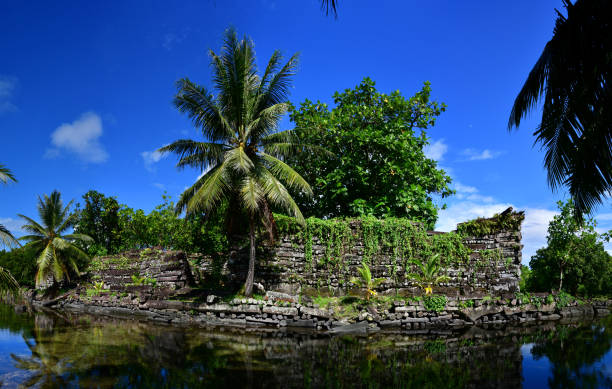
Far out in the western Pacific Ocean, thousands of miles from the world’s great capitals, lies one of the most extraordinary archaeological sites ever created. Hidden among the tropical islands of Micronesia is an ancient city unlike any other on Earth. Massive stone walls rise from shallow waters. Artificial islands are connected by canals. Towering basalt columns stand in carefully arranged formations that seem almost impossible to have been constructed in such a remote location.
This remarkable place is known as Nan Madol.
Often called the “Venice of the Pacific,” Nan Madol has fascinated explorers, archaeologists, historians, and travelers for generations. At first glance, it looks almost unreal. The city appears to float upon the sea itself, its stone structures emerging from mangrove forests and coral reefs.
For centuries, local legends have told stories about magical builders, powerful rulers, and supernatural forces connected to Nan Madol. Some tales claim that giant stones were carried through the air by sorcerers. Others describe mysterious beings who possessed powers beyond ordinary human understanding.
While modern archaeology has uncovered many facts about Nan Madol, important questions remain unanswered. How did its builders transport enormous stones across difficult terrain? Why was such a massive city constructed in this isolated location? How did its rulers maintain power over the surrounding islands? And why was the city eventually abandoned?
The story of Nan Madol is not only a tale of engineering and architecture. It is also a story of human ambition, cultural achievement, environmental adaptation, and enduring mystery.
Even today, standing among its silent ruins, visitors often feel as though they have stepped into another world.
The Island of Pohnpei
To understand Nan Madol, it is important to understand its setting.
Nan Madol is located off the southeastern coast of Pohnpei, one of the largest islands in Micronesia. Pohnpei sits in the tropical Pacific, surrounded by vast stretches of ocean.
The island itself is lush and mountainous. Dense rainforests cover volcanic peaks, while rivers and waterfalls flow toward the coast. The environment is beautiful but challenging. Heavy rainfall occurs throughout much of the year, making Pohnpei one of the wettest places on Earth.
For thousands of years, Pacific Islanders successfully adapted to this environment. They developed sophisticated navigation skills, built thriving communities, and maintained connections across enormous distances of open ocean.
Long before European explorers arrived, the people of Pohnpei had already created a rich and complex society.
Nan Madol would become one of their greatest achievements.
Discovering a Lost Wonder
European visitors first encountered Nan Madol centuries after its decline.
When explorers heard stories of ancient stone ruins hidden among the reefs, many found the claims difficult to believe. Massive stone architecture was rarely associated with small Pacific islands in the minds of outsiders.
Yet as explorers approached the site, they discovered something astonishing.
The ruins stretched across a large area of shallow coastal waters. Stone walls rose several meters high. Artificial islets appeared carefully planned and constructed.
The city seemed completely unlike the villages that surrounded it.
Many early visitors struggled to understand how such a place could exist.
Their surprise reflected a common misunderstanding of Pacific cultures. For a long time, outsiders underestimated the achievements of Oceanic societies. Nan Madol challenged those assumptions.
It demonstrated that complex political systems, large-scale construction projects, and impressive engineering feats had flourished in the Pacific long before European contact.
What Exactly Is Nan Madol?
Nan Madol is not a single building.
Instead, it is a complex urban center consisting of nearly one hundred artificial islets constructed atop coral reefs and connected by a network of canals.
The city covers approximately 200 acres along the coast.
Each islet served a specific purpose. Some contained residences for nobles. Others were used for ceremonies, food preparation, administration, or religious activities.
Stone walls surrounded many of the islets, creating enclosed spaces that separated different functions and social groups.
The layout suggests careful planning rather than random growth.
The canals flowing between the islets gave the city a unique appearance. Boats could move through the waterways, creating transportation routes throughout the settlement.
This distinctive design is one reason Nan Madol is often compared to Venice.
However, the comparison only goes so far. Nan Madol’s architecture and cultural context are entirely unique.
Nothing quite like it exists anywhere else in the Pacific.
The Incredible Stone Architecture
The most striking feature of Nan Madol is its stone construction.
Many walls consist of enormous basalt columns stacked horizontally in crisscross patterns resembling giant log cabins.
Some individual stones weigh several tons.
Others may weigh more than twenty tons.
These dark volcanic columns create a dramatic visual effect. Even after centuries of exposure to tropical weather, many structures remain standing.
The scale of construction becomes even more impressive when considering the island’s limited resources.
There were no wheeled vehicles.
There were no metal cranes.
There were no draft animals such as horses or oxen.
Yet the builders somehow transported and positioned thousands of massive stones with remarkable precision.
This accomplishment remains one of the most fascinating aspects of Nan Madol.
Where Did the Stones Come From?
Archaeologists have identified the source of much of the basalt used in Nan Madol.
The stone originated from volcanic formations on the main island of Pohnpei, particularly from areas some distance away from the construction site.
This discovery solved one mystery but created another.
The challenge was not finding the stone.
The challenge was moving it.
Transporting enormous basalt columns across rugged terrain and coastal waters would have required immense effort.
Researchers believe the stones were likely moved using combinations of human labor, canoes, rafts, and careful engineering techniques.
Even so, the logistics remain extraordinary.
Some estimates suggest that thousands of tons of stone were transported during the city’s construction.
The achievement reflects sophisticated organization and the ability to mobilize large numbers of workers over extended periods.
The Rise of the Saudeleur Dynasty
Nan Madol became the political and ceremonial center of the powerful Saudeleur Dynasty.
According to both archaeological evidence and local traditions, the Saudeleurs ruled much of Pohnpei for several centuries.
Their authority represented one of the earliest centralized political systems in Micronesia.
Before the rise of the Saudeleurs, communities on Pohnpei were more decentralized.
The dynasty changed this arrangement by concentrating power in a single ruling elite.
Nan Madol served as the heart of this system.
From their island capital, the rulers managed religious ceremonies, political affairs, tribute collection, and social organization.
The city’s design itself reflected social hierarchy.
Access to certain areas was restricted.
Elite families occupied privileged spaces.
Religious activities reinforced the authority of the ruling class.
The architecture helped maintain the political order.
Legends of the Founders
Local oral traditions offer fascinating stories about Nan Madol’s origins.
One popular legend tells of two brothers named Olosihpa and Olosohpa.
According to the story, the brothers arrived from a distant land seeking a place to build an altar dedicated to agricultural and religious practices.
Finding the reef near Pohnpei suitable for their purposes, they began constructing the city.
The most remarkable part of the legend involves the transportation of stones.
The brothers supposedly used magical powers to make enormous basalt columns fly through the air.
The stones floated into place without ordinary labor.
To modern readers, such tales may sound fantastical.
Yet legends often preserve important cultural memories.
While the flying stones are mythical, the stories reflect genuine amazement at the engineering accomplishments of Nan Madol.
Even generations after its construction, local people viewed the achievement as extraordinary.
Why Build a City on a Reef?
One of the greatest mysteries surrounding Nan Madol concerns its location.
Building a city on a coral reef presented enormous challenges.
Fresh water was limited.
Construction was difficult.
Food resources had to be transported.
Why choose such a site?
Several explanations have been proposed.
The location may have offered political advantages.
Separating the ruling elite from the general population reinforced social control.
Access to the city could be carefully monitored.
The marine environment also held spiritual significance.
Water often plays an important role in religious traditions, and the canals may have carried symbolic meaning.
Some researchers believe the site’s visibility and uniqueness enhanced the prestige of the ruling dynasty.
Whatever the reason, the choice demonstrates intentional planning rather than convenience.
The builders clearly believed the benefits outweighed the challenges.
Life Inside the Ancient City
Nan Madol was not a bustling city in the modern sense.
Its population was probably much smaller than many people imagine.
Most ordinary residents of Pohnpei likely lived elsewhere.
Instead, Nan Madol functioned primarily as a ceremonial, political, and elite center.
Nobles, priests, administrators, and attendants occupied many of its structures.
Religious rituals played a major role in daily life.
Tributes from surrounding communities flowed into the city.
Feasts, ceremonies, and political gatherings reinforced social relationships.
The canals and stone walls created an environment unlike any other in the region.
Visitors entering Nan Madol would have immediately sensed its importance.
The architecture communicated power, authority, and sacred significance.
The Sacred Heart of Nan Madol
Religion stood at the center of Saudeleur society.
Nan Madol contained spaces dedicated to ceremonial activities and ancestor worship.
Many structures appear to have served ritual purposes.
One of the most famous sections of the city is known as Nandauwas.
This massive walled enclosure contains some of the site’s largest and most impressive architecture.
Archaeologists believe it served as a royal mortuary complex where important leaders were buried.
Towering basalt walls surround the area, creating an atmosphere of solemnity and mystery.
Even today, visitors often describe Nandauwas as the most awe-inspiring part of Nan Madol.
The site’s monumental construction reflects the importance of ancestors and elite status within Pohnpeian society.
How Archaeologists Study Nan Madol
Investigating Nan Madol presents unique challenges.
Dense vegetation covers many structures.
Tropical weather accelerates deterioration.
Water surrounds much of the site.
Despite these difficulties, archaeologists have made significant progress.
Excavations, mapping projects, radiocarbon dating, geological studies, and oral histories have helped reconstruct the city’s history.
Research suggests that construction occurred over several centuries rather than all at once.
The city gradually expanded as rulers added new islets and structures.
This long-term development required sustained political stability and organizational capacity.
Each discovery helps fill gaps in our understanding while revealing new questions.
Nan Madol remains an active area of archaeological investigation.
The Mystery of Labor and Logistics
One question continues to intrigue researchers.
How many people were required to build Nan Madol?
The answer remains uncertain.
Constructing artificial islets, transporting stone, erecting walls, and maintaining infrastructure would have demanded considerable labor.
The project likely involved generations of workers.
Coordinating such efforts required effective leadership and social organization.
The ruling dynasty must have possessed the authority to mobilize resources on a large scale.
This reality challenges outdated stereotypes about Pacific societies.
Nan Madol demonstrates that sophisticated political systems capable of managing ambitious public works existed in Micronesia long before European arrival.
Its construction stands as evidence of remarkable human ingenuity.
The Fall of the Saudeleur Dynasty
No dynasty lasts forever.
Eventually, the power of the Saudeleurs began to decline.
According to local traditions, a warrior named Isokelekel arrived from another island and challenged the ruling elite.
Legends describe dramatic battles and supernatural events surrounding the conflict.
While details remain uncertain, archaeological and historical evidence suggests significant political changes occurred around this period.
The centralized authority of the Saudeleurs collapsed.
New political arrangements emerged.
Nan Madol gradually lost its role as the center of power.
The city’s importance diminished as rulers shifted their attention elsewhere.
The once-dominant capital entered a long period of decline.
Why Was Nan Madol Abandoned?
Abandonment rarely happens for a single reason.
Several factors likely contributed to Nan Madol’s decline.
Political changes reduced its importance.
Maintaining the city required constant effort.
Transporting food and supplies remained challenging.
Environmental pressures may also have played a role.
As populations shifted and power structures changed, the advantages of maintaining the site diminished.
Gradually, fewer people lived there.
Buildings deteriorated.
Vegetation reclaimed abandoned spaces.
The city that had once symbolized authority and prestige became a collection of silent ruins.
Nature slowly took control.
European Contact and Changing Perspectives
When European explorers reached Micronesia, Nan Madol had already been abandoned for centuries.
Its ruins inspired curiosity and speculation.
Unfortunately, early interpretations were often influenced by colonial attitudes.
Some outsiders doubted that local populations could have built such an impressive site.
As a result, fanciful theories emerged.
Some suggested lost civilizations.
Others imagined foreign builders from distant lands.
A few even proposed connections to Atlantis.
Modern archaeology has firmly rejected these ideas.
Evidence overwhelmingly indicates that Nan Madol was built by the ancestors of the people of Pohnpei.
The site’s achievements belong to Micronesian history and culture.
Recognizing this fact represents an important correction to earlier misconceptions.
The Atlantis Connection
Despite lacking evidence, comparisons between Nan Madol and Atlantis remain popular.
The city’s canals, mysterious ruins, and ocean setting naturally inspire imagination.
Writers seeking lost civilizations often highlight the site.
Yet the reality is both simpler and more impressive.
Nan Madol does not require mythical explanations.
Its builders were real people.
Their accomplishments resulted from knowledge, organization, and determination rather than supernatural intervention.
The true story is more meaningful because it celebrates genuine human achievement.
Understanding the actual history of Nan Madol allows us to appreciate the ingenuity of its creators.
Environmental Challenges
Life in Nan Madol was never easy.
The city’s reef location exposed it to storms, tides, and environmental pressures.
Fresh water supplies required careful management.
Food production occurred largely outside the urban center.
The inhabitants depended upon networks connecting the city to surrounding communities.
Maintaining these relationships was essential for survival.
The challenges highlight the sophistication of the social systems supporting Nan Madol.
Its existence depended not only on architecture but also on cooperation, trade, and resource management.
The city functioned because people worked together across an entire island society.
Nan Madol and World Heritage
Today, Nan Madol is recognized as one of the world’s most significant archaeological sites.
In 2016, UNESCO added Nan Madol to the World Heritage List.
This designation acknowledges its extraordinary cultural importance.
UNESCO described the site as a masterpiece of human creativity and engineering.
The recognition also helps support preservation efforts.
Protecting Nan Madol is not easy.
Vegetation, erosion, rising sea levels, and environmental changes threaten the ruins.
Conservation work seeks to balance preservation with respect for local traditions and ecological realities.
The future of the site depends upon continued care and research.
What Makes Nan Madol So Special?
Many ancient cities impress visitors with their size.
Others are famous for beautiful artwork or monumental temples.
Nan Madol stands apart because of its uniqueness.
There is simply nothing quite like it.
Its artificial islands, basalt architecture, reef setting, and political history combine to create an archaeological landscape unlike any other.
The city demonstrates that human societies can achieve remarkable things even in remote environments.
Its existence expands our understanding of world history.
It reminds us that innovation and complexity are not limited to famous civilizations such as Egypt, Rome, or China.
Extraordinary achievements have emerged in every corner of the globe.
Nan Madol is one of those achievements.
The Enduring Mystery
Despite decades of research, Nan Madol continues to guard some of its secrets.
Archaeologists still debate aspects of construction techniques.
Questions remain about population size, political organization, and ritual practices.
New discoveries continue to reshape our understanding.
This uncertainty contributes to the site’s appeal.
Mystery invites curiosity.
Each unanswered question encourages further exploration.
Yet the greatest mystery may not be how the city was built.
Perhaps the greater mystery is how such a remarkable achievement remained overlooked by much of the world for so long.
Nan Madol deserves recognition alongside humanity’s most impressive archaeological treasures.
Conclusion
The story of Nan Madol is a story of vision, power, engineering, and cultural achievement. Rising from the waters of Pohnpei’s coast, this extraordinary city challenged its builders with immense logistical obstacles. Yet they succeeded in creating one of the most unique urban centers ever constructed.
For centuries, legends attributed its creation to magic and supernatural forces. Modern archaeology tells a different story—one of human ingenuity, careful planning, and sophisticated social organization. The ancestors of Pohnpei transformed coral reefs into a monumental ceremonial capital that served as the heart of a powerful dynasty.
Although many questions remain unanswered, the broad outlines of Nan Madol’s history are now clearer than ever. It was not the work of lost civilizations, mythical giants, or visitors from distant continents. It was the achievement of Pacific Islanders whose knowledge and determination shaped a landscape unlike any other.
Today, as waves move gently through the ancient canals and tropical vegetation surrounds the towering stone walls, Nan Madol continues to inspire wonder. It reminds us that some of humanity’s greatest accomplishments are found not in the most famous places, but in remote corners of the world where history still whispers through the ruins.
The mysterious builders of Nan Madol may be gone, but their legacy endures in stone, water, and memory—a remarkable testament to what human beings can create when imagination and determination come together.