Some stories survive for thousands of years because they reveal something timeless about human nature. The tale of Narcissus is one of them. At first glance, it seems like a simple myth about an extraordinarily handsome young man who became enchanted by his own reflection. But beneath its beautiful and tragic surface lies a story about vanity, loneliness, unreturned love, self-awareness, and the dangers of obsession.
The myth of Narcissus has fascinated poets, artists, philosophers, and psychologists for centuries. It has inspired countless paintings, sculptures, poems, and books. Even today, his name lives on in everyday language through the word “narcissism,” describing excessive self-love or self-centeredness. Yet the original Greek myth is far more emotional and complex than the modern psychological term suggests.
Rather than celebrating beauty, the story warns about the consequences of rejecting genuine human connection. It asks difficult questions about identity and love. Can someone truly love another person if they love only themselves? Can beauty become a curse instead of a gift? What happens when admiration turns into obsession?
The legend of Narcissus continues to resonate because every generation recognizes something familiar within it. While few people literally fall in love with their reflections, many become trapped by appearances, pride, or impossible desires. In that sense, Narcissus remains surprisingly modern.
The World of Greek Mythology
To understand Narcissus, it helps to understand the world in which his story emerged.
Ancient Greek mythology was filled with gods, nymphs, heroes, monsters, and mortals whose lives often intertwined. The gods were powerful but deeply emotional. They loved, envied, punished, rewarded, and interfered constantly in human affairs.
Nature itself was considered alive with divine beings. Rivers had gods. Mountains had spirits. Forests were inhabited by nymphs. Every spring, tree, and stream might possess its own supernatural guardian.
Greek myths rarely existed simply for entertainment. They explored human emotions, explained natural phenomena, and taught moral lessons about pride, love, justice, and fate.
The story of Narcissus belongs to this rich tradition.
The Birth of an Extraordinary Child
According to the most famous version of the myth, preserved by the Roman poet Ovid in his work Metamorphoses, Narcissus was born to the river god Cephissus and the beautiful nymph Liriope.
From the moment of his birth, it was clear that the child was unusually beautiful.
His mother became concerned about his future and sought guidance from the famous blind prophet Tiresias.
She asked whether her son would live a long life.
Tiresias gave an answer that sounded mysterious:
“He will live to old age, if he never knows himself.”
The prophecy puzzled everyone.
How could a person avoid knowing themselves?
Only much later would its tragic meaning become clear.
Growing Into Remarkable Beauty
As Narcissus grew older, his beauty became legendary.
People admired him wherever he went.
Young women fell in love with him.
Young men admired him as well.
Stories of his appearance spread across the countryside.
Yet despite all the admiration he received, Narcissus remained emotionally distant.
He rejected everyone who loved him.
His heart seemed untouched by affection or compassion.
Many admirers approached him with hope.
All eventually left disappointed.
His extraordinary beauty became both a gift and a barrier. Instead of bringing people closer, it separated him from everyone around him.
The Pain of Rejected Love
Greek myths often remind readers that actions have consequences.
Narcissus did not simply decline romantic advances politely.
Many versions of the story portray him as proud and dismissive. Those who confessed their love were often humiliated.
One by one, rejected admirers walked away heartbroken.
Some prayed that the gods would one day teach Narcissus what it felt like to experience impossible love.
These prayers did not go unheard.
In Greek mythology, excessive pride—known as hubris—often attracted divine punishment.
The gods believed that arrogance eventually required correction.
For Narcissus, that correction would arrive in a deeply ironic form.
Echo’s Tragic Story
Among those who fell in love with Narcissus was the mountain nymph Echo.
Echo had her own tragic history.
She had once been cheerful, lively, and endlessly talkative.
She loved conversations and possessed a beautiful voice.
According to the myth, Echo often distracted Hera, queen of the gods, with endless conversation while Hera’s husband, Zeus, secretly met other nymphs.
Eventually Hera discovered the deception.
Furious, she punished Echo.
The curse was cruel.
Echo could no longer speak freely.
She lost the ability to begin conversations.
Instead, she could only repeat the last words spoken by someone else.
Imagine wanting desperately to express your thoughts but being unable to create your own sentences.
Her voice remained beautiful, but her freedom to communicate disappeared.
It was a punishment perfectly suited to someone once known for conversation.
Echo Falls in Love
One day Echo saw Narcissus wandering through the forest.
Like so many before her, she was captivated.
She followed him silently among the trees.
She longed to speak.
She wanted to introduce herself.
She wished to tell him how she felt.
But Hera’s curse made this impossible.
Eventually Narcissus noticed movement among the trees.
“Who’s there?” he called.
“There!” Echo answered automatically.
“Come here!”
“Here!”
Unable to explain herself, Echo finally stepped from the shadows with open arms.
She hoped Narcissus would understand.
Instead, he recoiled.
He rejected her completely.
Humiliated, Echo fled into the mountains.
Heartbroken, she withdrew from society.
According to the myth, her body gradually faded away until nothing remained except her voice.
From then on, only her echoes lingered among cliffs and valleys.
The myth beautifully explains the natural phenomenon of echoes while telling an emotionally powerful story about loneliness and rejection.
The Gods Respond
Echo was not the only victim of Narcissus’ indifference.
Many others had suffered similar heartbreak.
Eventually, divine justice intervened.
In Ovid’s version, the goddess Nemesis answered the prayers of those whom Narcissus had rejected.
Nemesis represented justice and the balancing of excessive pride.
Rather than striking Narcissus with lightning or transforming him immediately, she chose a punishment that perfectly matched his character.
He would experience the same hopeless love he had inflicted upon others.
But his beloved would forever remain beyond reach.
The Fateful Pool
One hot afternoon, Narcissus wandered through a quiet forest after hunting.
He discovered an untouched pool of crystal-clear water.
No shepherd had disturbed it.
No animals had muddied it.
Trees sheltered the water from the wind, leaving its surface perfectly smooth.
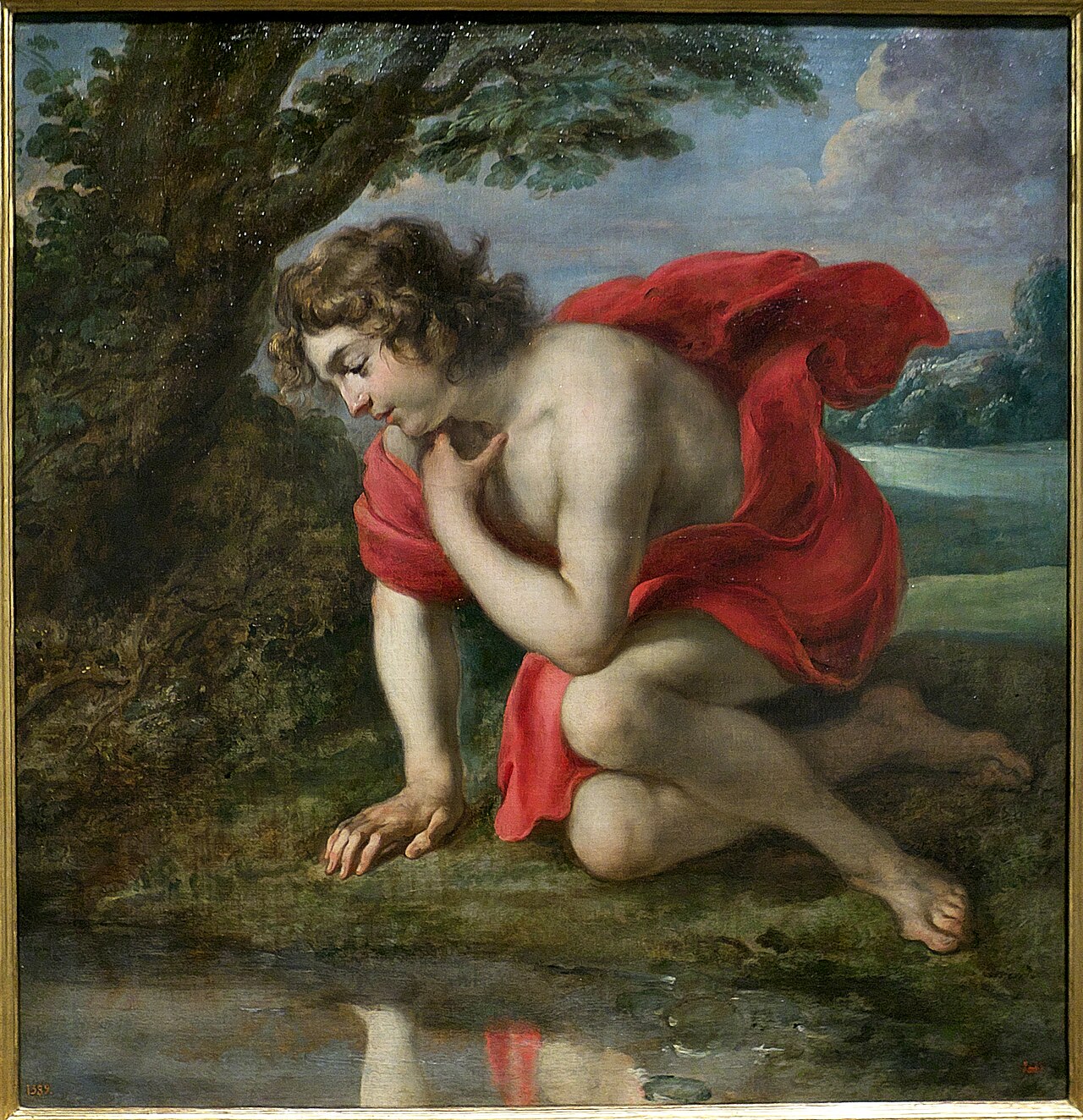
Tired and thirsty, Narcissus knelt to drink.
As he leaned toward the water, he saw a face unlike any he had ever encountered.
It was breathtaking.
Its eyes sparkled.
Its expression seemed gentle.
Its beauty appeared almost divine.
He did not realize he was looking at himself.
Instead, he believed another beautiful person gazed back from beneath the water.
At that moment, everything changed.
Falling in Love
Narcissus became completely enchanted.
He smiled.
The mysterious stranger smiled back.
He reached toward the face.
The image reached toward him.
Whenever he touched the water, the face disappeared.
When the ripples settled, it returned.
Confused but captivated, Narcissus remained beside the pool.
He could not leave.
He spoke to the beautiful stranger.
The stranger appeared to respond silently.
He stretched out his arms.
The image did the same.
Yet they could never touch.
The object of his love existed only as a reflection.
For the first time in his life, Narcissus experienced the agony of unattainable love.
The irony was complete.
He suffered exactly as countless admirers had suffered because of him.
The Slow Realization
As time passed, Narcissus gradually understood the truth.
The beautiful face belonged to him.
He was in love with his own reflection.
The realization brought no relief.
Instead, it deepened his despair.
He now understood that the beloved he desired could never be separated from himself.
No embrace was possible.
No kiss could succeed.
Every attempt disturbed the water and destroyed the image.
His love became an endless cycle of hope and disappointment.
The pool became both mirror and prison.
Love Without Possession
The emotional power of the story lies in its impossible situation.
Narcissus finally learned what genuine longing felt like.
He experienced desire, vulnerability, and heartbreak.
Yet unlike his earlier admirers, he could never even hope for success.
His beloved vanished whenever he tried to touch it.
His suffering became constant.
He refused to eat.
He barely slept.
He remained beside the water, staring endlessly into the reflection.
His obsession consumed every part of his life.
Echo Watches
Some versions of the myth describe Echo secretly watching Narcissus from nearby.
Despite everything he had done to her, she still loved him.
She witnessed his suffering with sadness rather than satisfaction.
Whenever Narcissus cried out in despair, Echo repeated his final words.
The scene became especially tragic.
The young man who had once ignored the pain of others now experienced that same pain himself.
The woman he had rejected remained unable to comfort him because of her curse.
Their stories became forever intertwined through loneliness.
The Death of Narcissus
Eventually Narcissus could no longer endure his impossible love.
His strength faded.
His body weakened.
He remained beside the pool until death overtook him.
When friends came searching for him, they found only flowers growing where he had lain.
According to the myth, the gods transformed his body into the beautiful white and yellow flower now known as the narcissus.
Each spring these flowers bloom beside streams, ponds, and rivers.
Their blossoms often bend toward the ground, appearing to gaze into the water below.
This graceful image has helped preserve the legend for thousands of years.
The Meaning Behind the Flower
The narcissus flower carries rich symbolism.
In different cultures it represents rebirth, remembrance, hope, and renewal because it blooms in early spring.
Within Greek mythology, however, it also symbolizes beauty, self-reflection, and the dangers of excessive pride.
The transformation from human to flower reflects a common theme in Greek myths.
Rather than disappearing completely, important characters often become part of nature itself.
Their stories continue through trees, rivers, stars, birds, or flowers.
In this way, mythology connects human experience with the natural world.
Was Narcissus Simply Vain?
Modern readers often assume Narcissus was merely arrogant.
The original myth is more complicated.
Certainly, he rejected others and behaved with pride.
Yet once he encountered his reflection, he did not celebrate himself.
Instead, he became trapped by longing.
He suffered deeply.
Some scholars argue that Narcissus represents not simple vanity but an inability to form healthy relationships.
His tragedy lies less in loving himself than in failing to recognize genuine love until it became impossible.
The myth therefore explores emotional isolation as much as self-obsession.
The Birth of Narcissism
Today the word “narcissism” has become part of everyday language.
In psychology, narcissism refers to a personality trait characterized by an inflated sense of self-importance, a strong need for admiration, and reduced empathy for others.
The term was inspired directly by the myth of Narcissus.
However, modern psychological narcissism is more complex than the ancient story.
Not everyone who enjoys attention is narcissistic.
Likewise, healthy self-confidence differs greatly from excessive self-centeredness.
The myth serves as inspiration for the term rather than a precise psychological case study.
Artistic Interpretations
For centuries artists have returned to the story of Narcissus.
Painters captured the quiet moment beside the still water.
Sculptors portrayed the beautiful youth frozen in contemplation.
Poets emphasized the emotional tragedy of impossible love.
Writers explored themes of identity and illusion.
Each artistic generation interpreted the myth differently.
Some emphasized beauty.
Others highlighted loneliness.
Still others focused on the fragile boundary between self-knowledge and self-deception.
The story proved endlessly adaptable because its emotional themes remain universal.
Philosophical Lessons
The myth raises profound philosophical questions.
How well do people truly know themselves?
Can appearance become a distraction from reality?
Does excessive admiration prevent genuine relationships?
Is beauty meaningful without kindness?
Plato and later philosophers often argued that wisdom begins with self-knowledge.
Ironically, Tiresias predicted that Narcissus would live long only if he never “knew himself.”
The prophecy becomes meaningful because Narcissus ultimately recognizes himself only through obsession, and that recognition leads to destruction.
His self-discovery is physical rather than emotional.
He recognizes his face but never develops deeper understanding until it is too late.
Why the Story Endures
The myth continues to resonate because modern society still wrestles with many of its themes.
People often become captivated by appearances.
Fame, beauty, status, and public image can become powerful distractions.
Technology has introduced new ways for individuals to present carefully crafted versions of themselves to the world.
While these developments differ greatly from the ancient myth, they remind readers that excessive focus on image can sometimes come at the expense of genuine human connection.
The story encourages balance.
It reminds us that admiration is not the same as love.
Beauty alone cannot satisfy the human heart.
Relationships require empathy, understanding, and mutual care.
Without these qualities, even extraordinary gifts may become sources of isolation.
Conclusion
The story of Narcissus is far more than the tale of a handsome youth captivated by his own reflection. It is a timeless exploration of love, identity, pride, and loneliness. Through the tragedy of one young man and the heartbreak of Echo, Greek mythology presents a powerful reminder that true fulfillment cannot be found in appearances alone.
Whether interpreted as a moral lesson, a psychological symbol, or a poetic explanation for the narcissus flower, the myth continues to speak across cultures and centuries. It reminds us that beauty without compassion can become empty, admiration without empathy can become destructive, and obsession—whether directed toward another person or toward ourselves—can prevent us from experiencing genuine connection.
More than two thousand years after it was first told, the legend of Narcissus still reflects something deeply human. Like the still pool in the ancient forest, it invites us to look closely—not merely at our outward image, but at the character, relationships, and values that define who we truly are.