Love is one of the oldest human experiences. Long before modern novels, romantic films, and poetry collections existed, people gathered around fires, sat in royal courts, or listened in temple halls to hear stories of love. These tales traveled across deserts, crossed oceans, and survived the rise and fall of civilizations. Some were carved into stone tablets. Others were passed down through generations by storytellers who ensured they would never be forgotten.
Ancient legends are filled with heroes, gods, monsters, wars, and quests, but at the heart of many of these stories lies love. Sometimes it is joyful and triumphant. Sometimes it is heartbreaking and tragic. Sometimes it inspires incredible courage, and other times it leads to disaster. Yet regardless of the outcome, love often becomes the force that drives the story forward.
What makes these ancient love stories remarkable is that they still resonate today. Although thousands of years separate us from the people who first told them, the emotions feel surprisingly familiar. The longing of separated lovers, the pain of loss, the excitement of first attraction, and the willingness to sacrifice everything for another person are experiences that transcend time.
These legends reveal not only how ancient cultures viewed love but also how deeply human beings have always desired connection. Through gods and heroes, kingdoms and curses, they tell stories about the hopes, fears, and dreams that continue to shape our lives.
Why Love Became Central to Ancient Legends
Love appears so frequently in ancient myths because it is one of the most powerful motivations humans experience. Ancient storytellers understood that audiences would become emotionally invested when characters cared deeply for one another.
Love could explain why a warrior crossed dangerous lands, why a queen challenged fate, or why a god intervened in human affairs. It created stakes that felt personal and meaningful.
In many ancient societies, love was not viewed solely as a private emotion. It was often connected to family, community, religion, and destiny. Marriages could determine the future of kingdoms. Relationships could influence wars. Divine romances could shape the natural world itself.
As a result, stories of love became stories about much more than two people. They became stories about humanity, morality, sacrifice, and the forces that govern existence.
The Tragic Love of Orpheus and Eurydice
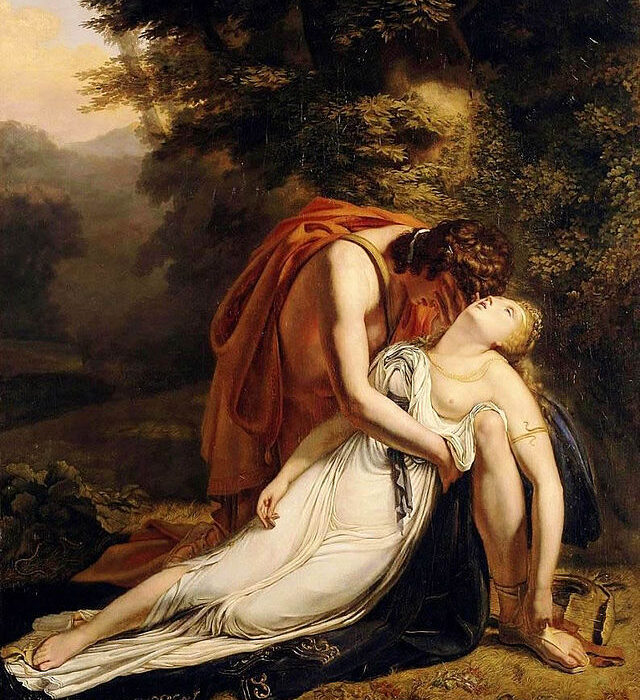
Among the most famous love stories from ancient Greece is the tale of Orpheus and Eurydice.
Orpheus was a musician of extraordinary talent. His music was said to be so beautiful that animals stopped to listen, rivers changed their course, and even stones seemed to move.
He fell deeply in love with Eurydice, and the two were married. Their happiness, however, did not last long.
Shortly after their wedding, Eurydice died after being bitten by a snake.
Overwhelmed with grief, Orpheus refused to accept her loss. He made a decision few mortals would dare attempt. He journeyed into the underworld itself to bring her back.
There, he played his music before the rulers of the dead. The beauty of his songs moved every soul who heard them. Even the stern gods of the underworld were touched.
They agreed to release Eurydice on one condition. Orpheus must walk ahead of her and not look back until they both reached the world above.
The journey seemed endless.
As they approached the surface, doubt entered Orpheus’s mind. He wondered whether the gods had deceived him. He feared Eurydice might not truly be behind him.
Moments before reaching safety, he turned to look.
In an instant, Eurydice vanished forever.
The tragedy of the story lies not in a lack of love but in a moment of human weakness. Orpheus loved Eurydice so deeply that he could not overcome his fear.
For centuries, the story has symbolized the power of love, grief, hope, and the painful consequences of doubt.
Pyramus and Thisbe: The Ancient Inspiration for Star-Crossed Lovers
Long before Shakespeare wrote Romeo and Juliet, there was the story of Pyramus and Thisbe.
According to the legend, the two young lovers lived in neighboring houses. Their families, however, opposed their relationship.
Unable to meet openly, they communicated through a crack in the wall separating their homes.
Eventually, they planned to escape together.
They arranged to meet beneath a tree outside the city.
Thisbe arrived first but fled when she encountered a lioness. In her haste, she dropped her veil.
Later, Pyramus found the veil stained with blood from the lion’s recent meal. Believing Thisbe had been killed, he was overcome with despair.
Convinced that life without her was impossible, he took his own life.
When Thisbe returned and discovered what had happened, she too chose death.
The story is tragic, but it captures themes that have echoed throughout literature for centuries. Miscommunication, forbidden love, and devotion beyond death continue to appear in countless romantic narratives.
The tale reminds us how easily fear and misunderstanding can destroy happiness.
Isis and Osiris: Love Beyond Death
Ancient Egypt produced one of the most enduring love stories in mythology.
The tale of Isis and Osiris is not simply a romance. It is also a story about loyalty, resurrection, and the triumph of love over destruction.
Osiris was a wise and beloved ruler. His jealous brother Seth murdered him and scattered his remains across the land.
Most stories would end there.
But Isis refused to surrender.
Driven by devotion, she searched tirelessly for the pieces of Osiris. She traveled across Egypt, gathering what had been lost.
Through magic and determination, she restored him long enough to conceive their son, Horus.
Although Osiris could not return permanently to the world of the living, he became ruler of the underworld.
Their love endured despite death itself.
For ancient Egyptians, the story reflected powerful beliefs about life, death, rebirth, and eternal connection.
It demonstrated that true love could survive even the greatest tragedy.
Cupid and Psyche: Love Tested by Trust
One of the most beautiful love stories from classical mythology is the tale of Cupid and Psyche.
Psyche was a mortal woman of extraordinary beauty. Her appearance became so famous that people began comparing her to the goddess Venus.
Consumed by jealousy, Venus ordered her son Cupid to punish Psyche.
Instead, Cupid fell in love with her.
He secretly brought Psyche to a magnificent palace and visited her only at night. He asked her never to look upon his face.
For a time, their relationship flourished.
Yet curiosity eventually overcame Psyche.
One night she lit a lamp and gazed upon Cupid while he slept.
The sight of the god startled her, and a drop of hot oil awakened him.
Feeling betrayed, Cupid departed.
Heartbroken, Psyche embarked on a difficult journey to win him back. She endured impossible tasks, dangerous trials, and tremendous suffering.
Ultimately, her perseverance and devotion succeeded.
The lovers were reunited, and Psyche was granted immortality.
The story explores trust, forgiveness, and personal growth. Love is not presented as effortless. Instead, it requires courage, patience, and the willingness to overcome obstacles.
The Love of Rama and Sita
One of the most beloved love stories in Indian tradition comes from the ancient epic Ramayana.
Rama and Sita represent ideal devotion and commitment.
Their marriage begins with joy, but their happiness is disrupted when Rama is forced into exile.
Sita chooses to accompany him into the wilderness, demonstrating her loyalty and love.
Their greatest challenge comes when Sita is abducted by the demon king Ravana.
Rama’s quest to rescue her becomes one of the epic’s central narratives.
The story involves battles, alliances, and extraordinary adventures, but beneath these dramatic events lies a deeply emotional relationship.
Rama and Sita’s love is tested repeatedly by hardship, separation, and social expectations.
For millions of people, their story continues to symbolize faithfulness, sacrifice, and enduring devotion.
The Chinese Legend of the Cowherd and the Weaver Girl
Among the most cherished love stories in Chinese folklore is the tale of the Cowherd and the Weaver Girl.
The Weaver Girl was a celestial being responsible for weaving beautiful clouds in heaven.
The Cowherd was a humble mortal living on Earth.
When they met, they fell deeply in love.
Their happiness angered the heavenly authorities, who believed their union violated divine order.
The lovers were separated by a vast river of stars, often associated with the Milky Way.
Yet the story does not end entirely in sorrow.
According to the legend, once each year a bridge of birds forms across the heavens, allowing the lovers to reunite for a single night.
This annual meeting became associated with a traditional festival that is still celebrated today.
The story captures the bittersweet nature of longing and the hope that love can endure even prolonged separation.
Tristan and Isolde: Love and Fate
The medieval legend of Tristan and Isolde became one of the greatest romantic stories in European tradition.
Tristan was a brave knight.
Isolde was destined to marry a king.
Through a twist of fate, the two accidentally drank a magical love potion.
Instantly, they became deeply and irrevocably devoted to one another.
Their love, however, created immense complications.
Duty, loyalty, and social obligations stood in opposition to their feelings.
The lovers found themselves trapped between personal desire and moral responsibility.
The resulting conflict led to secrecy, suffering, and tragedy.
What makes the story compelling is that neither character seeks to create chaos. They are victims of circumstances beyond their control.
Their love becomes both a blessing and a curse.
The legend explores the tension between passion and duty, a theme that continues to resonate in modern storytelling.
Layla and Majnun: Love as Obsession and Devotion
One of the most celebrated love stories in Middle Eastern tradition is the tale of Layla and Majnun.
The story tells of Qays, a young man who falls hopelessly in love with Layla.
His feelings become so intense that people begin calling him Majnun, meaning “the mad one.”
Their families oppose the relationship, preventing them from marrying.
Unable to be with Layla, Majnun withdraws from society and wanders the wilderness.
His love becomes all-consuming.
In many versions of the story, the lovers never achieve a happy reunion.
Yet their devotion transcends ordinary romance.
The tale evolved into a powerful symbol of spiritual longing and selfless love.
For generations, poets and writers have interpreted the story as a reflection of humanity’s search for ultimate truth and beauty.
The Japanese Legend of Izanagi and Izanami
Ancient Japanese mythology contains a moving story about love and loss.
Izanagi and Izanami were divine beings who helped create the islands of Japan.
They worked together, built a family, and shaped the world.
Their happiness ended when Izanami died while giving birth to a fire deity.
Grief-stricken, Izanagi traveled to the land of the dead in an attempt to bring her back.
The story shares similarities with the Greek tale of Orpheus and Eurydice.
Izanagi eventually sees Izanami in her transformed state and flees in horror.
The couple is permanently separated.
Their tragedy explains aspects of Japanese mythology concerning life, death, and the natural order.
At its heart, however, it is also a story about the pain of losing someone deeply loved.
Love Between Gods and Mortals
Many ancient legends feature romances between divine beings and ordinary humans.
These stories often reflect both the wonder and danger of crossing boundaries.
In Greek mythology, gods frequently became involved with mortals.
Such relationships could bring extraordinary blessings but also immense challenges.
The imbalance between divine power and human vulnerability often created dramatic tension.
These stories reveal how ancient cultures viewed the relationship between humanity and the supernatural.
Love became a bridge connecting two very different worlds.
At the same time, these romances often carried warnings about ambition, temptation, or the limits of human understanding.
Why Ancient Love Stories Are Often Tragic
One striking feature of ancient legends is how many love stories end in sorrow.
Modern audiences sometimes expect romance to conclude with happiness.
Ancient storytellers often chose a different path.
Tragedy allowed them to explore profound emotions.
Loss highlighted the value of love.
Separation emphasized devotion.
Sacrifice demonstrated commitment.
A tragic ending could also make a story more memorable.
People remembered tales that moved them deeply.
Even today, many of the world’s most famous love stories involve heartbreak rather than perfect happiness.
The emotional impact lingers long after the story ends.
Love as a Reflection of Cultural Values
Ancient love stories reveal much about the societies that created them.
In some cultures, loyalty and duty are emphasized.
In others, passion and desire take center stage.
Certain stories celebrate perseverance, while others focus on sacrifice.
Although the details differ, these legends often explore universal questions.
How much should a person sacrifice for love?
Can love survive separation?
What happens when love conflicts with social expectations?
Is love stronger than death?
These questions remain relevant because human emotions have changed remarkably little across the centuries.
The Lasting Influence of Ancient Love Legends
The influence of ancient love stories can be seen everywhere.
Modern novels, films, songs, and television series continue to draw inspiration from these ancient narratives.
Themes such as forbidden romance, tragic misunderstanding, devotion beyond death, and lovers separated by fate appear repeatedly in contemporary storytelling.
Writers often reinvent ancient tales for new audiences.
The settings may change, but the emotional core remains the same.
The reason is simple.
These stories speak to experiences that are fundamentally human.
People continue to fall in love, experience loss, confront obstacles, and dream of lasting connection.
Ancient legends provide timeless expressions of these emotions.
What These Stories Teach Us About Love
Although ancient love stories vary widely in their details, they share several important truths.
Love is portrayed as powerful enough to inspire extraordinary courage.
It motivates heroes to cross dangerous lands, challenge gods, and confront death itself.
At the same time, love is shown to involve vulnerability.
Those who love deeply also risk heartbreak.
The stories remind us that love often requires trust, patience, sacrifice, and resilience.
They suggest that genuine connection is worth pursuing despite uncertainty and pain.
Most importantly, they show that love gives meaning to human experience.
Even when relationships end tragically, the love itself remains significant.
The emotional journey matters.
The devotion matters.
The willingness to care deeply matters.
Conclusion
Love stories in ancient legends have endured for thousands of years because they capture something essential about humanity. From the grief of Orpheus and Eurydice to the devotion of Isis and Osiris, from the trials of Cupid and Psyche to the enduring longing of the Cowherd and the Weaver Girl, these tales explore the many faces of love.
Some celebrate loyalty. Some warn of jealousy or impatience. Some reveal the pain of separation. Others emphasize hope, forgiveness, and perseverance. Together, they form a rich tapestry of human emotion that stretches across cultures and centuries.
Although the worlds of gods, heroes, and magical beings may seem distant from our own, the feelings at the heart of these stories remain familiar. The desire to be understood, the fear of loss, the joy of connection, and the willingness to sacrifice for someone we love are experiences shared by people throughout history.
Ancient civilizations may have disappeared, and the storytellers who first told these tales may be long gone, but their stories continue to live because they speak to timeless truths. They remind us that love has always been one of the greatest forces in human life—capable of inspiring greatness, enduring hardship, and leaving a legacy that survives long after the lovers themselves have passed into legend.