Every time you visit a website, send a message, stream a movie, or connect a smart device to the internet, something remarkable happens behind the scenes. Your device communicates with countless other devices around the world, and it all begins with one essential piece of information—an Internet Protocol (IP) address.
An IP address is like the home address of a device on the internet. Without it, computers, smartphones, servers, gaming consoles, and smart home devices would have no way to find each other. For decades, the internet relied almost entirely on IPv4, a system that powered the digital revolution. But as billions of new devices came online, the world began running out of available addresses.
To solve this growing problem, engineers developed IPv6, the next generation of the Internet Protocol. While IPv4 continues to power much of today’s internet, IPv6 is gradually becoming the future of global networking.
Understanding the differences between IPv4 and IPv6 is becoming increasingly important because both protocols are shaping how the internet works today and how it will continue to grow in the decades ahead.
What Is an IP Address?
An Internet Protocol (IP) address is a unique numerical identifier assigned to every device connected to a network that uses the Internet Protocol.
Think of it as a mailing address for your computer or smartphone. Just as a postal service needs an address to deliver a letter to the correct house, the internet needs an IP address to deliver data to the correct device.
Whenever you load a webpage, watch a YouTube video, send an email, or play an online game, data packets travel across many networks until they reach the IP address of your device.
Without IP addresses, internet communication would be impossible.
What Is IPv4?
IPv4 stands for Internet Protocol Version 4. It is the fourth version of the Internet Protocol and remains the most widely used addressing system on the internet today.
IPv4 was standardized in the early 1980s, when the internet was still a relatively small research network. At that time, few people imagined that billions of computers, smartphones, tablets, smart TVs, cars, sensors, and household appliances would eventually need internet connections.
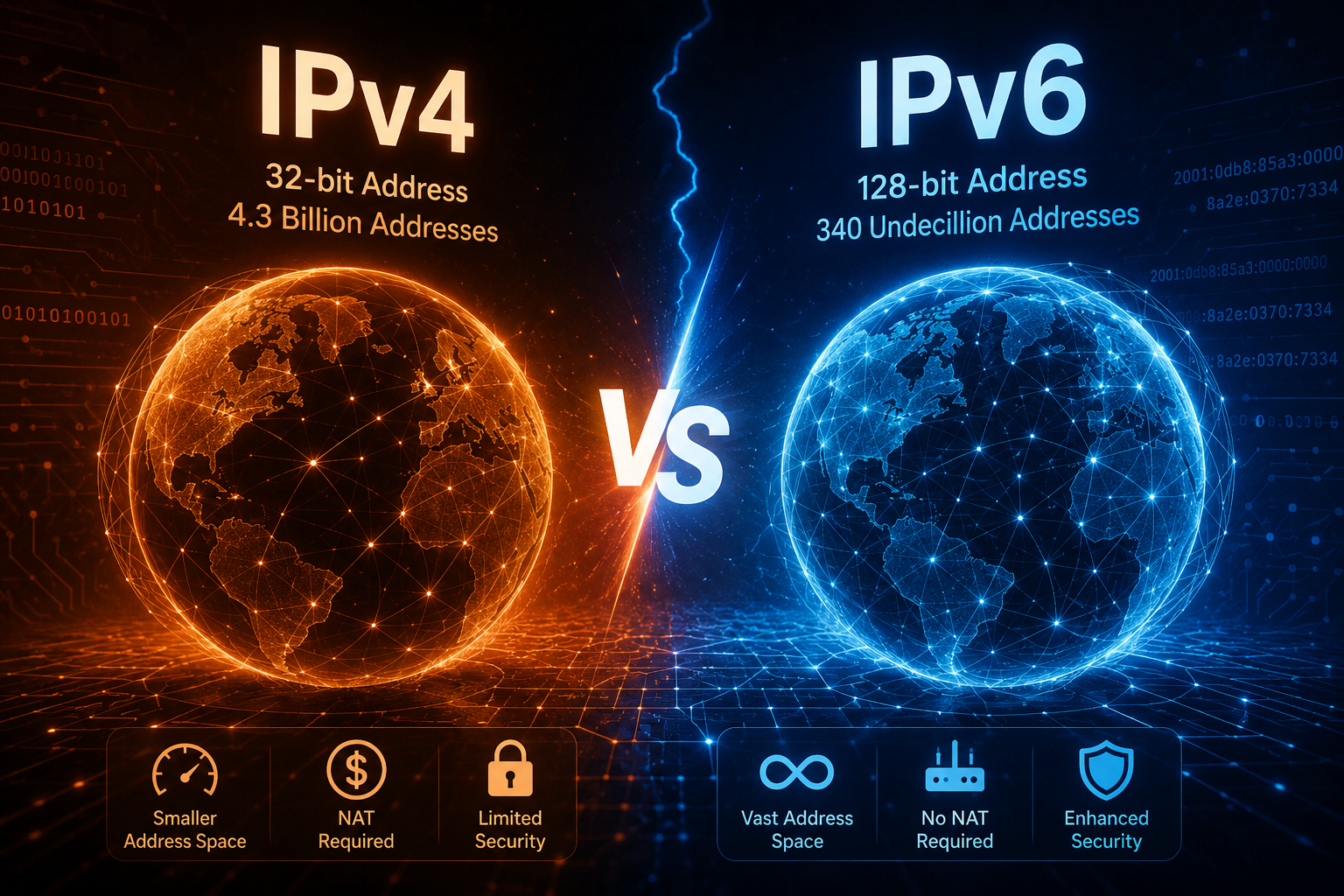
IPv4 uses 32-bit addresses, allowing approximately 4.3 billion unique IP addresses.
An IPv4 address consists of four numbers separated by periods.
For example:
192.168.1.1
8.8.8.8
104.18.32.45
Each number ranges from 0 to 255 because every section contains 8 bits, often called an octet.
This simple format made IPv4 easy to implement and played a major role in the explosive growth of the internet.
Why Did IPv4 Become So Successful?
IPv4 arrived at exactly the right moment in internet history.
It was relatively simple, reliable, and efficient for the size of the internet at the time.
Engineers could build routers, computers, and network equipment that easily understood IPv4 addresses.
For many years, four billion addresses seemed almost limitless.
But the internet expanded far beyond anyone’s expectations.
Today, there are billions of smartphones, laptops, tablets, smart speakers, security cameras, wearable devices, industrial sensors, connected vehicles, and Internet of Things (IoT) devices.
The available pool of IPv4 addresses gradually became exhausted.
The IPv4 Address Shortage
One of the biggest limitations of IPv4 is its limited address space.
Although 4.3 billion sounds enormous, the actual number of usable public addresses is significantly smaller because some addresses are reserved for special purposes such as private networks, multicast communication, testing, and network management.
As internet usage exploded across the globe, organizations responsible for allocating IP addresses eventually exhausted their pools of available IPv4 addresses.
This shortage became one of the primary reasons for developing IPv6.
What Is IPv6?
IPv6 stands for Internet Protocol Version 6.
It was designed to replace IPv4 by providing vastly more addresses and introducing several improvements that make modern networking more efficient.
Unlike IPv4, IPv6 uses 128-bit addresses.
This increase may sound modest at first glance, but mathematically it represents an extraordinary leap.
IPv6 supports approximately:
340 undecillion addresses
That number is written as:
340,282,366,920,938,463,463,374,607,431,768,211,456
This is such an unimaginably large number that it provides enough unique addresses for virtually every device humanity could realistically create for the foreseeable future.
What Does an IPv6 Address Look Like?
IPv6 addresses appear much longer than IPv4 addresses.
Instead of four decimal numbers, IPv6 uses eight groups of hexadecimal values separated by colons.
For example:
2001:0db8:85a3:0000:0000:8a2e:0370:7334
Since writing long addresses repeatedly would be inconvenient, IPv6 includes rules that allow consecutive zeros to be abbreviated.
The same address might therefore appear as:
2001:db8:85a3::8a2e:370:7334
Although IPv6 addresses initially look more complicated, computers process them automatically, so users rarely need to type them manually.
The Biggest Difference Between IPv4 and IPv6
The most important difference is the number of available addresses.
IPv4 offers approximately 4.3 billion addresses.
IPv6 offers around 340 undecillion addresses.
To appreciate the scale, imagine assigning billions of unique addresses to every person on Earth.
Even after doing so, almost all IPv6 addresses would still remain unused.
This enormous address space ensures the internet can continue growing for generations.
Address Length
IPv4 addresses contain 32 bits.
IPv6 addresses contain 128 bits.
Because IPv6 addresses contain four times as many bits, the total number of possible combinations increases exponentially rather than merely quadrupling.
This mathematical expansion is what gives IPv6 its seemingly limitless address capacity.
Address Representation
IPv4 uses decimal numbers.
IPv6 uses hexadecimal notation.
Hexadecimal includes the digits 0 through 9 along with the letters A through F.
Although hexadecimal may seem unfamiliar, it is simply a more compact way of representing large binary numbers.
Network Address Translation and IPv4
Because IPv4 addresses became scarce, engineers developed a workaround called Network Address Translation (NAT).
NAT allows many devices inside a home or office to share a single public IPv4 address.
For example, your home Wi-Fi network may contain:
A laptop
Two smartphones
A smart TV
A gaming console
Several smart home devices
Although all these devices connect to the internet, your internet service provider may assign only one public IPv4 address.
Your router keeps track of which internal device requested each piece of data.
NAT has greatly extended the lifespan of IPv4.
Without it, the IPv4 address shortage would have become a serious problem much earlier.
Why IPv6 Reduces the Need for NAT
Because IPv6 provides such a massive address space, nearly every internet-connected device can receive its own globally unique IP address.
This reduces the dependence on NAT.
Direct device-to-device communication becomes simpler, making certain applications easier to design and potentially improving network efficiency.
However, some networks still use translation techniques alongside IPv6 for administrative or security reasons.
Header Design
Every IP packet contains a header that tells routers where the packet came from and where it should go.
IPv6 simplifies this header compared with IPv4.
The IPv6 header has a more streamlined design that reduces processing complexity for routers.
By removing or redesigning several fields used in IPv4, IPv6 allows network equipment to forward packets more efficiently under many conditions.
Built-In Support for Modern Networking
IPv6 was designed with today’s internet in mind rather than the much smaller internet of the early 1980s.
It includes improved support for:
Mobile networking
Large-scale internet infrastructure
Internet of Things devices
Efficient routing
Automatic address configuration
These features help modern networks operate more smoothly.
Automatic Address Configuration
One convenient feature of IPv6 is its ability to automatically configure addresses.
Using a process known as Stateless Address Autoconfiguration (SLAAC), compatible devices can often generate their own IPv6 addresses without requiring manual configuration.
When a new device joins an IPv6 network, it can automatically communicate with nearby routers and assign itself a suitable address.
This simplifies network management, especially in large environments.
Security Differences
Many people believe IPv6 is automatically more secure than IPv4.
The reality is slightly more nuanced.
IPv6 was designed with built-in support for IPsec, a suite of protocols that encrypts and authenticates network communications.
Although IPsec can also be used with IPv4, IPv6 was developed with stronger support for secure communication.
However, neither protocol is inherently secure on its own.
Actual security depends on proper network configuration, software updates, firewalls, authentication, and encryption.
Routing Efficiency
The internet consists of thousands of interconnected networks.
Routers constantly determine the best path for data packets.
IPv6 introduces improvements that simplify routing in many situations.
Its hierarchical addressing structure helps reduce the size of routing tables, allowing internet infrastructure to scale more effectively as the global network continues expanding.
Multicast Instead of Broadcast
IPv4 frequently relies on broadcast traffic, where messages are sent to every device on a local network.
IPv6 largely eliminates broadcast communication.
Instead, it uses multicast, allowing data to be sent only to devices that actually need it.
This reduces unnecessary network traffic and can improve efficiency.
Better Support for Mobile Devices
Modern devices constantly move between networks.
Smartphones switch between home Wi-Fi, public Wi-Fi, and cellular networks.
Laptops connect in offices, airports, hotels, and homes.
IPv6 was designed with improved mobility support, helping devices maintain connectivity more efficiently while moving between different networks.
Internet of Things and IPv6
The rise of the Internet of Things has dramatically increased the number of connected devices.
Smart thermostats.
Fitness trackers.
Security cameras.
Smart lighting.
Industrial sensors.
Medical equipment.
Agricultural monitoring systems.
Connected vehicles.
Future smart cities may contain billions of network-connected devices.
IPv4 simply does not have enough addresses for such massive growth.
IPv6 was specifically designed to support this expanding connected world.
Performance Differences
Many people wonder whether IPv6 is faster than IPv4.
The answer depends on the network.
IPv6 itself is not automatically faster.
However, in some environments, IPv6 connections may perform slightly better because of more efficient routing, reduced translation overhead, or improved network design.
In other cases, IPv4 and IPv6 perform almost identically.
Internet speed is influenced by many factors beyond the IP protocol, including:
Internet service provider quality
Network congestion
Server performance
Wi-Fi strength
Distance to servers
Available bandwidth
Compatibility
IPv4 and IPv6 are not directly compatible.
A device using only IPv4 cannot communicate directly with a device using only IPv6.
During the global transition, networks use several methods to allow both protocols to coexist.
Many internet providers operate dual-stack networks, where devices receive both IPv4 and IPv6 addresses simultaneously.
This allows communication with both older IPv4 services and newer IPv6 services.
Translation technologies also help bridge communication between the two protocols when necessary.
Why Hasn’t IPv6 Completely Replaced IPv4?
Although IPv6 was introduced in the late 1990s, the transition has taken many years.
Several factors explain why.
The internet contains enormous amounts of existing infrastructure.
Routers.
Servers.
Software.
Firewalls.
Business systems.
Cloud platforms.
Consumer devices.
Many organizations have invested heavily in IPv4 over several decades.
Replacing or upgrading this infrastructure requires time, planning, and financial investment.
As a result, IPv4 and IPv6 currently coexist across much of the internet.
Which Protocol Is More Future-Proof?
IPv6 was built specifically for the future.
Its enormous address space removes one of the biggest limitations facing the continued growth of the internet.
As billions of additional devices connect over the coming decades, IPv6 provides enough addresses to support expanding technologies such as artificial intelligence, autonomous vehicles, smart factories, global sensor networks, and future innovations that have yet to be imagined.
How IPv4 and IPv6 Work Together Today
Most internet users unknowingly use both protocols every day.
Many modern operating systems automatically prefer IPv6 when it is available.
If a website supports IPv6, your device may connect using it.
If not, the connection falls back to IPv4.
This seamless transition allows users to browse the internet without noticing which protocol is carrying their data.
Behind the scenes, internet providers, cloud companies, and network engineers carefully maintain compatibility between both systems.
Is IPv6 Safer for the Future?
As internet infrastructure continues evolving, IPv6 offers several long-term advantages.
Its simplified architecture, massive address capacity, efficient routing, and support for modern networking make it well suited for the expanding digital world.
Nevertheless, good cybersecurity practices remain essential regardless of whether a network uses IPv4 or IPv6.
Firewalls, encryption, software updates, strong authentication, and secure network management remain the foundations of internet security.
The Future of Internet Addressing
The internet has transformed dramatically since IPv4 first appeared. What began as a relatively small network connecting researchers has grown into a global system linking billions of people and devices. Smartphones, cloud computing, streaming services, smart homes, autonomous technologies, and the Internet of Things have all placed increasing demands on internet infrastructure.
IPv6 represents the next step in this evolution. By providing an almost inexhaustible supply of unique addresses and introducing improvements designed for modern networking, it ensures that the internet can continue expanding without the address limitations of IPv4.
Although IPv4 remains deeply embedded in today’s internet and will likely coexist with IPv6 for years to come, the long-term direction is clear. As more internet service providers, businesses, cloud platforms, and websites adopt IPv6, the global internet is steadily moving toward a future built on the next generation of Internet Protocol.