Take a moment to look at your hands.
They can write stories, paint masterpieces, build skyscrapers, play musical instruments, and gently hold another person’s hand. Your eyes can gaze at distant galaxies. Your brain can imagine worlds that do not yet exist. You can laugh, dream, invent, and wonder why the universe exists at all.
It is easy to think that humans have always been this way.
But the truth is far more extraordinary.
Everything that makes us human is the result of an evolutionary journey stretching back billions of years. Our ancestors survived devastating climate changes, fierce predators, deadly diseases, volcanic eruptions, and fierce competition from other human relatives. Entire species appeared and vanished. Some became evolutionary dead ends. Others gave rise to new branches on the tree of life.
Our own species, Homo sapiens, was never guaranteed success. In fact, there were moments when humanity may have come dangerously close to extinction. Had just a few events unfolded differently, the world today might belong to another human species—or perhaps no humans at all.
Human evolution is not a simple story of progress from “primitive” to “advanced.” Instead, it is a winding path filled with surprising twists, unexpected discoveries, and remarkable adaptations.
Modern fossils, genetics, archaeology, and anthropology have transformed our understanding of where we came from. They reveal that our history is far stranger, richer, and more fascinating than scientists imagined even a few decades ago.
The story of human evolution is ultimately the story of every person alive today. It explains why we walk upright, why we speak, why we think the way we do, and why our ancestors became the only surviving human species on Earth.
Evolution Begins Long Before Humans
The story of humanity begins long before the first human ever existed.
Life appeared on Earth around 3.5 to 4 billion years ago. The earliest organisms were tiny single-celled microbes living in ancient oceans.
For hundreds of millions of years, life remained simple.
Gradually, evolution produced more complex organisms.
Plants colonized land.
Fish evolved into amphibians.
Some amphibians gave rise to reptiles.
Certain reptiles eventually evolved into mammals.
Dinosaurs dominated Earth for millions of years before an asteroid impact dramatically changed the planet’s ecosystems around 66 million years ago.
With dinosaurs gone, mammals diversified rapidly.
Among these mammals were small tree-dwelling creatures that would eventually become primates.
Our story truly begins there.
Meet the Primates
Primates evolved around 55 million years ago.
They possessed several characteristics that proved remarkably successful.
Their forward-facing eyes provided excellent depth perception.
Flexible shoulders allowed climbing.
Opposable thumbs made grasping branches easier.
Larger brains supported increasingly complex behaviors.
These adaptations helped primates thrive in forest environments.
Over millions of years, primates diversified into many different groups.
Today, their descendants include lemurs, monkeys, apes, and humans.
Although humans often think of themselves as separate from other animals, biologically we are one branch of the primate family tree.
Humans Did Not Evolve From Modern Monkeys
One of the most common misunderstandings about evolution is that humans evolved directly from monkeys.
That is not how evolution works.
Modern humans and modern monkeys share ancient common ancestors.
Imagine a family tree.
Two cousins share grandparents, but neither descended from the other.
Similarly, humans and chimpanzees share a common ancestor that lived roughly six to seven million years ago.
From that shared ancestor, different evolutionary branches emerged.
One branch eventually produced chimpanzees and bonobos.
Another branch eventually led to humans.
Both groups have continued evolving ever since.
Why Standing Up Changed Everything
One of evolution’s most dramatic turning points was walking on two legs.
This adaptation, known as bipedalism, fundamentally changed our ancestors’ lives.
Scientists still debate exactly why upright walking evolved.
Several ideas have strong support.
Walking upright reduced exposure to the hot African sun.
It allowed individuals to see over tall grasses.
It freed the hands to carry food, infants, or tools.
It also made long-distance travel more energy efficient.
Whatever the exact combination of reasons, bipedalism became one of humanity’s defining features.
Long before large brains evolved, our ancestors were already walking upright.
The Earliest Human Ancestors
The earliest known human relatives lived in Africa.
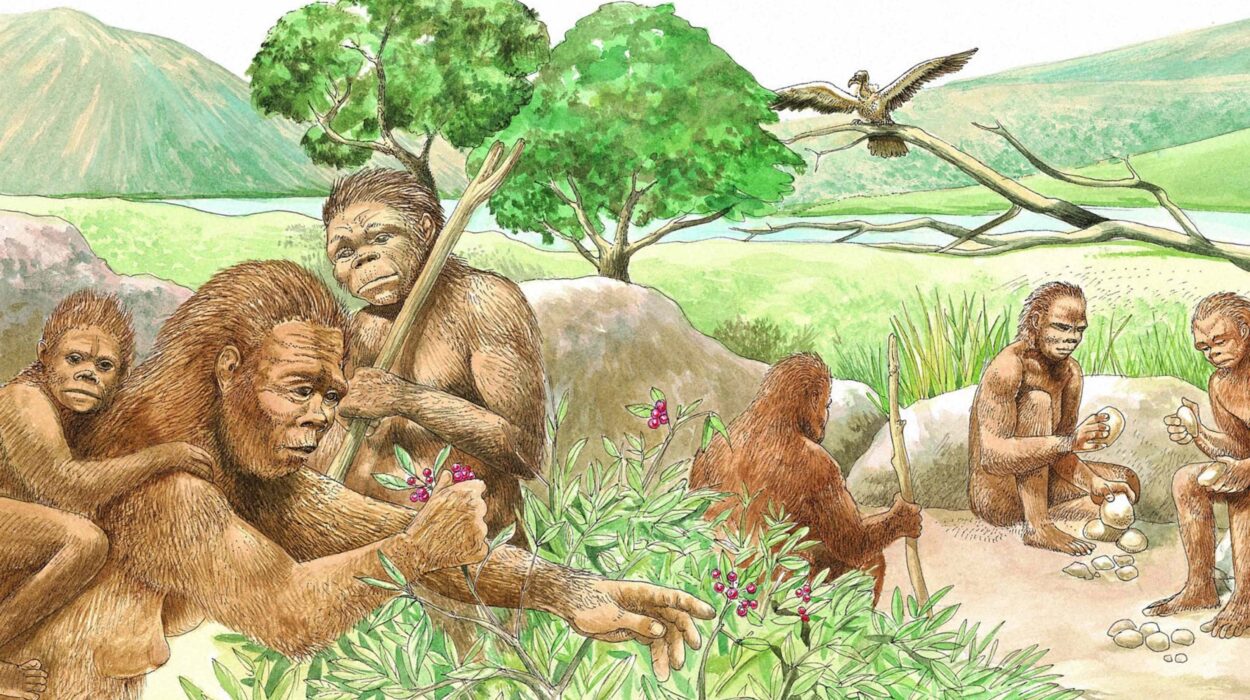
Species such as Sahelanthropus tchadensis, Orrorin tugenensis, and Ardipithecus ramidus provide glimpses into this distant past.
These ancient hominins combined ape-like and human-like traits.
Some could probably climb trees well while also walking on two legs.
They lived in environments that included forests, woodlands, and grasslands.
Although fossils remain incomplete, they reveal that human evolution began as a gradual process rather than a sudden transformation.
Each species represented an experiment in evolution.
Some lineages disappeared.
Others contributed to later human ancestors.
Lucy and the Age of Australopithecus
One fossil changed the study of human evolution forever.
In 1974, researchers discovered the remarkably complete skeleton of an ancient female in Ethiopia.
Nicknamed Lucy, she belonged to the species Australopithecus afarensis.
Lucy lived approximately 3.2 million years ago.
She stood only about one meter tall.
Her brain remained relatively small, similar to that of a chimpanzee.
Yet her skeleton clearly showed she walked upright.
Lucy demonstrated that bipedalism evolved millions of years before the dramatic expansion of the human brain.
This discovery overturned previous assumptions and reshaped scientific thinking.
Climate Changed Our Future
Evolution does not happen in isolation.
It responds to changing environments.
Africa experienced dramatic climate fluctuations during human evolution.
Dense forests gradually gave way to expanding grasslands.
Rainfall became less predictable.
Food sources changed.
Animals migrated.
These environmental shifts placed enormous pressure on early hominins.
Those capable of adapting survived.
Those unable to adjust often disappeared.
Changing climates repeatedly pushed human evolution in unexpected directions.
Bigger Brains Begin to Emerge
Around 2.5 million years ago, something remarkable happened.
Brain size began increasing significantly in some human ancestors.
Scientists continue debating why.
Perhaps more challenging environments rewarded greater intelligence.
Maybe increasingly complex social relationships favored larger brains.
Tool use likely became increasingly important.
Dietary changes may also have contributed.
Whatever the reasons, brain expansion transformed our evolutionary future.
Larger brains enabled planning, problem-solving, communication, and innovation.
Yet bigger brains also created new challenges.
Human babies had to be born earlier because large heads made childbirth more difficult.
This led to longer childhoods and greater parental care.
Ironically, human helplessness at birth became one of our greatest evolutionary strengths.
The First Stone Tools
One of humanity’s greatest inventions was surprisingly simple.
A sharp stone.
The earliest known stone tools date back over three million years.
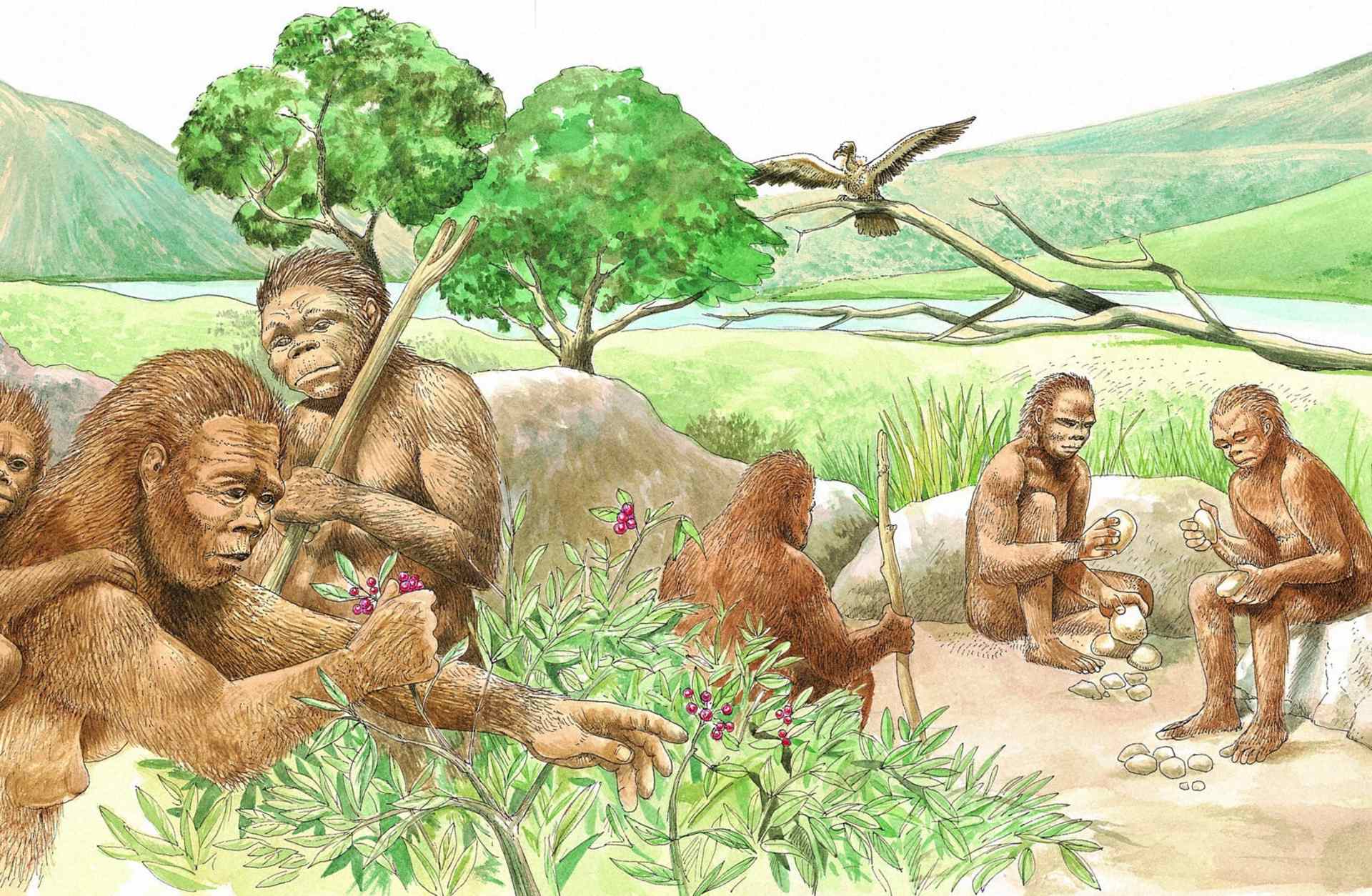
These tools allowed cutting meat, breaking bones, scraping hides, and processing plants.
Stone technology dramatically expanded available food sources.
It also changed survival strategies.
Instead of relying solely on physical strength, early humans increasingly depended on intelligence.
Tools became extensions of the body.
Each generation improved upon previous designs.
Technology had begun.
Homo habilis: The Handy Human
Around 2.4 million years ago, a new species appeared.
Homo habilis, often called the “handy human,” possessed a larger brain than earlier australopithecines.
This species is closely associated with early stone tools.
Although researchers continue debating its exact place in human evolution, Homo habilis represents an important transition.
Its members combined ape-like features with increasingly human characteristics.
They likely lived in cooperative groups.
Social learning became increasingly important.
Knowledge could now pass from one generation to the next.
This ability fundamentally changed evolution.
The Rise of Homo erectus
Around 1.9 million years ago, one of humanity’s greatest success stories emerged.
Homo erectus survived for nearly two million years, making it one of the longest-lasting human species ever.
These humans looked much more familiar.
They possessed longer legs, shorter arms, and body proportions similar to modern people.
Their brains continued growing.
Most importantly, Homo erectus became the first human species known to spread beyond Africa.
They colonized parts of Asia and Europe.
This expansion demonstrated remarkable adaptability.
Few species in Earth’s history have occupied such diverse environments so successfully.
The Power of Fire
At some point, early humans learned to control fire.
Exactly when remains uncertain.
Evidence suggests Homo erectus may have been using fire regularly hundreds of thousands of years ago.
Fire transformed human evolution.
It provided warmth.
It frightened predators.
It extended productive hours after sunset.
Most importantly, it allowed cooking.
Cooking softened food and made nutrients easier to digest.
Some researchers argue cooked food supplied additional energy that supported continued brain growth.
Evening gatherings around fires may also have strengthened social bonds.
Stories, knowledge, and traditions could now be shared after dark.
Human culture expanded alongside human biology.
Hunting Together
Early humans gradually became increasingly cooperative.
Large animals often required teamwork to hunt successfully.
Planning became essential.
Communication improved.
Individuals developed specialized roles.
Cooperation offered tremendous advantages.
Groups sharing food had better chances of surviving difficult times.
Children learned from multiple adults.
Knowledge accumulated rather than disappearing each generation.
Evolution increasingly rewarded social intelligence.
Being clever mattered.
Working together mattered even more.
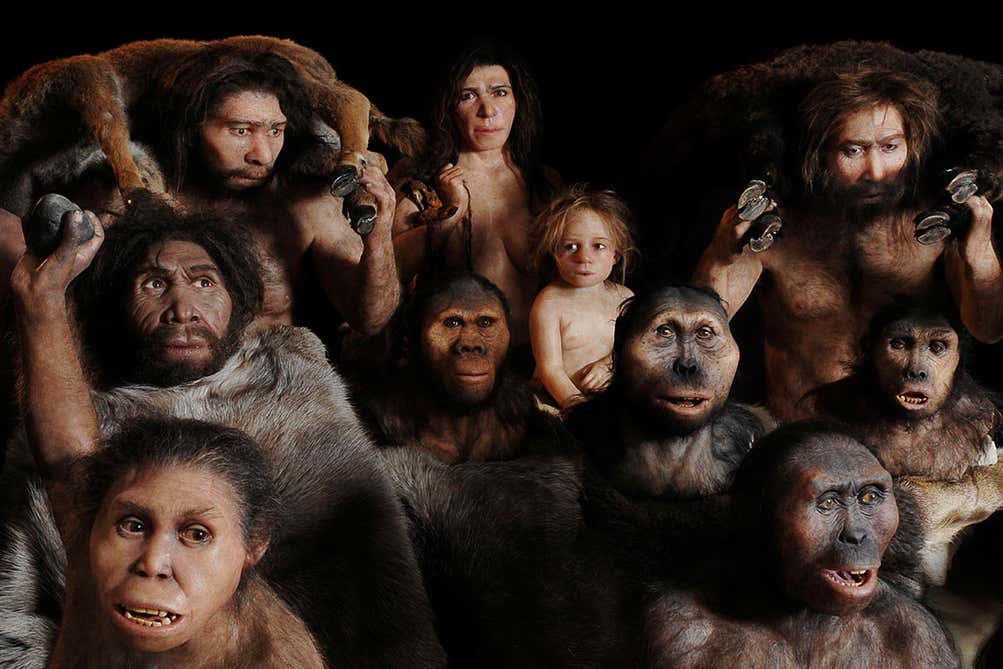
The Human Family Was Surprisingly Crowded
For much of history, scientists imagined a simple evolutionary ladder.
One human species replaced another until modern humans appeared.
Reality proved far more complicated.
Recent discoveries reveal multiple human species often lived at the same time.
Neanderthals occupied Europe and western Asia.
Denisovans lived across parts of Asia.
Homo floresiensis inhabited Indonesia.
Homo naledi lived in southern Africa.
Other species continue being discovered.
Rather than a ladder, human evolution resembled a branching bush filled with diverse relatives.
Our species was only one branch among many.
Meeting the Neanderthals
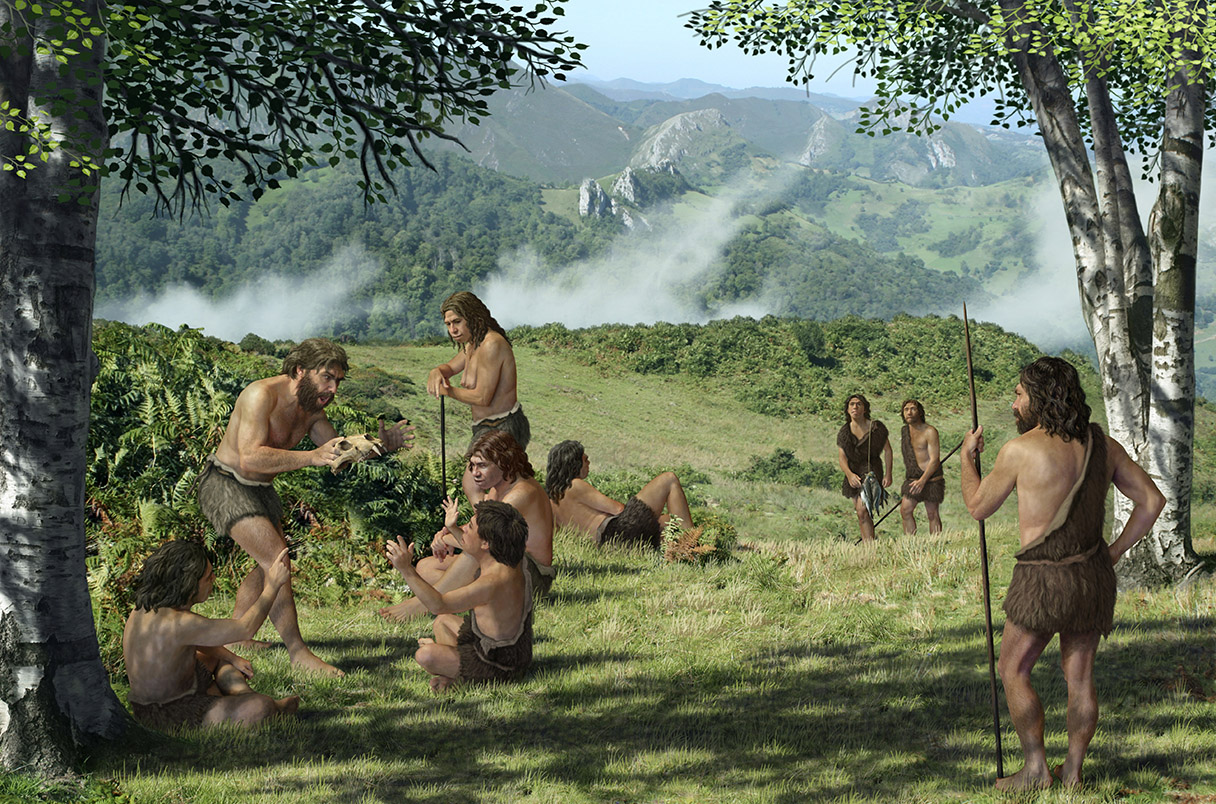
Neanderthals were not primitive cavemen.
They were intelligent humans adapted to Ice Age Europe.
They made sophisticated stone tools.
They hunted large animals.
They cared for injured individuals.
They probably buried some of their dead.
Evidence suggests they created jewelry and perhaps symbolic art.
Most surprising of all, modern humans and Neanderthals interbred.
Today, many people outside Africa carry approximately one to two percent Neanderthal DNA.
Their story continues inside us.
The Denisovan Surprise
One of the most astonishing discoveries in recent anthropology came from a tiny finger bone found inside a Siberian cave.
DNA analysis revealed it belonged to an entirely unknown human species.
Scientists named them Denisovans.
Very few Denisovan fossils have been found.
Yet genetics shows they once occupied enormous regions of Asia.
Modern populations in Oceania and parts of Asia still carry Denisovan DNA.
This discovery demonstrated the incredible power of ancient DNA research.
Entire human species can now be identified from tiny fossil fragments.
Homo sapiens Appears
Around 300,000 years ago, our own species emerged in Africa.
Early Homo sapiens looked broadly similar to people today.
They possessed high foreheads, rounded skulls, and relatively small faces.
Yet becoming anatomically modern did not immediately make humans behaviorally modern.
Complex culture developed gradually.
Art, symbolic expression, advanced tools, and long-distance trade expanded over thousands of years.
Human evolution continued even after our species appeared.
Leaving Africa
One of the most important journeys in history began around 60,000 to 70,000 years ago.
Groups of Homo sapiens left Africa.
They gradually spread across Asia, Europe, Australia, and eventually the Americas.
This migration transformed the planet.
Humans adapted to deserts, tropical forests, mountains, frozen tundra, and islands.
Every environment presented new challenges.
Every generation learned new survival strategies.
Eventually, humans occupied every continent except Antarctica.
No other primate has achieved such extraordinary geographical success.
Why Humans Succeeded
Scientists continue debating exactly why Homo sapiens survived while other human species disappeared.
Several factors likely worked together.
Language became increasingly sophisticated.
Cooperation expanded.
Innovation accelerated.
Social networks connected distant communities.
People exchanged ideas rather than simply genes.
Culture became humanity’s greatest survival tool.
Unlike claws or sharp teeth, culture evolves incredibly quickly.
Knowledge accumulates.
One invention inspires another.
Each generation inherits more information than the previous one.
This cultural evolution transformed humanity into Earth’s dominant species.
The Birth of Art
One of evolution’s most beautiful surprises was art.
Humans began painting caves, carving figurines, decorating tools, and creating musical instruments.
These activities served no immediate survival function.
Instead, they reflected imagination.
Art allowed ideas to outlive individuals.
Stories could be shared.
Beliefs could be expressed.
Communities developed shared identities.
Creativity became a defining feature of our species.
Agriculture Changes Everything
For most of human history, people lived as hunter-gatherers.
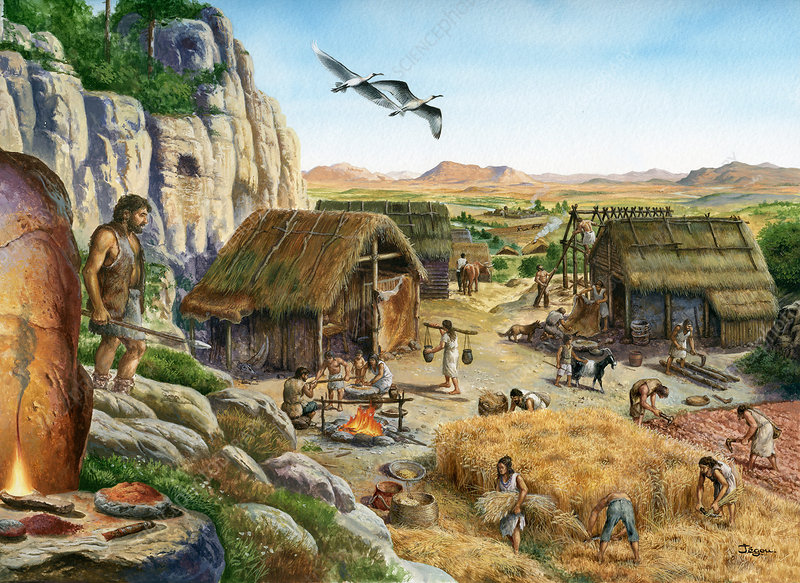
Then, around 12,000 years ago, another revolutionary change occurred.
Humans began farming.
Agriculture allowed permanent settlements.
Food production increased.
Populations expanded rapidly.
Villages became towns.
Towns became cities.
Civilizations emerged.
Writing developed.
Science followed.
Modern society ultimately traces its origins to this agricultural revolution.
Ironically, agriculture represents only a tiny fraction of our evolutionary history.
For more than ninety-five percent of human existence, our ancestors lived as mobile foragers.
Evolution Never Stopped
Many people imagine evolution ended with modern humans.
It did not.
Human evolution continues today.
Natural selection still operates.
Genetic mutations continue appearing.
Populations adapt to changing environments.
Examples include lactose tolerance in some populations, resistance to certain diseases, and adaptations to living at high altitudes.
Evolution has no final destination.
As environments change, humanity continues changing too.
The Future of Human Evolution
For the first time in history, humans may increasingly influence their own evolution.
Medicine allows individuals with previously fatal conditions to survive and have children.
Genetic technologies continue advancing.
Artificial intelligence, biotechnology, and space exploration may eventually shape future human evolution.
Climate change presents new environmental challenges.
Future generations may live on other planets.
Evolution’s next chapter remains unwritten.
Just as our ancestors could never imagine smartphones or space telescopes, we cannot fully predict humanity’s future.
What Human Evolution Teaches Us
Perhaps the greatest lesson from evolution is humility.
Every human alive today descends from countless generations who survived extraordinary challenges.
Our bodies carry traces of ancient ancestors.
Our genes preserve memories of encounters with extinct human relatives.
Our brains reflect millions of years of adaptation.
Evolution reminds us that humans are part of nature, not separate from it.
It also reminds us that diversity has always characterized our species.
Migration, adaptation, and change define humanity’s story.
There has never been a single, unchanging version of what it means to be human.
Conclusion
Human evolution is one of the greatest stories ever uncovered by science. It is a journey spanning billions of years, beginning with the earliest life on Earth and leading, through countless evolutionary twists, to the emergence of modern humans. Along the way, our ancestors learned to walk upright, developed larger brains, mastered fire, crafted tools, created art, crossed continents, and built civilizations.
Perhaps the most surprising discovery is that our evolutionary path was never straightforward. We shared the Earth with other human species, survived dramatic climate shifts, interbred with close relatives like the Neanderthals and Denisovans, and overcame challenges that could easily have erased our lineage forever. At every stage, chance, adaptation, and innovation shaped who we became.
Modern genetics, archaeology, and anthropology continue to rewrite this remarkable story. Every new fossil, every ancient genome, and every archaeological discovery adds another piece to the puzzle. Rather than revealing a finished picture, science shows that human evolution remains an ongoing investigation, with many mysteries still waiting to be solved.
In the end, perhaps the most astonishing truth is this: every person alive today is the latest chapter in an ancient story that began millions of years ago. The atoms in our bodies, the structure of our hands, the power of our brains, and the curiosity that drives us to ask where we came from are all products of evolution. We are not the end of that journey—we are simply its newest travelers, carrying within us the legacy of every ancestor who survived long enough to pass life to the next generation.