Human beings have always wondered where they came from. Long before modern science, people created stories to explain their origins. Today, thanks to fossils, genetics, archaeology, and decades of scientific research, we have a remarkable answer grounded in evidence. The story of human evolution is not only the story of our ancestors—it is the story of every person alive today.
Every heartbeat, every thought, every smile, and every step you take is the result of millions of years of evolution. The shape of your hands, the structure of your brain, your ability to speak, and even your tendency to cooperate with others are all part of a long evolutionary journey that began long before the first humans appeared.
Human evolution is one of the greatest scientific stories ever uncovered. It stretches across millions of years, countless generations, changing environments, and many now-extinct human relatives. It explains how a small group of African primates gradually evolved into a species capable of building cities, exploring space, creating art, and asking questions about its own origins.
What Is Human Evolution?
Human evolution is the long biological process through which modern humans, Homo sapiens, evolved from ancient ape-like ancestors over millions of years. It is a gradual process of genetic change across many generations, driven by evolution through natural selection and other evolutionary mechanisms such as genetic drift, mutation, and gene flow.
Evolution does not happen because individuals choose to change. Instead, small inherited genetic variations appear naturally in populations. Some of these variations help individuals survive or reproduce more successfully in their environments. Over thousands or millions of generations, beneficial traits become more common, gradually changing entire populations.
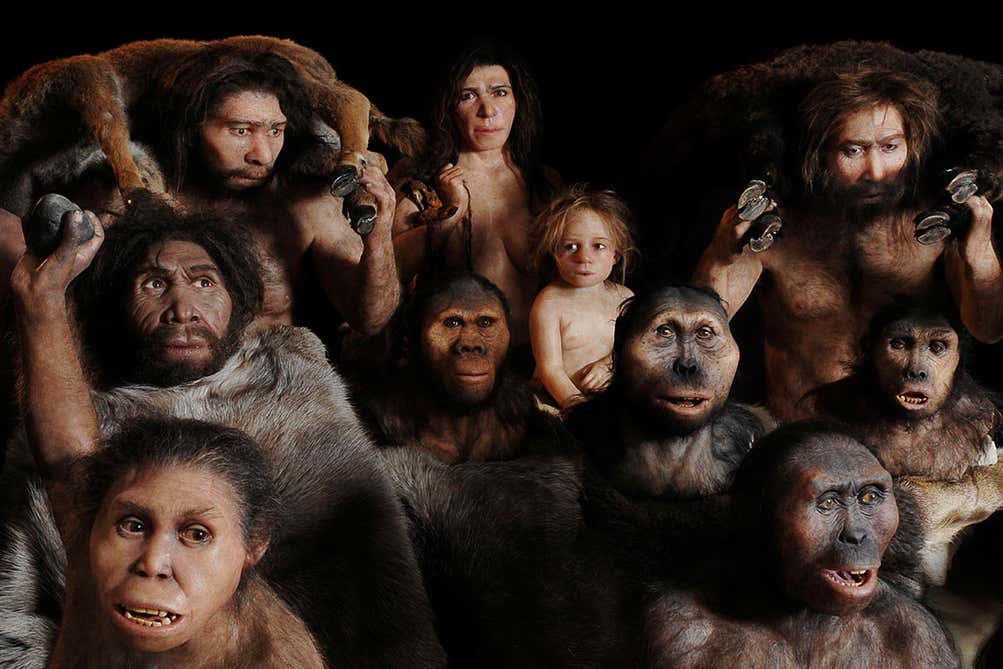
Human evolution did not happen in a straight line toward modern humans. Instead, it resembled a branching tree with many different species existing at different times. Some branches eventually disappeared, while one branch led to our own species.
What Does Evolution Mean?
Evolution is the process by which populations of living organisms change over generations through changes in inherited characteristics.
Every generation inherits DNA from its parents. Occasionally, random genetic mutations occur. Most mutations have little or no effect, some are harmful, and a few provide advantages under certain environmental conditions.
When advantageous traits help individuals survive and have more offspring, those traits become increasingly common over time. This process is known as natural selection, first explained by Charles Darwin and independently by Alfred Russel Wallace during the nineteenth century.
Modern evolutionary biology combines Darwin’s ideas with genetics, molecular biology, paleontology, and ecology to explain how species evolve.
Humans Are Part of Nature
One of the most important discoveries in biology is that humans are part of the natural world.
Humans belong to the animal kingdom, specifically the order Primates. Our closest living relatives are chimpanzees and bonobos. Humans and chimpanzees share approximately 98–99 percent of their DNA, reflecting a common evolutionary ancestry.
This does not mean humans evolved from modern chimpanzees. Instead, both species descended from a common ancestor that lived around six to seven million years ago. After that ancestral population split into separate evolutionary lineages, one eventually gave rise to humans while the other led to modern chimpanzees and bonobos.
Evolution is like a family tree, not a ladder.
The Beginning of the Human Story
The earliest chapter of human evolution begins in Africa, where the oldest known hominin fossils have been discovered.
A hominin is any species more closely related to humans than to chimpanzees after their evolutionary split from a common ancestor.
Around seven million years ago, early hominins began appearing in Africa. These ancient relatives still resembled apes in many ways but also showed features associated with walking on two legs.
Scientists continue discovering new fossils that improve our understanding of these earliest ancestors. Because fossil evidence is incomplete, some details remain uncertain, but the overall evolutionary picture is strongly supported by multiple lines of evidence.
Why Walking on Two Legs Was So Important
One of the defining features of human evolution is bipedalism, the ability to walk upright on two legs.
Early hominins gradually evolved anatomical changes that made upright walking more efficient. Their pelvis became shorter and broader, the spine developed distinctive curves, the legs grew longer relative to the arms, and the feet evolved arches and a forward-pointing big toe.
Walking on two legs offered several advantages. It freed the hands for carrying food, infants, and tools. It allowed individuals to see over tall grass, travel longer distances more efficiently, and reduce exposure to direct sunlight while moving across open landscapes.
Although the exact reasons remain debated, bipedalism became one of the earliest defining characteristics of human ancestors.
Australopithecus: Among Our Earliest Well-Known Ancestors
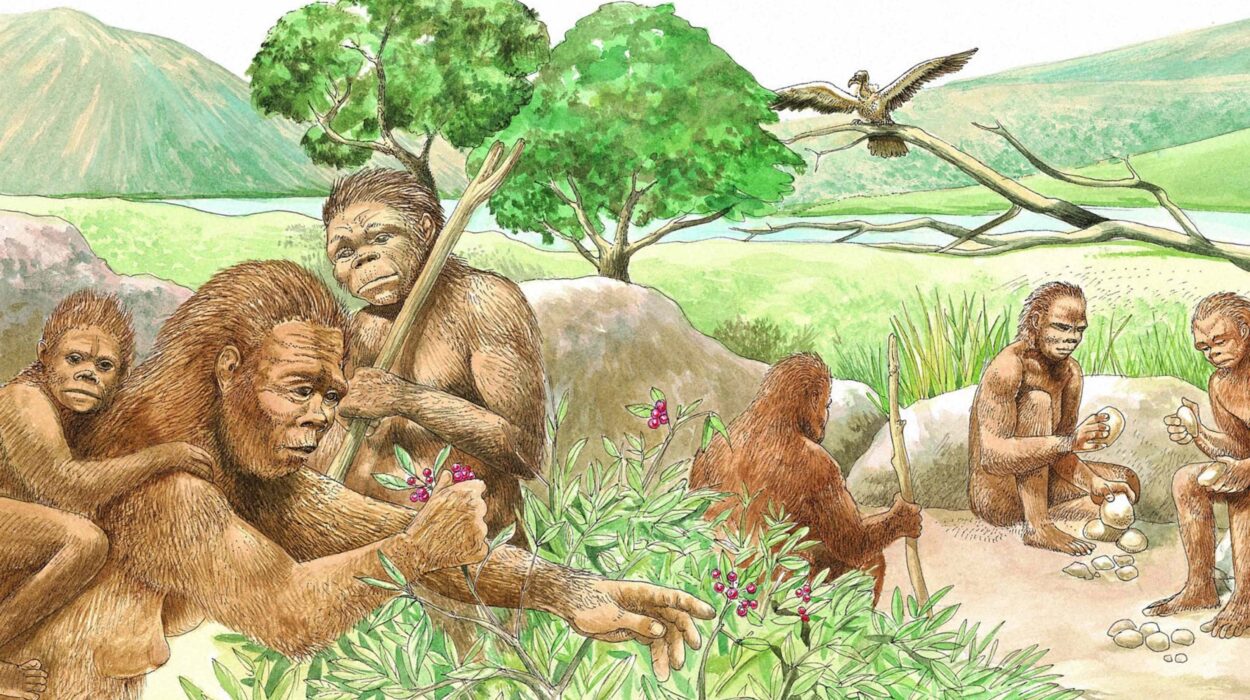
One of the best-known early hominin groups is Australopithecus, which lived between about four million and two million years ago.
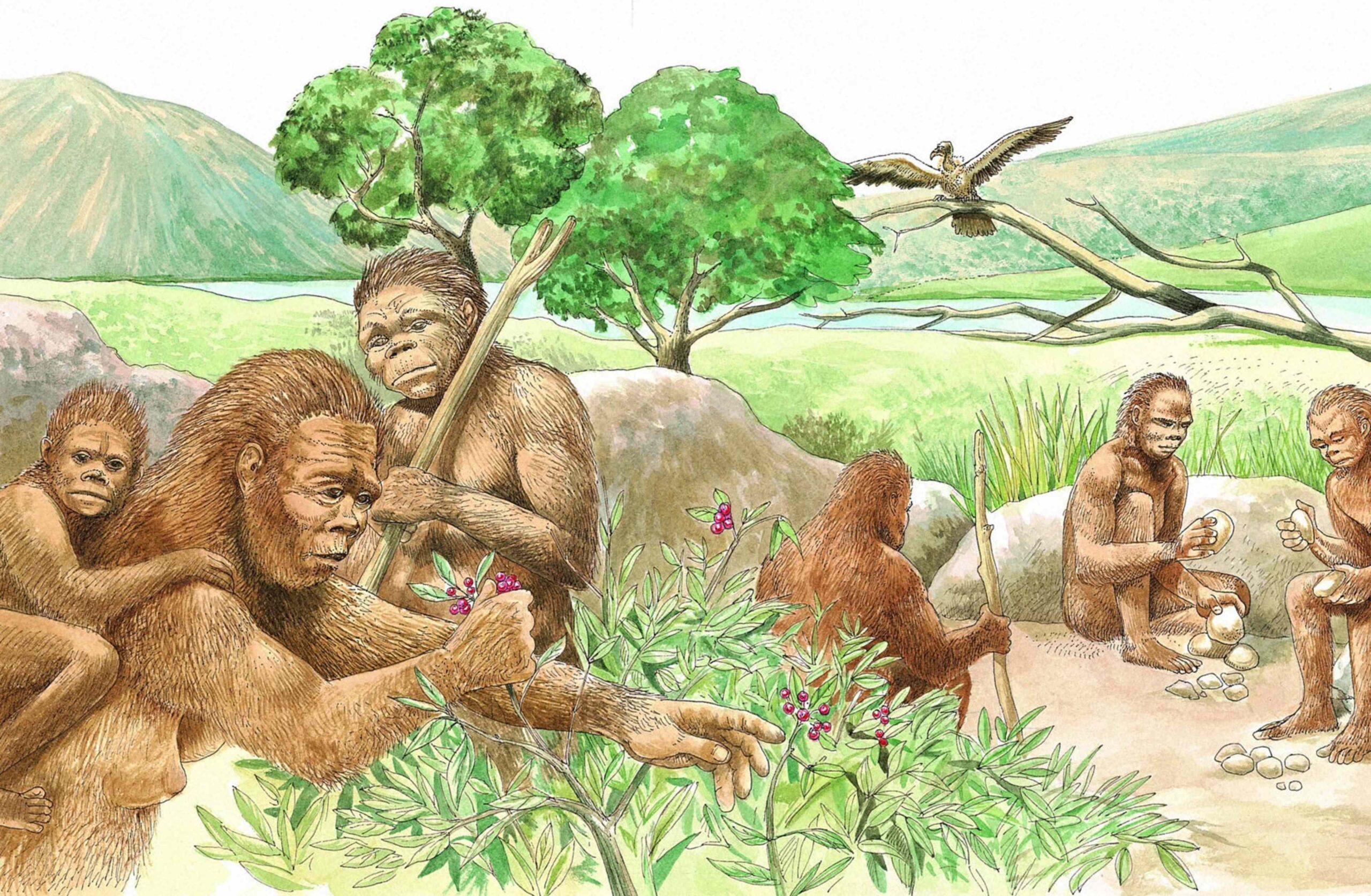
Australopithecines walked upright but still retained many ape-like features, including relatively small brains and long arms suited for climbing trees.
Perhaps the most famous fossil is “Lucy,” discovered in Ethiopia in 1974. Lucy belonged to the species Australopithecus afarensis and provided strong evidence that upright walking evolved before the dramatic increase in brain size.
These early hominins lived in changing African environments that included forests, woodlands, and grasslands.
The Genus Homo Appears
Around 2.8 million years ago, the earliest members of the genus Homo appeared.
Compared with Australopithecus, these early humans generally had larger brains, smaller teeth, more sophisticated behaviors, and greater reliance on stone tools.
One of the earliest recognized species is Homo habilis, often associated with simple stone tools known as the Oldowan industry.
These tools allowed early humans to process food more efficiently, break bones for nutritious marrow, and expand the range of resources they could use.
Although tool use was not unique to humans, increasingly sophisticated technology became a hallmark of our evolutionary lineage.
Homo erectus Changed the Human Story
One of the most successful human species was Homo erectus, which first appeared nearly two million years ago.
Homo erectus had longer legs, a body shape similar to modern humans, and a substantially larger brain than earlier ancestors.
This species became the first known human to spread beyond Africa, eventually reaching parts of Asia and Europe.
Evidence suggests Homo erectus made more advanced stone tools, may have controlled fire, hunted large animals, and adapted to a wide range of environments.
Some populations survived for well over one million years, making Homo erectus one of the longest-lasting human species in evolutionary history.
The Human Family Tree Was Surprisingly Diverse
Human evolution did not produce a single species progressing steadily toward modern humans.
Instead, many human species existed at different times, sometimes living alongside one another.
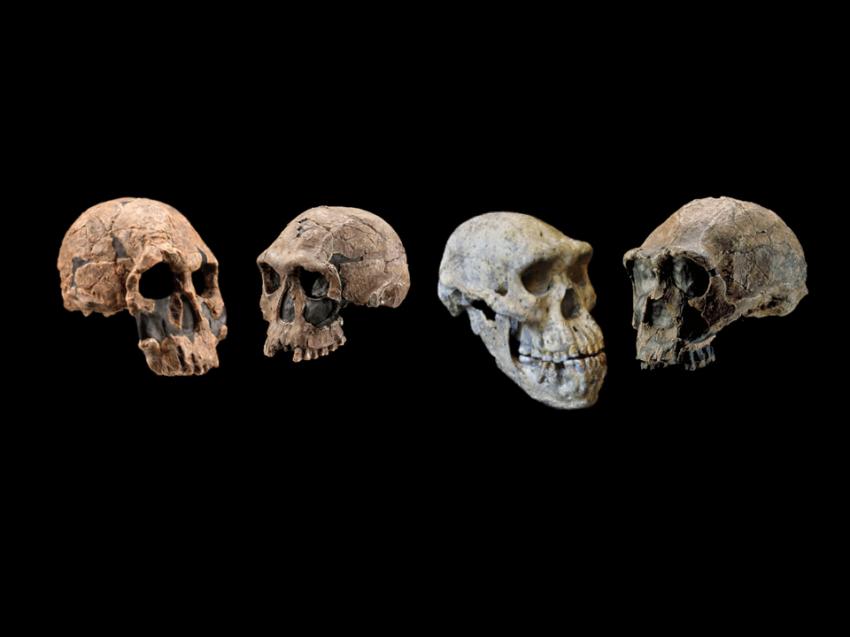
These included Homo heidelbergensis, Homo naledi, Homo floresiensis, Homo luzonensis, the Denisovans, and the Neanderthals.
Each species had its own unique adaptations and evolutionary history.
Some lived in Africa, while others occupied Europe or Asia. Some made sophisticated tools, buried their dead, or survived harsh climates.
Modern humans were only one branch of this rich evolutionary tree.
Neanderthals Were Not Primitive Cavemen
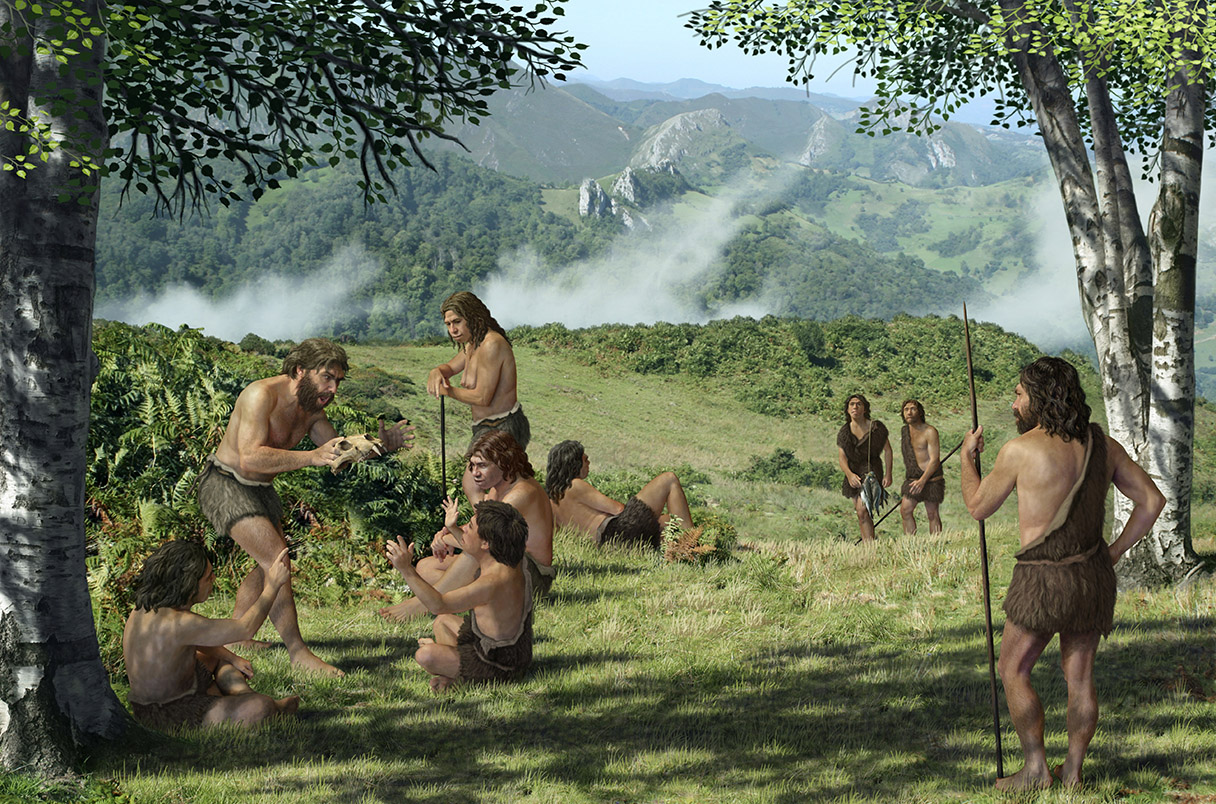
Neanderthals, or Homo neanderthalensis, lived across Europe and parts of western Asia until around 40,000 years ago.
For many years, they were incorrectly portrayed as unintelligent or brutish.
Modern research paints a very different picture.
Neanderthals had large brains, crafted sophisticated stone tools, controlled fire, hunted effectively, cared for injured individuals, and likely expressed symbolic behavior through ornaments and pigments.
Genetic studies also reveal that Neanderthals and modern humans interbred after Homo sapiens expanded beyond Africa.
As a result, many people living today outside Africa carry a small percentage of Neanderthal DNA.
Denisovans: The Human Relatives We Barely Knew
One of the most remarkable discoveries in recent decades came from a tiny fossil fragment found in Siberia.
DNA analysis revealed an entirely unknown group of ancient humans called the Denisovans.
Very few Denisovan fossils have been found, yet genetic evidence shows they interbred with both Neanderthals and modern humans.
Today, some populations in Asia and Oceania carry inherited Denisovan DNA that contributes to traits such as adaptation to high-altitude environments.
This discovery demonstrates how genetics can reveal ancient human populations even when fossils are scarce.
When Did Modern Humans Evolve?
The oldest widely accepted fossils of Homo sapiens date to around 300,000 years ago in Africa.
Early Homo sapiens already possessed many anatomical features seen in people today, although some characteristics continued evolving over time.
Like earlier human species, they lived by hunting, gathering, making tools, and adapting to changing environments.
Eventually, modern humans developed increasingly sophisticated technology, symbolic culture, long-distance trade, artistic expression, and complex language.
These developments transformed human societies and allowed our species to spread across nearly every continent.
The Journey Out of Africa
The overwhelming scientific evidence indicates that modern humans originated in Africa.
Beginning around 60,000 to 70,000 years ago, groups of Homo sapiens expanded into the Middle East before spreading throughout Asia, Europe, Australia, and eventually the Americas.
As humans entered new environments, they adapted to different climates, foods, diseases, and ecosystems.
These migrations shaped the genetic diversity seen among people today.
Despite visible differences in appearance, all living humans belong to the same species and share a remarkably recent common ancestry.
How Fossils Reveal Our Past
Fossils are among the most important sources of evidence for human evolution.
A fossil forms when the remains or traces of ancient organisms become preserved in rock over long periods.
Scientists carefully excavate fossil sites, analyze skeletal features, determine ages using radiometric dating methods, and compare discoveries with known species.
Each new fossil helps fill gaps in our understanding of human history.
Although the fossil record is incomplete, thousands of discoveries from Africa, Europe, Asia, and elsewhere collectively provide a detailed picture of human evolution.
DNA Revolutionized Human Evolution Research
The development of genetics transformed our understanding of human origins.
DNA carries the genetic instructions inherited from parents.
By comparing DNA from living people with ancient DNA recovered from fossils, scientists can reconstruct evolutionary relationships with remarkable precision.
Ancient DNA has revealed unexpected interbreeding between Homo sapiens, Neanderthals, and Denisovans.
It has also confirmed that all modern humans ultimately trace their ancestry to populations that lived in Africa.
Genetics continues revealing new details about migration, adaptation, and evolutionary history.
Natural Selection Shaped Human Traits
Many familiar human characteristics evolved because they improved survival or reproduction under particular conditions.
Large brains supported increasingly complex problem-solving, planning, and social behavior.
Flexible hands with opposable thumbs enabled precise tool use.
Language allowed communication, cooperation, and cultural transmission.
Changes in skin pigmentation evolved largely in response to differences in ultraviolet radiation across the globe.
Lactase persistence, the ability of some adults to digest milk, evolved independently in several populations after the domestication of dairy animals.
Resistance to certain diseases also evolved in response to local environments.
Evolution continues wherever genetic variation affects reproductive success.
Culture Became Part of Human Evolution
Unlike most other species, humans evolve not only biologically but also culturally.
Knowledge can be passed from one generation to the next through learning rather than genetics.
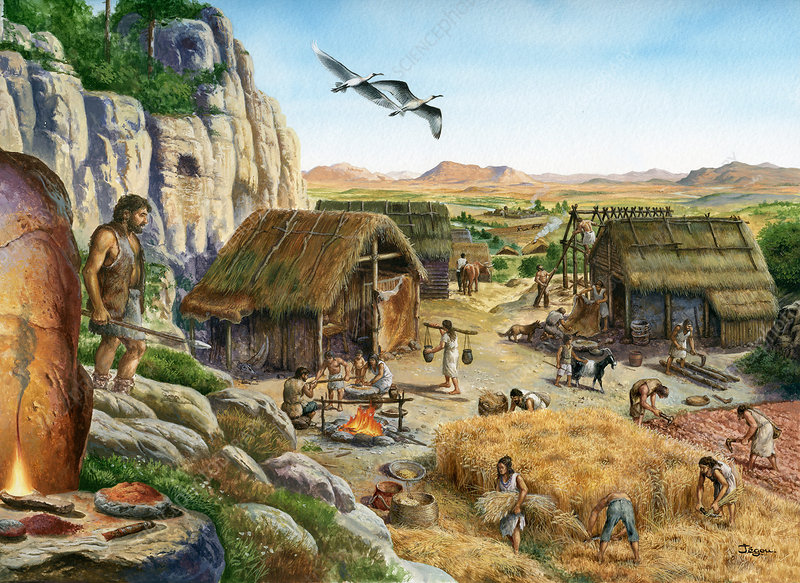
The invention of tools, agriculture, writing, medicine, science, and technology dramatically changed how humans interact with the environment.
Culture often allows humans to adapt much faster than biological evolution alone.
Today, people survive in deserts, polar regions, rainforests, mountains, and even aboard spacecraft because of cultural knowledge and technological innovation.
Is Human Evolution Still Happening?
Yes. Human evolution has not stopped.
Mutations continue to occur in every generation. Natural selection, genetic drift, and gene flow continue shaping human populations.
Modern medicine, migration, changing diets, and new environments have altered some evolutionary pressures, but evolution itself remains an ongoing biological process.
Researchers continue studying how humans adapt to diseases, climate, altitude, diet, and other environmental challenges.
Evolution is not a completed event from the distant past—it continues today.
Common Misunderstandings About Human Evolution
Human evolution is often misunderstood.
One common misconception is that humans evolved directly from modern monkeys or chimpanzees. In reality, humans and modern apes share common ancestors but evolved along separate evolutionary paths.
Another misunderstanding is that evolution has a predetermined goal. Evolution has no planned direction. It does not strive toward perfection or complexity. Instead, it reflects adaptation to changing environments through natural processes.
It is also incorrect to imagine evolution as a straight ladder with one species replacing another. Human evolution is better understood as a branching tree with many extinct relatives existing at different times.
Finally, scientists do not claim to know every detail. Like all scientific fields, human evolution continues to improve as new fossils, archaeological discoveries, and genetic evidence emerge.
Why Human Evolution Matters
Understanding human evolution helps us understand ourselves.
It explains why our bodies are built the way they are, why we share so much DNA with other animals, and why people around the world are genetically so similar despite outward differences.
It also helps scientists study disease, genetics, adaptation, and human biology.
Perhaps most importantly, human evolution reminds us that every person alive today belongs to the same extended family. Regardless of nationality, culture, language, or appearance, all humans share a common evolutionary history that stretches back millions of years.
The Endless Journey of Discovery
The story of human evolution is one of resilience, adaptation, curiosity, and survival. From small populations of upright-walking ancestors in ancient Africa to a species capable of decoding its own genome and exploring other worlds, humanity’s journey has been extraordinary.
Yet the story is far from complete. New fossils continue to emerge from ancient rocks. Advances in DNA technology reveal unexpected chapters of our past. Archaeological discoveries constantly reshape our understanding of how our ancestors lived, migrated, and interacted.
Human evolution is not simply the history of bones buried beneath the ground. It is the story of how nature, time, and countless generations shaped every human being alive today. It is a powerful reminder that we are part of Earth’s long history of life—a history that continues to unfold with every new scientific discovery.