Far beyond the planets we know, beyond the icy realm of Pluto, and even beyond the distant objects of the Kuiper Belt, lies one of the most mysterious regions of our Solar System. It is a place so remote that no spacecraft has ever reached it and no telescope has ever photographed it directly. Yet astronomers are convinced it exists because of the silent messengers that occasionally arrive from its depths—long-period comets that travel for millions of years before briefly lighting up our skies.
This distant cosmic reservoir is known as the Oort Cloud. It is thought to surround the Solar System like a vast, spherical shell filled with trillions of icy objects. If the planets are the familiar neighborhood of our Solar System, then the Oort Cloud is its unimaginably distant frontier, stretching almost halfway to the nearest stars.
Although invisible to us, the Oort Cloud plays a vital role in understanding how the Solar System formed, how comets are born, and how our cosmic neighborhood interacts with the rest of the Milky Way.
Understanding the Oort Cloud
The Oort Cloud is a hypothetical but strongly supported cloud of icy bodies that surrounds the Solar System at enormous distances from the Sun. Scientists believe it is the source of most long-period comets, which take more than 200 years—and sometimes millions of years—to complete a single orbit around the Sun.
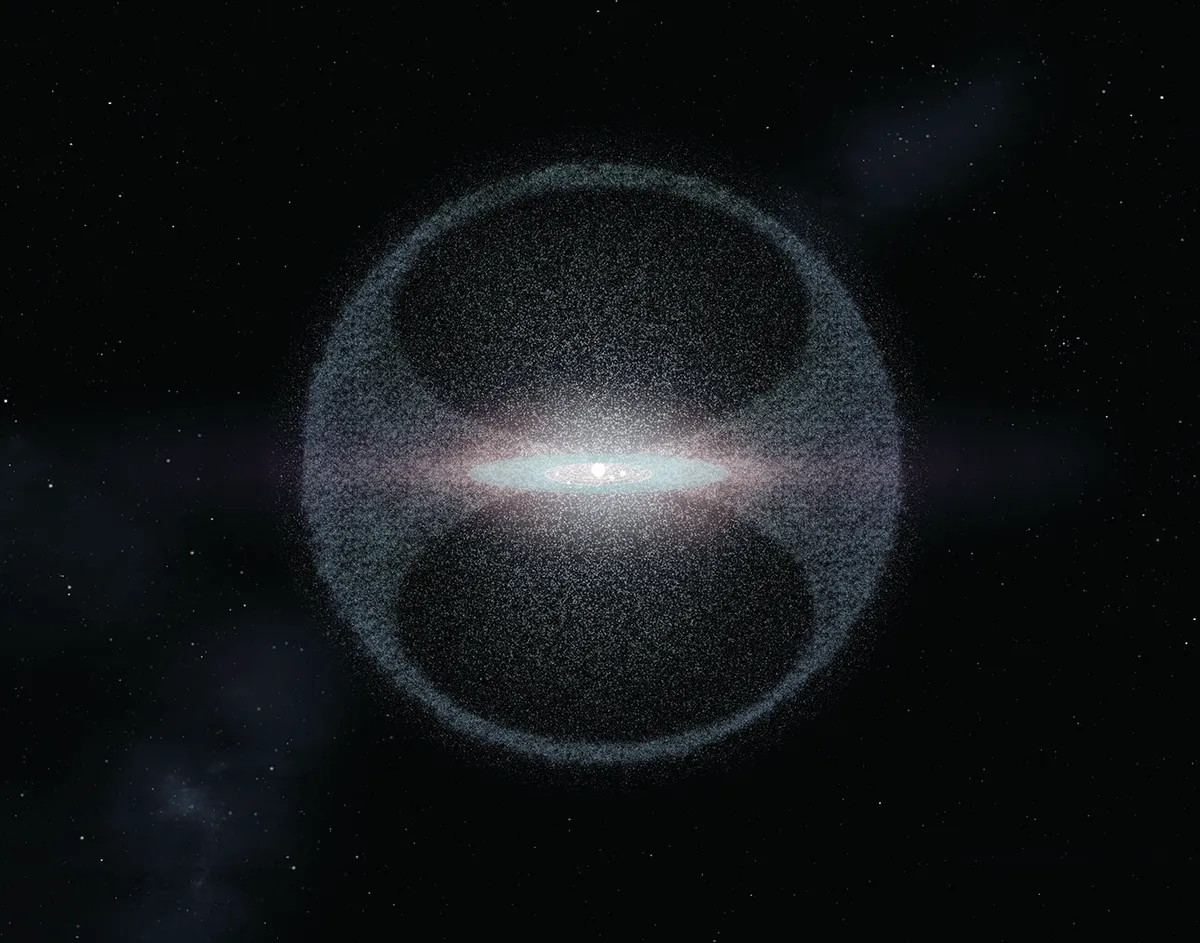
Unlike the planets, which orbit within roughly the same flat plane, the Oort Cloud is believed to form an almost spherical shell around the Solar System. This means comets from the Oort Cloud can approach the Sun from virtually any direction.
The objects in the Oort Cloud are thought to be leftovers from the formation of the Solar System about 4.6 billion years ago. They have remained frozen in the darkness for billions of years, preserving material from the earliest days of planetary formation.
Why Is It Called the Oort Cloud?
The Oort Cloud is named after the Dutch astronomer Jan Oort, who proposed its existence in 1950.
At the time, astronomers had noticed something unusual about long-period comets. Many of them appeared to come from extremely great distances, almost as though they originated from a giant reservoir surrounding the Solar System.
Jan Oort carefully studied the orbits of these comets and concluded that they were unlikely to have formed near the planets. Instead, he suggested they came from a distant cloud of icy bodies that occasionally sent comets inward.
Although earlier astronomers had considered similar ideas, Oort’s detailed analysis provided the strongest evidence and led to the cloud being named in his honor.
Where Is the Oort Cloud?
The Oort Cloud lies far beyond every known planet and well outside the Kuiper Belt.
Its inner edge is thought to begin somewhere between about 2,000 and 5,000 astronomical units (AU) from the Sun. One astronomical unit is the average distance between Earth and the Sun, about 150 million kilometers (93 million miles).
Its outer edge may extend as far as 100,000 AU, and some estimates suggest it could reach even farther.
To appreciate this distance, consider that Neptune, the outermost major planet, orbits at only about 30 AU from the Sun. Pluto typically orbits between about 30 and 49 AU, while the Kuiper Belt extends to roughly 50 AU. The Oort Cloud begins thousands of times farther away.
Light from the Sun takes about 8 minutes to reach Earth.
It takes over 4 hours to reach Neptune.
It may take more than a year for sunlight to reach the outer regions of the Oort Cloud.
At such distances, the Sun would appear as an exceptionally bright star rather than the brilliant disk we see from Earth.
A Nearly Spherical Shell Around the Solar System
One of the most fascinating features of the Oort Cloud is its shape.
The planets orbit the Sun in a relatively flat disk called the ecliptic plane. Most asteroids and Kuiper Belt objects also follow this general arrangement.
The Oort Cloud is very different.
Scientists believe it surrounds the Solar System in nearly every direction, forming a giant three-dimensional sphere.
This explains why long-period comets can arrive from above, below, or any angle relative to the planetary orbits.
If the Solar System were the size of a small coin, the Oort Cloud would stretch outward over an enormous surrounding volume, emphasizing just how tiny the planetary region really is compared with the Solar System’s outermost reaches.
What Is the Oort Cloud Made Of?
The Oort Cloud is believed to contain countless icy bodies composed primarily of frozen water, carbon dioxide, methane, ammonia, carbon monoxide, and other volatile compounds.
These objects are often described as “dirty snowballs” because they contain mixtures of ice, rock, dust, and organic material.
Many are probably only a few kilometers across, while some may be significantly larger.
Because temperatures are extremely low, these materials remain frozen solid for billions of years.
Scientists estimate that the Oort Cloud may contain billions or even trillions of icy objects, although their exact number remains uncertain.
Despite this enormous population, the objects are spread across such a vast volume of space that they are incredibly far apart from one another.
How Did the Oort Cloud Form?
The Oort Cloud likely formed during the chaotic early history of the Solar System.
About 4.6 billion years ago, the Sun formed from a giant cloud of gas and dust. Around it, a rotating disk of material gradually produced planets, moons, asteroids, and comets.
During this period, the giant planets—Jupiter, Saturn, Uranus, and Neptune—were especially influential.
As these massive planets grew, their powerful gravity repeatedly scattered countless icy objects outward.
Many of these objects gained enough speed to leave the planetary region but not enough to escape the Sun’s gravity entirely.
Instead, they settled into enormous, elongated orbits far from the Sun.
Over millions of years, gravitational influences from nearby stars, giant molecular clouds, and the tidal forces of the Milky Way gradually reshaped these elongated orbits into the nearly spherical distribution that astronomers believe exists today.
The Oort Cloud is therefore thought to be a fossil record of the Solar System’s earliest evolution.
The Difference Between the Oort Cloud and the Kuiper Belt
Because both regions contain icy objects, the Oort Cloud and the Kuiper Belt are often confused.
However, they are fundamentally different.
The Kuiper Belt lies just beyond Neptune and forms a relatively flat disk surrounding the Sun. It contains dwarf planets such as Pluto, Eris, Makemake, and Haumea, along with many smaller icy bodies.
The Oort Cloud begins thousands of astronomical units farther away and is believed to surround the Solar System in nearly every direction rather than forming a flat disk.
Most short-period comets, which return regularly within 200 years, originate from the Kuiper Belt or the related scattered disk population.
Most long-period comets, which may take thousands or even millions of years to return, are believed to come from the Oort Cloud.
Long-Period Comets: Visitors From the Edge
The strongest evidence for the Oort Cloud comes from long-period comets.
These comets spend nearly all of their existence in the freezing darkness of the outer Solar System.
Occasionally, something disturbs one of them.
The gravitational pull of a passing star, the tidal influence of the Milky Way, or interactions with other massive objects can slightly alter its orbit.
A tiny gravitational change at such enormous distances can eventually send the comet falling toward the Sun.
As it approaches the inner Solar System, sunlight begins heating its icy surface.
Frozen gases turn directly into vapor through sublimation, carrying dust away from the nucleus.
This process creates the glowing coma and spectacular tails that make comets among the most beautiful objects in the night sky.
After passing near the Sun, some comets return to the Oort Cloud, while others are ejected from the Solar System forever.
Why Haven’t We Seen the Oort Cloud?
Despite decades of increasingly powerful telescopes, the Oort Cloud has never been directly observed.
The reason is simple.
Its objects are extraordinarily small, extremely dark, and unimaginably far away.
Even the largest telescopes cannot detect individual Oort Cloud objects under normal conditions because they reflect very little sunlight.
Instead, astronomers infer the cloud’s existence by studying the paths of incoming long-period comets.
The consistency of these orbital patterns provides strong indirect evidence for the cloud’s presence.
Although direct imaging remains beyond current technology, future telescopes and improved astronomical surveys may reveal more clues about this distant region.
Could Spacecraft Reach the Oort Cloud?
No spacecraft has yet entered the Oort Cloud.
The two most distant human-made objects, Voyager 1 and Voyager 2, are traveling through interstellar space after leaving the heliosphere, but they remain far inside the expected inner boundary of the Oort Cloud.
Even moving at tremendous speeds, it would take these spacecraft hundreds of years to approach the cloud’s inner edge and many thousands of years to travel through it.
This highlights the astonishing scale of our Solar System.
The planets occupy only a tiny fraction of the Sun’s gravitational domain.
The Oort Cloud and Interstellar Space
The outer regions of the Oort Cloud may blend gradually into interstellar space.
At these immense distances, the Sun’s gravitational influence becomes increasingly weak.
Nearby stars passing through the Milky Way can perturb Oort Cloud objects.
Over billions of years, the Sun may lose some icy bodies while capturing others that originally belonged to different stars.
Some astronomers even suggest that portions of the Oort Cloud could contain material exchanged between neighboring stellar systems during the Sun’s birth within a crowded star cluster.
If true, tiny frozen objects in the Oort Cloud may have originated around entirely different stars.
Could There Be Planets in the Oort Cloud?
Scientists have occasionally proposed the possibility of undiscovered large objects in the distant Solar System.
These ideas include hypothetical planets located far beyond Neptune.
However, no planet has been confirmed within the Oort Cloud itself.
Searches continue for distant massive objects, but current evidence remains inconclusive.
Until observations provide direct confirmation, such planets remain speculative rather than established scientific fact.
The Oort Cloud and Earth’s History
Although the Oort Cloud is incredibly distant, it has influenced Earth throughout its history.
Some long-period comets originating there have crossed Earth’s orbit.
A few may have collided with our planet in the distant past.
Such impacts have shaped Earth’s geological history and may have delivered water and complex organic molecules during the early Solar System, although scientists continue to study the relative contributions of comets and asteroids.
Most comets, however, pass safely through the Solar System without posing any danger.
How Scientists Study the Oort Cloud
Because the Oort Cloud cannot yet be observed directly, researchers rely on computer simulations, mathematical models, and careful measurements of comet orbits.
By tracing comet trajectories backward, astronomers estimate where they likely originated.
Powerful simulations recreate the early Solar System, showing how giant planets could scatter icy bodies into distant orbits.
These models match many observed characteristics of long-period comets, strengthening the case for the Oort Cloud’s existence.
As new telescopes discover more comets, scientists continually refine their understanding of this distant region.
Why the Oort Cloud Matters
The Oort Cloud is much more than a distant collection of frozen rocks.
It is a time capsule from the birth of the Solar System.
The icy bodies preserved there have changed very little over billions of years.
Studying them helps scientists understand the processes that built the planets, the migration of the giant planets, the history of comet impacts, and the evolution of our cosmic neighborhood.
The Oort Cloud also reminds us that the Solar System extends far beyond the familiar worlds shown in textbooks.
Its immense scale challenges our intuition and expands our appreciation of the Sun’s gravitational reach.
Conclusion
The Oort Cloud remains one of astronomy’s greatest unseen frontiers. Hidden in the darkness far beyond the planets, it is believed to be an enormous spherical reservoir of ancient icy objects left over from the birth of the Solar System. Although no spacecraft has reached it and no telescope has photographed it directly, the steady arrival of long-period comets provides compelling evidence that this distant cloud is real.
As astronomers continue exploring the universe with increasingly powerful telescopes and sophisticated computer models, the Oort Cloud remains a symbol of how much there is still to discover. It reminds us that even within our own Solar System, vast regions remain unexplored, holding clues to our origins and perhaps to the history of countless other planetary systems across the Milky Way.