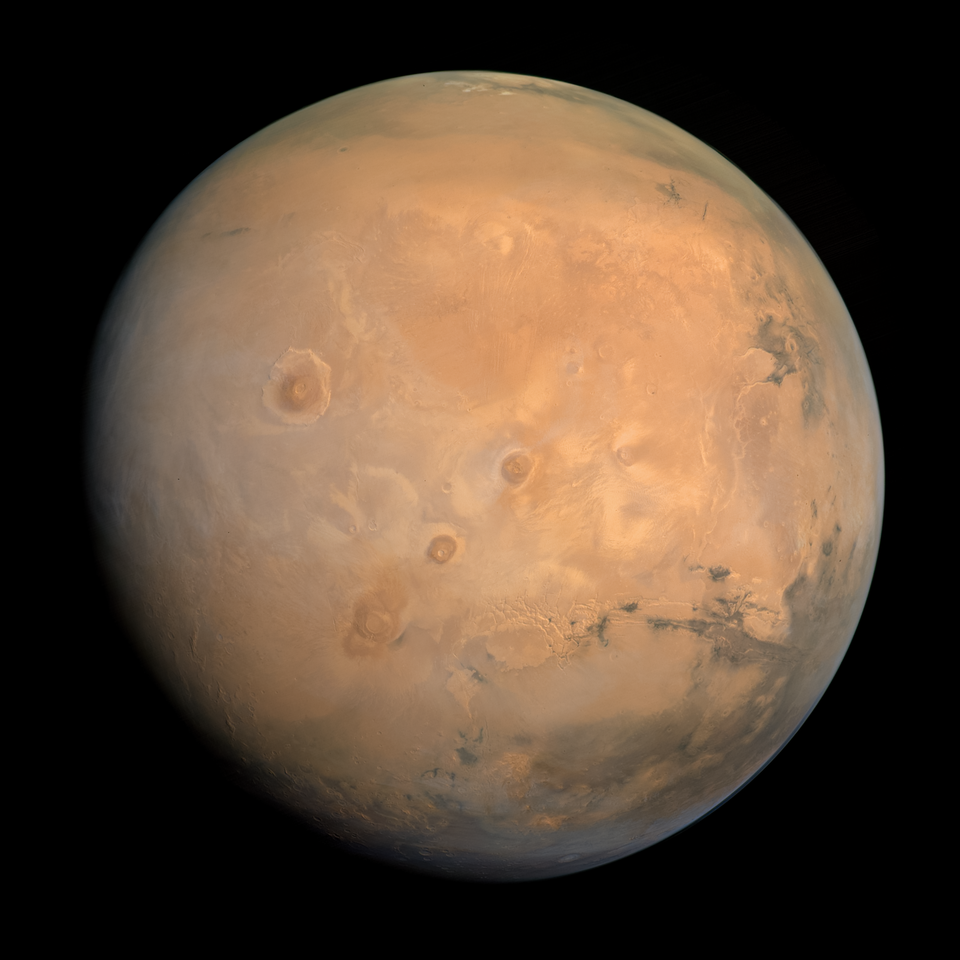
For thousands of years, Mars has fascinated humanity. Ancient civilizations saw it as a mysterious red star wandering across the night sky. Today, powerful telescopes and robotic spacecraft have transformed that distant point of light into a real world—a cold, rocky planet with towering volcanoes, vast canyons, frozen polar ice caps, and evidence that liquid water once flowed across its surface.
As scientists learn more about Mars, one question continues to capture imaginations around the world: Could humans actually live there?
It is a question that belongs not only to science fiction but also to modern science. Space agencies and private companies are actively developing technologies that could one day send astronauts to Mars. Yet living on another planet is one of the greatest challenges humanity has ever considered.
The answer is both exciting and complicated. Humans could potentially live on Mars in the future, but not without extraordinary technology. Unlike Earth, Mars is not naturally suitable for human life. Every breath of air, every drop of water, every meal, and every degree of warmth would have to be carefully created or protected.
Understanding whether humans can live on Mars begins with understanding the planet itself.
What Is Mars Like?
Mars is the fourth planet from the Sun and Earth’s closest planetary neighbor after Venus, although the distance between Earth and Mars changes continuously as both planets orbit the Sun.
Mars is often called the Red Planet because its surface contains large amounts of iron oxide, commonly known as rust. This rusty dust gives the planet its distinctive reddish appearance.
Although Mars and Earth share some similarities, they are very different worlds.
A Martian day, called a sol, lasts about 24 hours and 39 minutes, making it remarkably close to an Earth day. Mars also has seasons because its rotational axis is tilted by about 25 degrees, similar to Earth’s 23.5-degree tilt.
However, almost everything else is far less welcoming.
Mars is only about half the diameter of Earth and has just 38 percent of Earth’s surface gravity. If you weighed 100 kilograms on Earth, you would weigh only about 38 kilograms on Mars. Although this lower gravity would make lifting heavy objects easier, scientists still do not know how living for years in reduced gravity would affect the human body.
Can Humans Breathe on Mars?
The biggest obstacle to living on Mars is its atmosphere.
Earth’s atmosphere contains about 21 percent oxygen, which humans need to survive.
Mars is very different.
Its atmosphere is extremely thin—less than 1 percent of Earth’s atmospheric pressure at the surface. It is composed primarily of carbon dioxide, with only tiny amounts of oxygen.
A person standing on Mars without a pressurized spacesuit would quickly lose consciousness because there is not enough oxygen to breathe and the atmospheric pressure is far too low to support normal human physiology.
Any future Martian habitat would therefore need systems that continuously provide breathable air while maintaining a safe internal pressure.
Scientists are also studying ways to produce oxygen directly on Mars. One approach is to separate oxygen from carbon dioxide using electricity. In 2021, NASA’s MOXIE experiment aboard the Perseverance rover successfully demonstrated this technology by producing oxygen from the Martian atmosphere, showing that local oxygen production is technically possible for future missions.
How Cold Is Mars?
Mars is an extremely cold world.
The average surface temperature is around −63°C (−81°F), although temperatures vary widely depending on location and season.
Near the equator during a sunny afternoon, temperatures can occasionally rise to around 20°C (68°F) for a short time. At night, however, they can plunge well below −70°C (−94°F).
Near the poles during winter, temperatures may fall below −125°C (−193°F).
Future homes on Mars would require excellent insulation and reliable heating systems to keep people alive and comfortable.
Is There Water on Mars?
Water is essential for life.
For many years, scientists wondered whether Mars ever had water.
Today, the evidence is overwhelming.
Ancient river valleys, lakebeds, minerals formed in water, and sedimentary rocks all show that billions of years ago Mars was much warmer and wetter than it is today.
Although liquid water cannot remain stable on most of the present-day Martian surface because of the planet’s low atmospheric pressure, large amounts of water still exist as ice.
Water ice has been found beneath the surface, within permanently shadowed regions, and at the polar ice caps.
Future astronauts could potentially mine this ice and purify it for drinking, growing food, producing oxygen, and making rocket fuel through the electrolysis of water.
Using local resources rather than transporting everything from Earth is considered one of the most important strategies for long-term exploration.
Would Mars Have Enough Food?
No natural food exists on Mars.
Everything needed to feed a human settlement would initially have to come from Earth or be produced locally.
Scientists are already experimenting with growing crops in environments that simulate Martian conditions.
Plants could potentially be grown inside pressurized greenhouses using artificial lighting or filtered sunlight.
Hydroponic and aeroponic farming systems, which grow plants without traditional soil, may prove especially valuable because they recycle water efficiently.
Besides providing food, plants would also help recycle carbon dioxide into oxygen, improving the habitat’s atmosphere.
However, farming on Mars would require careful management of temperature, humidity, nutrients, and lighting.
What Is Martian Soil Like?
At first glance, Mars appears to have soil similar to Earth’s deserts.
In reality, Martian soil is very different.
It contains volcanic rock fragments, dust, and chemicals called perchlorates, which can be harmful to humans in high concentrations and may interfere with plant growth if left untreated.
Future settlers would likely need to process Martian soil before using it for agriculture.
Some researchers also believe that specially engineered growing systems may avoid the need to use Martian soil altogether.
Understanding Martian geology continues to be an important area of scientific research.
Radiation Is One of the Greatest Dangers
Earth enjoys powerful natural protection.
Its magnetic field and thick atmosphere block much of the harmful radiation arriving from space.
Mars lacks both a global magnetic field and a thick atmosphere.
As a result, astronauts on Mars would receive significantly higher doses of cosmic rays and energetic particles from the Sun than people living on Earth.
Long-term exposure to radiation increases the risk of cancer, cataracts, cardiovascular disease, and damage to the nervous system.
Protecting future settlers from radiation is one of the biggest engineering challenges.
Scientists are exploring several possible solutions.
Habitats could be built underground inside lava tubes, covered with thick layers of Martian soil, or constructed using materials that block radiation more effectively.
Dust Storms on Mars
Mars experiences enormous dust storms.
Some are local and relatively small.
Others grow so large that they can cover nearly the entire planet for weeks.
Unlike hurricanes on Earth, Martian dust storms have much lower wind pressure because the atmosphere is so thin.
Even though wind speeds can be high, they are generally not powerful enough to knock over heavy structures.
The greater challenge comes from the fine dust itself.
Martian dust can cover solar panels, interfere with machinery, reduce visibility, and potentially affect astronauts’ equipment.
Designing reliable systems that continue operating during long dust storms is essential.
Would People Feel Different on Mars?
Life on Mars would affect the human body in many ways.
Lower gravity may weaken muscles and bones over time, similar to what astronauts experience aboard the International Space Station.
Scientists also wonder how reduced gravity might influence the heart, immune system, balance, and vision during missions lasting several years.
Exercise would almost certainly become a daily necessity for Martian settlers.
Researchers continue studying these effects because no human has yet lived for extended periods in Martian gravity.
How Long Does It Take to Reach Mars?
Mars is much farther away than the Moon.
Depending on the positions of Earth and Mars in their orbits, a spacecraft typically takes about six to nine months to reach the Red Planet using current technology.
Launch opportunities occur roughly every 26 months, when Earth and Mars are favorably aligned.
Communication also becomes challenging.
Radio signals traveling at the speed of light take between about 3 and 22 minutes to travel one way between Earth and Mars, depending on the planets’ positions.
This means conversations cannot happen in real time.
Future Martian crews would need to solve many problems independently.
Where Would People Live?
Astronauts could not simply pitch tents on the Martian surface.
Homes would need to be highly engineered habitats.
These structures would maintain breathable air, comfortable temperatures, safe pressure, clean water, and protection from radiation.
Engineers are designing concepts that include inflatable modules, underground shelters, and buildings constructed using Martian materials.
Some researchers are investigating whether robots could build habitats before humans even arrive.
Reliable life-support systems would be among the most important technologies for any settlement.
Can We Make Fuel on Mars?
Returning safely to Earth presents another major challenge.
Transporting all the necessary rocket fuel from Earth would be extremely expensive.
Instead, scientists hope future missions will manufacture fuel on Mars.
Carbon dioxide from the atmosphere and water extracted from underground ice could potentially be converted into methane and oxygen using chemical processes.
This approach, known as in-situ resource utilization, would greatly reduce the amount of material launched from Earth.
Producing fuel locally is considered one of the key technologies needed for sustainable exploration.
Could Children Be Born on Mars?
This is one of the most intriguing questions in space science.
At present, no one knows.
Scientists do not yet understand how reduced gravity, increased radiation, or other Martian environmental conditions might affect pregnancy, childbirth, or human development.
Before permanent settlements become possible, researchers would need much more knowledge about how the human body responds to life on another planet across multiple generations.
For now, this question remains unanswered.
Would Mars Ever Feel Like Earth?
Even if humans establish permanent settlements, Mars will probably never feel exactly like Earth.
The sky often appears butterscotch-colored during the day because of fine dust suspended in the atmosphere.
Sunsets can look strikingly different, sometimes appearing blue near the Sun because of the way Martian dust scatters light.
The air would remain unbreathable outside protected habitats.
People would need spacesuits for outdoor activities.
Simple tasks like walking, repairing equipment, or collecting samples would require careful planning.
Mars would always remind its residents that they are living on another world.
Could We Transform Mars?
Some people have suggested terraforming Mars—changing the planet so it becomes more Earth-like.
Ideas include warming the climate, thickening the atmosphere, and releasing trapped carbon dioxide.
Although fascinating, current scientific research indicates that terraforming Mars is far beyond today’s technological capabilities.
Studies suggest Mars does not contain enough easily accessible carbon dioxide to create a thick, warm atmosphere similar to Earth’s using existing methods.
Terraforming therefore remains a concept for the distant future rather than a practical engineering project.
Why Do Scientists Want to Go to Mars?
Mars offers an extraordinary scientific opportunity.
Because evidence shows it once had rivers, lakes, and perhaps even oceans, scientists want to know whether microbial life ever existed there.
Finding even ancient fossilized microorganisms would dramatically change our understanding of life in the universe.
Mars also provides clues about how rocky planets evolve.
Although Earth and Mars formed around the same time about 4.5 billion years ago, they followed very different paths.
Studying Mars helps scientists understand Earth’s own history, climate, geology, and future.
Human missions would also accelerate discoveries by allowing astronauts to explore far more efficiently than robotic rovers alone.
What Challenges Still Need to Be Solved?
Before humans can live on Mars for long periods, many technological and scientific challenges remain.
Reliable spacecraft, radiation protection, food production, water extraction, oxygen generation, waste recycling, medical care, power generation, and psychological well-being during long missions all require continued research.
Each challenge is difficult on its own.
Together, they represent one of the greatest engineering projects humanity has ever attempted.
Yet history has shown that remarkable achievements often begin with ambitious questions.
The Future of Humans on Mars
Humanity has already sent dozens of robotic missions to Mars. Orbiters map its surface from space, landers study its environment, and rovers explore ancient rocks in search of clues about the planet’s past.
The next great step may be sending people.
Whether that happens within the next few decades or takes longer will depend on advances in technology, international cooperation, funding, and scientific progress.
Even if permanent cities on Mars remain many years away, every new mission teaches us something valuable about how humans might one day become an interplanetary species.
Conclusion
Could humans live on Mars?
The scientific answer is yes—but not naturally.
Mars cannot support human life without advanced technology. Its thin atmosphere, freezing temperatures, intense radiation, limited accessible water, and lack of breathable oxygen make survival impossible without carefully designed habitats and life-support systems.
Yet none of these challenges appear fundamentally impossible to overcome. Scientists and engineers are steadily developing technologies to produce oxygen, recycle water, grow food, generate energy, and build shelters using Martian resources. Each new discovery brings humanity one step closer to turning a distant dream into reality.
Mars is not a second Earth, and it may never become one. But it is a world that invites exploration, challenges human ingenuity, and reminds us that our curiosity has no limits. One day, when the first people look up from the Martian surface and see a tiny blue Earth shining in the sky, they will represent one of the greatest milestones in the history of human exploration.