For thousands of years, people have looked up at the night sky and noticed a mysterious star-like object that glows with a reddish-orange color. Unlike the stars, it slowly moves across the sky over weeks and months, making it one of the “wandering stars” that ancient astronomers called planets. Its striking reddish appearance made it stand out from every other visible planet, inspiring stories, myths, and even fear among ancient civilizations.
Today, we know that this glowing object is Mars, our neighboring planet. But one question has fascinated people for centuries: Why is Mars called the Red Planet?
The answer lies not in oceans of fire or rivers of lava, as people once imagined, but in something much more ordinary—and surprisingly familiar. The planet’s famous color comes from rust, the same chemical process that turns old iron tools, bicycles, and bridges reddish-brown here on Earth.
Although the explanation is simple, the science behind Mars’ color reveals an extraordinary story about the planet’s history, its environment, and its place in our Solar System.
The Planet That Stands Out in the Night Sky
Mars is the fourth planet from the Sun, located between Earth and Jupiter. It is one of the easiest planets to recognize without a telescope because of its distinctive reddish glow.
Unlike stars, which twinkle because their light passes through Earth’s turbulent atmosphere, Mars usually shines with a steadier light. Depending on where it is in its orbit and how close it is to Earth, Mars can become one of the brightest objects in the night sky.
Even ancient observers who knew nothing about planets, chemistry, or astronomy noticed its unusual color. This single feature made Mars unforgettable.
Its appearance inspired names, legends, and beliefs across many cultures long before anyone understood what caused its red hue.
Ancient People Connected Mars With War
Because Mars appeared blood-red in the sky, many ancient civilizations associated it with conflict, violence, and warfare.
The ancient Romans named the planet after Mars, their god of war. The Greeks linked it to Ares, another war deity. In Babylonian mythology, the planet was associated with Nergal, a god connected with war, destruction, and disease.
In ancient China, Mars was sometimes called the “Fire Star” because of its reddish appearance.
These cultures had no way of knowing that the planet’s color came from minerals covering its surface. To them, the red glow seemed mysterious, powerful, and even ominous.
Although science has replaced mythology with evidence, the ancient nickname has endured. Even today, Mars is universally known as the Red Planet.
The Real Reason Mars Is Red
The true explanation for Mars’ color comes from chemistry.
Much of the Martian surface contains minerals rich in iron. Over billions of years, these iron-containing rocks reacted with oxygen to form iron oxide.
Iron oxide is better known as rust.
This is the same material that forms on old cars, metal fences, exposed nails, and abandoned machinery when iron reacts with oxygen and water on Earth.
On Mars, however, the process occurred on a planetary scale.
Tiny particles of iron oxide cover rocks, cliffs, sand dunes, and enormous regions of the planet. Winds constantly lift these microscopic dust particles into the atmosphere, spreading them across Mars and coating much of its surface.
Because iron oxide reflects sunlight in reddish and orange wavelengths more strongly than other colors, the entire planet appears red when viewed from space—or even from Earth.
Rust Covers More Than Just the Surface
Scientists once believed that only the top layer of Martian dust was rusty.
Modern spacecraft have revealed a more complex picture.
Iron oxide exists not only in surface dust but also within many rocks, sediments, and soils across the planet.
Powerful dust storms, some large enough to engulf the entire planet, continually redistribute this reddish material.
As a result, Mars has developed a nearly global coating of rust-colored dust.
This dusty blanket is one reason the planet looks consistently red from almost every angle.
How Did Mars Become Rusty?
Rust requires iron and oxygen.
Earth’s rust often forms because iron reacts with oxygen in the presence of water.
Mars contains abundant iron-rich volcanic rocks.
Billions of years ago, the planet also had liquid water flowing across its surface. Rivers carved valleys, lakes filled impact craters, and perhaps even shallow seas existed for extended periods.
During this wetter era, iron minerals reacted with oxygen, gradually forming iron oxide.
Even after most of Mars lost its liquid water, the iron oxide remained.
Today, the rusty minerals preserve evidence of ancient chemical reactions that occurred during a very different chapter of Martian history.
Did Mars Always Look Red?
Probably not.
Shortly after its formation about 4.5 billion years ago, Mars likely looked much darker than it does today.
Its young surface was dominated by volcanic rock, similar to basalt found on Earth.
As time passed, weathering, chemical reactions, and the formation of iron oxide slowly changed the planet’s appearance.
Dust storms spread the reddish material across vast distances, gradually creating the global color we recognize today.
In other words, Mars became red over immense periods of geological time.
Why Doesn’t Every Part of Mars Look the Same?
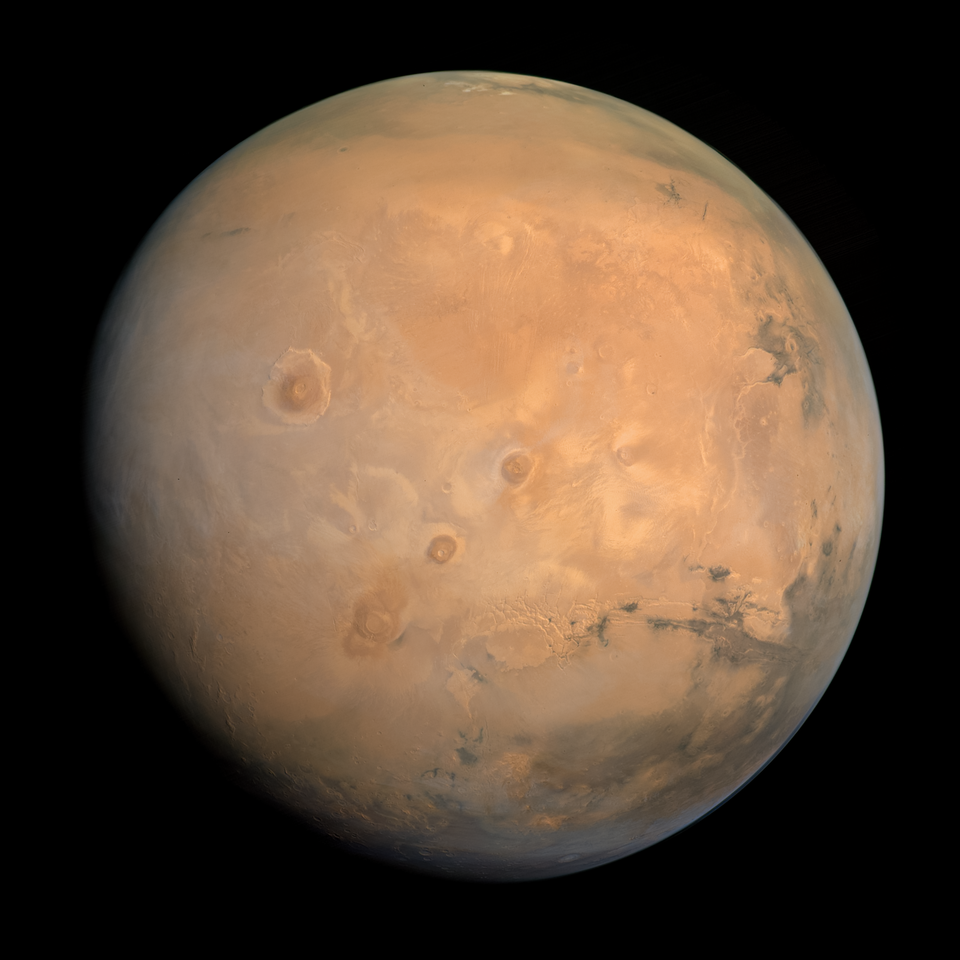
Although Mars is called the Red Planet, it is not entirely red.
Spacecraft orbiting Mars have photographed landscapes with many different colors.
Some regions appear tan, golden, brown, gray, black, or even slightly bluish under certain lighting conditions.
Fresh impact craters sometimes expose darker rocks buried beneath the dusty surface.
Ancient volcanic plains often appear darker than surrounding dusty areas.
The polar ice caps look bright white because they contain water ice and frozen carbon dioxide.
Certain mineral-rich regions display subtle shades of greenish, yellowish, or bluish colors in scientific images taken using specialized instruments.
The overall reddish appearance is the result of averaging countless landscapes across the entire planet.
Dust Makes Mars Look Even Redder
One of Mars’ most remarkable features is its dust.
The planet is covered with incredibly fine particles, much smaller than grains of beach sand.
These tiny dust grains are easily carried by wind.
Mars experiences dust devils similar to those found in Earth’s deserts, but it also experiences enormous dust storms unlike anything on our planet.
Some storms grow so large that they cover entire continents.
Occasionally, they expand until almost the whole planet disappears beneath a haze of airborne dust.
When sunlight passes through this suspended iron-rich dust, Mars appears even more reddish from space.
These storms help maintain the planet’s famous color by continually redistributing rusty material.
Looking at Mars From Earth
When you observe Mars through your eyes alone, it usually appears as a small reddish point of light.
Even modest telescopes reveal more.
Observers can often see bright polar caps, darker surface markings, and sometimes dust storms.
Large professional telescopes show extraordinary details, allowing astronomers to study seasonal changes on the planet.
The reddish color remains visible regardless of magnification because it reflects the true nature of the planet’s surface.
Mars Looks Different Up Close
When robotic spacecraft first landed on Mars, many people expected dramatic bright-red landscapes.
Instead, the images showed something more subtle.
The sky often appears butterscotch or pink because of fine dust suspended in the atmosphere.
The ground ranges from rusty red to orange, brown, tan, and gray.
Rocks display many shades depending on their composition and how much dust covers them.
The famous “red” appearance becomes most obvious when viewing the planet as a whole rather than standing on its surface.
Just as Earth looks blue from space because of its oceans, Mars looks red because of its global covering of iron-rich dust.
What Is Mars Made Of?
Mars is a rocky terrestrial planet, much like Earth, Venus, and Mercury.
Its crust contains volcanic rocks rich in minerals that include iron.
Beneath the crust lies a rocky mantle surrounding a metallic core composed primarily of iron, with lighter elements mixed in.
The abundance of iron throughout the planet’s rocks explains why rust-producing minerals are so widespread.
Scientists continue studying Martian rocks using orbiters, landers, and rovers to better understand the planet’s geological history.
Evidence From Space Missions
The idea that iron oxide gives Mars its color is supported by decades of spacecraft exploration.
Orbiters have mapped the planet using cameras and spectrometers that identify minerals by the wavelengths of light they reflect.
Landers have analyzed Martian soil directly.
Rovers have drilled into rocks, examined dust under microscopes, and performed chemical analyses.
These investigations consistently show that iron-bearing minerals and iron oxides are widespread across Mars.
The evidence from multiple missions leaves little doubt about the source of the planet’s distinctive appearance.
Why Is Earth Not Completely Red?
Earth also contains enormous amounts of iron.
So why doesn’t our planet look like Mars?
The answer lies in Earth’s dynamic environment.
Most of Earth’s surface is covered by oceans, forests, grasslands, deserts, glaciers, and clouds.
Plants provide widespread green color through chlorophyll.
Large oceans reflect blue light.
Clouds appear white.
Different rock types produce a variety of colors.
Mars, in contrast, lacks global oceans, extensive vegetation, and thick cloud cover.
Its surface is dominated by exposed rock and iron-rich dust, allowing the rusty color to dominate the planet’s appearance.
Does the Thin Atmosphere Affect Mars’ Color?
Mars has a very thin atmosphere composed mostly of carbon dioxide.
Although the atmosphere contributes to the appearance of the sky and influences how sunlight scatters, it is not the primary reason Mars looks red.
The dominant factor is still the iron oxide covering the surface.
However, dust suspended in the atmosphere can make the reddish color appear slightly brighter or hazier, especially during large dust storms.
Mars Is More Than Just a Red World
Although its color made Mars famous, the planet is remarkable for many other reasons.
It is home to Olympus Mons, the tallest known volcano in the Solar System, rising about 22 kilometers (14 miles) above the surrounding plains.
Mars also contains Valles Marineris, an immense canyon system stretching more than 4,000 kilometers (2,500 miles), making it one of the largest canyons known.
Its polar regions contain layers of ice, and ancient river valleys, lakebeds, and mineral deposits provide compelling evidence that liquid water once flowed across the surface.
These discoveries have transformed Mars from a mysterious red dot into one of the most intensively studied worlds beyond Earth.
Could Humans Change the Color of Mars?
Some people have wondered whether future human settlements might eventually change Mars’ appearance.
In reality, this would be extraordinarily difficult.
The planet’s reddish dust covers millions of square kilometers.
Even if cities were built on Mars, they would occupy only tiny areas compared with the planet’s enormous surface.
For the foreseeable future, Mars will almost certainly remain the Red Planet.
The Red Planet Continues to Inspire
Mars has inspired countless books, movies, scientific discoveries, and dreams of exploration.
Its reddish glow still captures the imagination just as it did thousands of years ago.
Today, however, we understand that the color is not a sign of fire, danger, or divine power. Instead, it tells a story written in minerals, chemistry, and planetary history.
The rusty dust covering Mars is a reminder that even an ordinary chemical process can shape the appearance of an entire world.
Every time we look at the Red Planet shining in the night sky, we are seeing the result of billions of years of geological change—a neighboring world whose iron-rich surface has preserved clues to its ancient past and continues to guide humanity’s search for understanding beyond Earth.