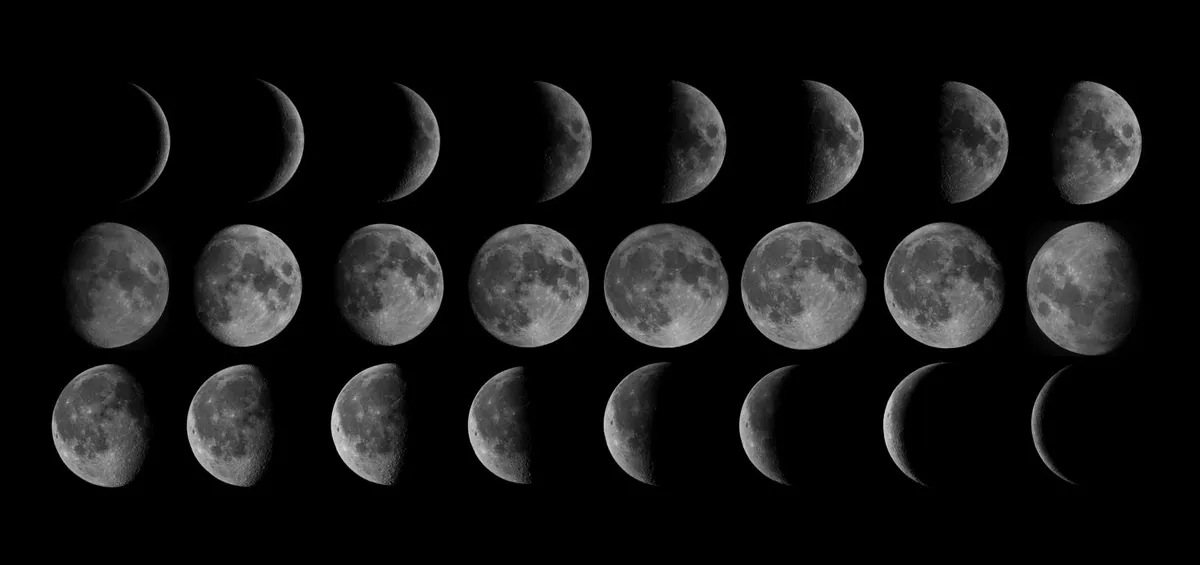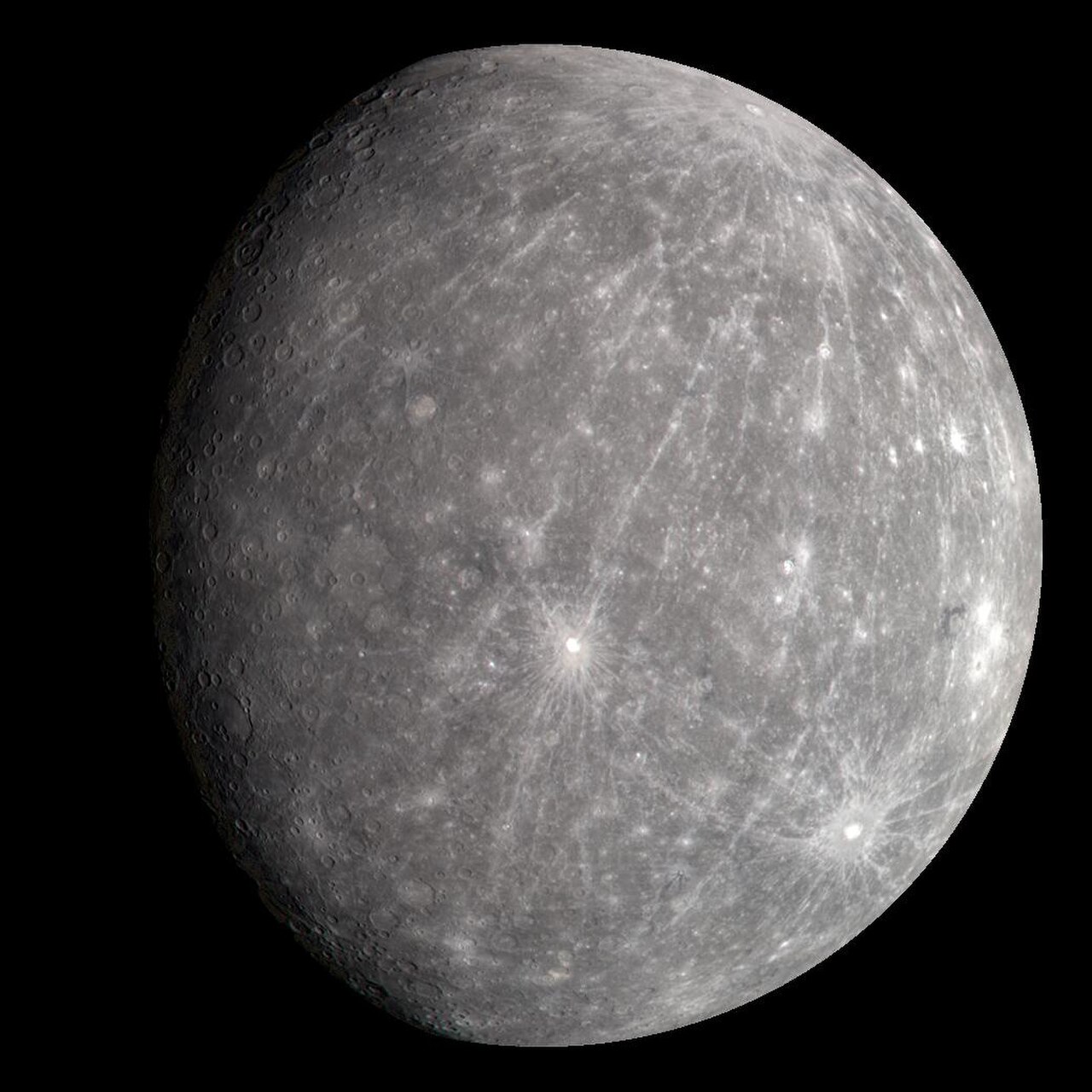
Mercury may be the smallest planet in our Solar System, but it has one of the biggest mysteries that often surprises people. While Earth has the Moon, Mars has two small moons, Jupiter has nearly a hundred known moons, and even tiny dwarf planets can have satellites, Mercury has none. Not a single natural moon circles the planet closest to the Sun.
At first, this seems strange. After all, Mercury is a real planet with enough gravity to hold itself together as a nearly spherical world. Why couldn’t it hold onto a moon as well?
The answer lies in a fascinating combination of gravity, distance, and the overwhelming influence of the Sun. Understanding why Mercury has no moons takes us on a journey into the invisible forces that shape our Solar System.
Mercury at a Glance
Mercury is the closest planet to the Sun, orbiting at an average distance of about 58 million kilometers (36 million miles). It is also the smallest of the eight planets, measuring just 4,879 kilometers (3,032 miles) in diameter.
Although Mercury is only slightly larger than Earth’s Moon, it is much denser because it contains an enormous iron-rich core that makes up about 85% of its radius. This gives the planet a surprisingly strong surface gravity for its size.
Mercury races around the Sun every 88 Earth days, making it the fastest planet in the Solar System. It also experiences some of the most dramatic temperature swings known on any planet, with daytime temperatures reaching about 430°C (800°F) and nighttime temperatures dropping to around −180°C (−290°F).
Despite these extremes, the lack of moons has nothing to do with Mercury’s temperatures. The real explanation is hidden in gravity.
What Is a Moon?
A moon, also called a natural satellite, is a natural object that orbits a planet or another larger body.
Moons come in many sizes. Earth’s Moon is one of the largest relative to its planet. Mars has two tiny moons named Phobos and Deimos, which are only a few kilometers across. Jupiter’s largest moon, Ganymede, is even bigger than Mercury itself.
For a moon to exist, it must remain trapped by a planet’s gravity while also avoiding being pulled away by another, stronger gravitational force.
This balancing act is where Mercury runs into trouble.
Gravity Is a Constant Tug-of-War
Every object with mass exerts gravity.
Mercury pulls on nearby objects, but the Sun also pulls on those same objects.
Because Mercury orbits so close to the Sun, the Sun’s gravitational pull is incredibly strong. In fact, the Sun dominates the region around Mercury far more than it does around planets farther away.
Imagine trying to hold onto a balloon during a powerful windstorm.
The stronger the wind becomes, the harder it is to keep the balloon from being blown away.
For Mercury, the Sun acts like that powerful wind, constantly trying to pull away anything that attempts to orbit the planet.
The Importance of the Hill Sphere
Astronomers use a concept called the Hill sphere to determine whether a planet can keep a moon.
The Hill sphere is the region around a planet where its gravity is stronger than the tidal influence of the Sun and can dominate the motion of nearby objects.
Inside this region, moons can maintain stable orbits over long periods.
Outside it, the Sun’s gravity becomes stronger, and objects are more likely to escape the planet’s control.
Mercury has the smallest Hill sphere of any planet in the Solar System because it is so close to the Sun.
Its Hill sphere extends only about 220,000 kilometers (137,000 miles) from the planet’s center. That might sound enormous, but compared with the vast Hill spheres of the outer planets, it is surprisingly small.
This leaves very little room for a moon to orbit safely.
Stable Orbits Need Space
Even if Mercury somehow captured a moon, the moon could not simply orbit anywhere inside the Hill sphere.
The orbit would also need to remain stable over millions or billions of years.
The outer part of Mercury’s Hill sphere is strongly disturbed by the Sun’s gravity. Objects there would experience repeated gravitational tugs that could gradually change their orbits.
If the moon orbited too far away, the Sun would eventually pull it loose.
If it orbited too close, tidal interactions with Mercury could slowly alter its orbit over time.
The narrow range of stable orbits makes it extremely difficult for Mercury to permanently host a natural satellite.
Mercury Is Too Small to Easily Capture a Moon
Gravity alone is not enough to capture a passing object.
Imagine throwing a baseball toward Earth. Unless something slows it down, it simply flies past.
The same thing happens in space.
For an asteroid or another object to become a permanent moon, it usually must lose energy somehow.
This can happen through collisions, interactions with gas in the early Solar System, or complex gravitational encounters involving multiple objects.
Mercury’s relatively small mass means its gravitational pull is much weaker than that of giant planets like Jupiter or Saturn.
This makes capturing wandering objects much more difficult.
Even if Mercury briefly captured an asteroid, the Sun’s gravity would likely remove it before it became a permanent moon.
The Early Solar System Was a Chaotic Place
About 4.6 billion years ago, the Solar System was filled with countless rocky bodies, planetesimals, and dust.
Planets were still growing through collisions.
Many moons formed during this violent period.
Some formed alongside their planets from disks of material.
Others were created when massive impacts blasted debris into orbit.
Still others were captured from passing asteroids.
Mercury certainly experienced many impacts during its early history, as shown by the thousands of craters that still cover its surface.
Yet none of these events appear to have produced a moon that survived.
Any moon that may have formed would have faced the powerful gravitational influence of the nearby Sun.
Could Mercury Have Had a Moon Long Ago?
Scientists cannot completely rule out the possibility that Mercury once possessed a moon.
If a giant impact created a moon early in the planet’s history, the moon may not have remained there forever.
Over time, gravitational interactions with the Sun could have destabilized its orbit.
Eventually, the moon might have escaped into its own orbit around the Sun, collided with Mercury, or even been pulled into the Sun itself.
Although this idea is scientifically possible, there is currently no direct evidence that Mercury ever had a moon.
At present, it remains only a hypothesis.
Why Venus Also Has No Moons
Mercury is not alone.
Venus also has no natural moons.
Although Venus is much larger than Mercury, it also orbits relatively close to the Sun.
Its Hill sphere is larger than Mercury’s, but the Sun still exerts a strong gravitational influence.
Some scientists think Venus may once have had a moon that was later lost, while others suggest it never acquired one at all.
The fact that both of the Solar System’s innermost planets lack moons hints that living close to the Sun makes it much harder for planets to keep natural satellites.
Earth Was Luckier
Earth sits much farther from the Sun than Mercury.
This gives our planet a much larger Hill sphere, allowing it to maintain a stable orbit for the Moon.
Earth’s Moon is thought to have formed after a Mars-sized object struck the young Earth around 4.5 billion years ago.
The debris from that colossal impact eventually came together under gravity to form the Moon.
Because Earth is farther from the Sun, the Moon’s orbit has remained stable for billions of years.
Mercury likely never had such favorable conditions.
Mars Managed to Keep Two Tiny Moons
Mars is smaller than Earth but much farther from the Sun than Mercury.
Its greater distance gives it a larger region where its gravity dominates over the Sun’s.
Mars has two small moons, Phobos and Deimos.
Most scientists think these moons may have originated from material produced by a large impact or possibly from captured asteroids that later settled into stable orbits. Their exact origin is still an active area of research.
Whatever their origin, Mars has been able to keep them because the Sun’s gravitational influence is weaker there than it is at Mercury’s orbit.
The Giant Planets Tell a Different Story
The outer planets possess enormous Hill spheres.
Jupiter’s gravitational reach extends tens of millions of kilometers.
This gives the giant planets plenty of room to capture, form, and retain moons.
Jupiter alone has nearly 100 confirmed moons, while Saturn has even more confirmed moons. Uranus and Neptune also have rich families of natural satellites.
Many of these moons have remained in orbit for billions of years because they lie far enough from the Sun that the planets’ own gravity dominates their surroundings.
Could Mercury Ever Capture a Moon in the Future?
The chances are extremely small.
Any object approaching Mercury would need exactly the right speed and direction to become gravitationally bound.
Even then, the Sun’s gravity would make the orbit difficult to maintain.
Modern computer simulations suggest that long-term stable moons around Mercury are highly unlikely.
Temporary captures may occur under rare circumstances, but they would probably last only a relatively short time in astronomical terms before the object escaped or collided with the planet.
Does Having No Moon Affect Mercury?
Mercury’s lack of a moon influences some aspects of its evolution, but it does not prevent the planet from existing or orbiting normally.
Earth’s Moon helps stabilize our planet’s axial tilt, contributing to long-term climate stability.
Mercury, however, has almost no axial tilt—less than 0.1 degree—primarily because of the way its rotation and orbit have evolved under the Sun’s gravitational influence. As a result, it does not need a large moon to maintain a relatively stable tilt.
Mercury also experiences powerful tides caused directly by the Sun.
Since the Sun is so close, its gravitational pull has gradually slowed Mercury’s rotation into a unique 3:2 spin-orbit resonance. This means Mercury rotates three times on its axis for every two trips around the Sun.
Its unusual day-night cycle is therefore shaped mainly by the Sun rather than by any moon.
Could Artificial Satellites Orbit Mercury?
Yes.
Although Mercury has no natural moons, spacecraft can orbit the planet.
NASA’s MESSENGER mission successfully orbited Mercury from 2011 to 2015, providing the first detailed global maps of the planet.
More recently, the joint European Space Agency and Japan Aerospace Exploration Agency mission BepiColombo is traveling to Mercury and is expected to enter orbit in the coming years to study the planet in unprecedented detail.
These spacecraft remain in orbit because engineers carefully calculate their trajectories and make adjustments when needed.
Unlike natural moons, they are actively designed to survive Mercury’s challenging gravitational environment.
What Mercury Teaches Us About Gravity
Mercury may seem lonely without a moon, but its empty skies reveal one of the most beautiful lessons in planetary science.
Gravity is not simply about how massive a planet is.
Location matters just as much.
Mercury’s proximity to the Sun means it lives deep inside the Sun’s immense gravitational influence. Although Mercury is strong enough to hold itself together and maintain a thin exosphere, it cannot easily provide a large, stable region where a natural moon can survive for billions of years.
In many ways, Mercury reminds us that every world in the Solar System is shaped not only by its own gravity but also by its place within the Sun’s vast gravitational kingdom.
Conclusion
Mercury has no moons because it orbits extremely close to the Sun, where the Sun’s powerful gravity leaves only a small region in which Mercury can control nearby objects. Its limited Hill sphere, relatively low mass, and the difficulty of capturing or retaining satellites make long-term natural moons highly unlikely.
While Earth enjoys the steady companionship of a large Moon and the giant planets host sprawling families of satellites, Mercury travels alone around the Sun. Yet this apparent emptiness tells a remarkable scientific story. It reveals how the delicate balance between gravity, distance, and orbital stability determines whether a planet can keep a moon at all. In Mercury’s case, the Sun’s overwhelming influence wins that cosmic tug-of-war, leaving the Solar System’s innermost planet to journey through space without a single natural companion.