On a clear, dark night, the sky appears filled with countless stars stretching in every direction. It is easy to imagine that our Solar System sits at the center of this magnificent cosmic display. For thousands of years, many civilizations believed exactly that. Today, however, astronomy has revealed a far more extraordinary reality. The Solar System is not the center of the universe, nor is it even the center of our galaxy. Instead, it occupies a quiet neighborhood within one of the hundreds of billions of galaxies scattered across the observable universe.
Our home in space is both humbling and fascinating. The Solar System is part of an immense cosmic structure that extends from planets to stars, from galaxies to galaxy clusters, and ultimately to the vast web of the universe itself. Understanding where the Solar System is located helps us appreciate not only our place in the cosmos but also the incredible scale of the universe.
The Solar System Is Centered on the Sun
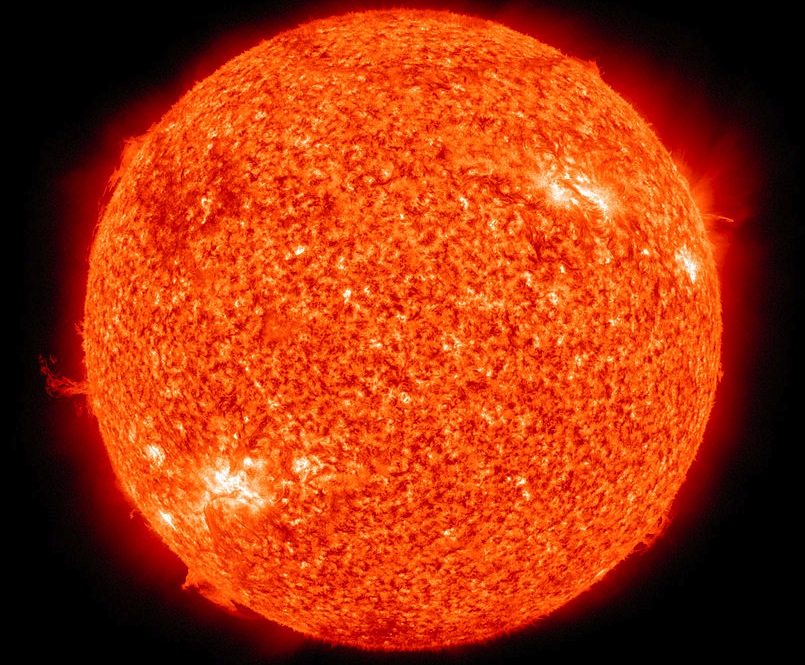
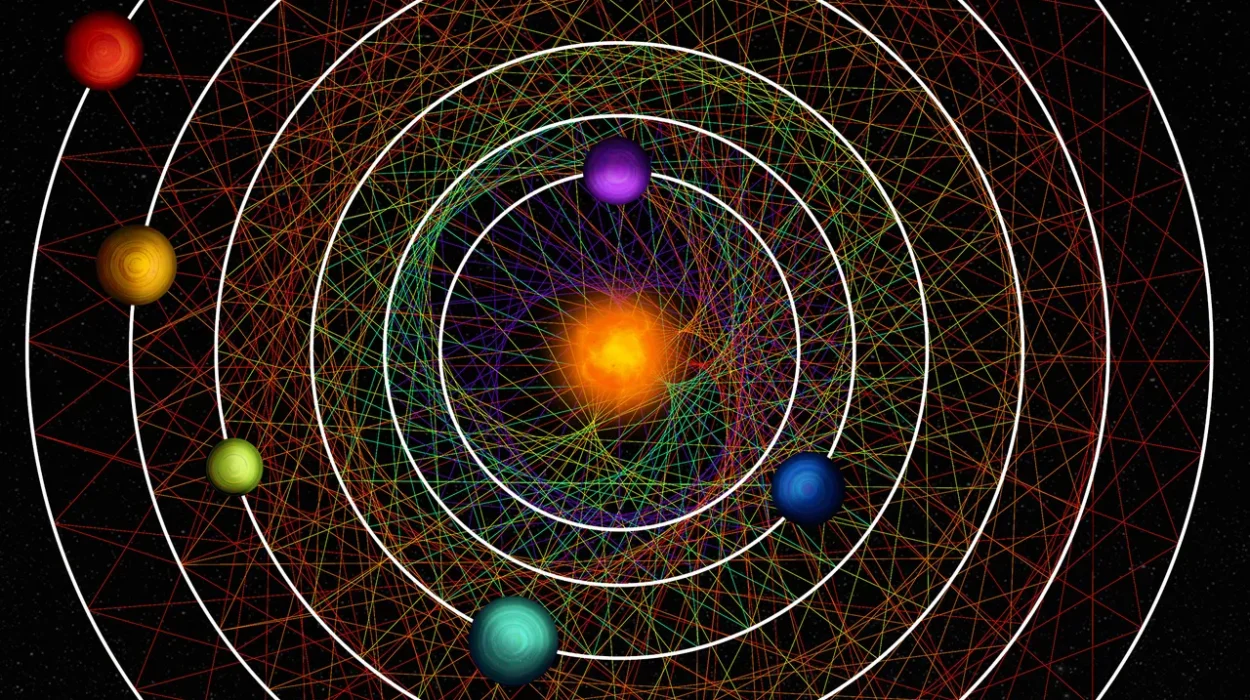
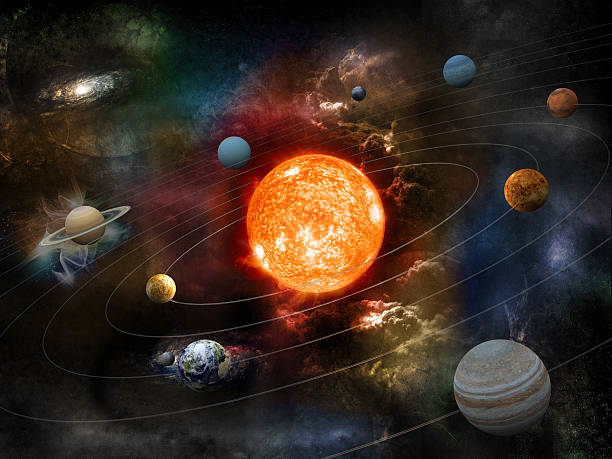
The Solar System is a gravitationally bound system centered on the Sun, a medium-sized star that contains about 99.8% of the Solar System’s total mass. Everything else in the Solar System—including the eight planets, dwarf planets, moons, asteroids, comets, and countless smaller objects—orbits the Sun because of its powerful gravitational pull.
Earth is the third planet from the Sun, orbiting at an average distance of about 150 million kilometers (93 million miles). The other planets follow their own paths around the Sun, each taking different amounts of time to complete an orbit. While the Solar System may seem enormous from our perspective, it is only a tiny part of a much larger cosmic structure.
The Solar System Is Inside the Milky Way Galaxy
The Solar System is located within the Milky Way, the spiral galaxy that is home to hundreds of billions of stars. The Milky Way is a vast disk-shaped galaxy with graceful spiral arms extending outward from a bright central region.
If you have ever seen a faint, milky band stretching across the night sky far from city lights, you have seen part of our galaxy from the inside. That glowing band is made up of the combined light of countless distant stars that cannot be distinguished individually with the naked eye.
Unlike photographs of other galaxies taken by powerful telescopes, we cannot capture a direct image of the Milky Way from the outside because we are inside it. Instead, astronomers have mapped its structure using observations of stars, gas clouds, radio waves, infrared light, and the motions of celestial objects.
We Live in the Orion Arm
The Solar System is not located near the center of the Milky Way. Instead, it lies within a smaller spiral feature known as the Orion Arm, or the Orion Spur.
This region is situated between two of the Milky Way’s larger spiral arms: the Sagittarius Arm and the Perseus Arm. The Orion Arm contains many stars, nebulae, and stellar nurseries where new stars continue to form.
Our neighborhood in the Orion Arm is relatively calm compared to some more crowded regions of the galaxy. This quieter location has likely helped create a stable environment for the Solar System over billions of years.
Nearby stars such as Alpha Centauri, Sirius, Vega, and Betelgeuse are all part of the Milky Way, although they are located at vastly different distances from Earth.
How Far Are We from the Galactic Center?
The center of the Milky Way lies approximately 26,000 light-years from the Solar System.
A light-year is the distance that light travels in one year—about 9.46 trillion kilometers (5.88 trillion miles). Since light moves at nearly 300,000 kilometers per second, even light takes about 26,000 years to travel from the galactic center to our Solar System.
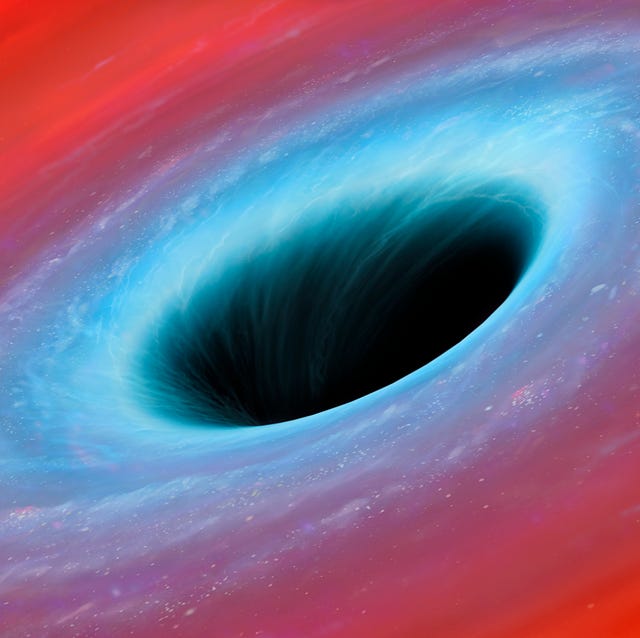
At the center of the Milky Way resides Sagittarius A*, a supermassive black hole containing about four million times the mass of the Sun. Although this black hole sounds intimidating, it is so far away that it has no direct influence on our daily lives.
The immense distance places the Solar System safely within one of the galaxy’s outer regions.
How Far Are We from the Edge of the Milky Way?
The Milky Way spans roughly 100,000 to 120,000 light-years across, although its outer regions extend even farther in a diffuse halo of stars and dark matter.
The Solar System lies about halfway between the galactic center and the galaxy’s visible outer edge.
This means we are neither near the crowded central bulge nor close to the galaxy’s outermost boundary. Our position is something like living in the suburbs of an enormous cosmic city.
The Solar System Is Constantly Moving
It may seem as though the Solar System sits quietly in space, but in reality, it is constantly moving in several different ways.
Earth rotates on its axis once every 24 hours.
Earth also travels around the Sun once every year.
Meanwhile, the entire Solar System orbits the center of the Milky Way.
Our orbital speed around the galaxy is astonishing—about 220 kilometers per second (roughly 790,000 kilometers per hour or 490,000 miles per hour).
Despite this incredible speed, we do not feel the motion because everything around us moves together.
A Galactic Year
Just as Earth has a year based on its orbit around the Sun, the Solar System has a much longer “galactic year.”
A galactic year is the time required for the Solar System to complete one orbit around the center of the Milky Way.
This journey takes approximately 225 to 250 million Earth years.
That means the last time the Solar System occupied its current position in the galaxy, dinosaurs had only recently begun to appear on Earth.
Since Earth formed about 4.54 billion years ago, the Solar System has completed only around 20 to 25 orbits around the Milky Way.
Our Cosmic Neighborhood
The Sun is not isolated.
It belongs to a region filled with neighboring stars known as the local stellar neighborhood.
The closest star system is Alpha Centauri, located about 4.37 light-years away.
Many nearby stars are grouped within a region called the Local Bubble, a cavity of relatively low-density gas thought to have been created by ancient supernova explosions millions of years ago.
The Solar System is also traveling through a small cloud of interstellar gas known as the Local Interstellar Cloud.
These nearby cosmic structures are part of the ever-changing environment through which the Solar System moves.
The Solar System Within the Local Arm
The Orion Arm itself is only one small segment of the Milky Way.
It contains many famous astronomical objects, including the Orion Nebula, one of the nearest and most active stellar nurseries visible from Earth.
This region has produced countless generations of stars over millions of years.
The Sun is simply one ordinary star among hundreds of billions within this enormous galaxy.
Yet around this ordinary star, at least one planet developed oceans, an atmosphere, life, and eventually intelligent observers capable of asking where they are in the universe.
The Milky Way Belongs to the Local Group
Our galaxy does not drift through space alone.
The Milky Way belongs to a collection of more than 100 galaxies known as the Local Group.
The two largest members are the Milky Way and the Andromeda Galaxy, with the Triangulum Galaxy being another significant member.
Most of the remaining galaxies are much smaller dwarf galaxies that orbit the larger ones.
The Local Group stretches across roughly 10 million light-years of space.
Gravity binds these galaxies together, causing them to move through space as a family.
The Local Group Is Part of a Larger Structure
The Local Group itself belongs to an even larger collection of galaxies called the Virgo Supercluster, which in turn forms part of an immense structure known as the Laniakea Supercluster.
Laniakea contains approximately 100,000 galaxies spread across more than 500 million light-years.
These enormous cosmic structures reveal that galaxies are not randomly scattered but are organized into vast interconnected networks shaped by gravity.
The Cosmic Web
On the largest observable scales, galaxies gather into clusters, superclusters, and enormous filaments separated by gigantic voids.
Together, these structures create what astronomers call the cosmic web.
This web-like pattern extends across billions of light-years and represents the largest known structure in the universe.
The Solar System ultimately occupies an incredibly tiny location within this vast cosmic network.
It is almost impossible to grasp the scale. If the Solar System were reduced to the size of a grain of sand, the observable universe would still be unimaginably enormous.
Why Our Location Matters
The Solar System’s location appears to be especially favorable for life.
The crowded central regions of the Milky Way contain many massive stars that explode as supernovae, intense radiation fields, and stronger gravitational disturbances.
The outermost regions of galaxies may contain fewer heavy elements needed to build rocky planets like Earth.
Our position within the Orion Arm places the Solar System in what astronomers sometimes refer to as the Galactic Habitable Zone—a region where conditions may be more suitable for long-term planetary stability and the development of complex life.
While scientists continue studying this idea, our location certainly seems to have provided a relatively stable environment over billions of years.
How Astronomers Determined Our Location
Because we cannot leave the Milky Way to photograph it from the outside, determining the Solar System’s location required generations of careful observations.
Astronomers measured distances to nearby stars using stellar parallax, tracked the motions of stars throughout the galaxy, observed radio emissions from hydrogen gas, mapped spiral arms using star-forming regions, and studied infrared light capable of penetrating the dust that obscures visible light.
Modern space missions such as the European Space Agency’s Gaia spacecraft have measured the positions and motions of more than a billion stars with extraordinary precision.
These observations continue refining our understanding of the Solar System’s exact location and movement within the Milky Way.
Is the Solar System Moving Toward Another Galaxy?
Yes. The Milky Way and the Andromeda Galaxy are gradually moving toward one another.
They are currently separated by about 2.5 million light-years, but gravity is slowly pulling them together.
Astronomers predict that they will begin merging in roughly 4 to 5 billion years.
By that time, the Sun will be nearing the end of its life as a main-sequence star.
Although the galaxies will collide, the enormous distances between individual stars mean that direct stellar collisions will be extremely unlikely. Instead, the galaxies will slowly merge through gravitational interactions over billions of years.
Our Address in the Universe
If the Solar System had a complete cosmic address, it would look something like this:
Earth is a planet orbiting the Sun.
The Sun is a star in the Orion Arm of the Milky Way Galaxy.
The Milky Way belongs to the Local Group of galaxies.
The Local Group is part of the Virgo Supercluster.
The Virgo Supercluster lies within the larger Laniakea Supercluster.
Laniakea forms part of the immense cosmic web that fills the observable universe.
This “address” reminds us that our home extends far beyond Earth itself.
A Tiny Home in an Enormous Universe
The Solar System occupies an almost unimaginably small corner of an unimaginably vast universe. It is located about 26,000 light-years from the center of the Milky Way, within the Orion Arm, orbiting the galaxy at tremendous speed while traveling alongside hundreds of billions of other stars.
Yet this seemingly ordinary location has become extraordinary because it is home to Earth—the only place in the universe where life is known to exist. From this small blue planet, humanity has learned to measure the distances between galaxies, detect black holes, observe planets around distant stars, and reconstruct the structure of the cosmos itself.
Every night sky reminds us that although our Solar System is only one tiny part of an immense universe, it is also the place from which we have begun to understand that universe. Our cosmic address may be modest, but it is the starting point of one of humanity’s greatest journeys: the quest to discover our place among the stars.