The internet has become an essential part of modern life. Whether you are streaming a movie, attending a video meeting, playing an online game, backing up photos to the cloud, or simply browsing your favorite websites, you expect everything to happen almost instantly. Yet not all internet connections deliver the same experience. Some struggle to load a webpage during busy hours, while others can download enormous files in just seconds.
One technology stands above the rest when it comes to speed and reliability: fiber internet.
But why is fiber internet so much faster than traditional broadband connections? The answer lies in physics, engineering, and the remarkable way information travels through strands of incredibly pure glass. Instead of sending electrical signals through metal wires, fiber-optic internet transmits data as pulses of light traveling at astonishing speeds. This simple difference changes everything.
Understanding why fiber internet is faster reveals not only how today’s internet works but also why fiber has become the foundation of the world’s digital future.
What Is Fiber Internet?
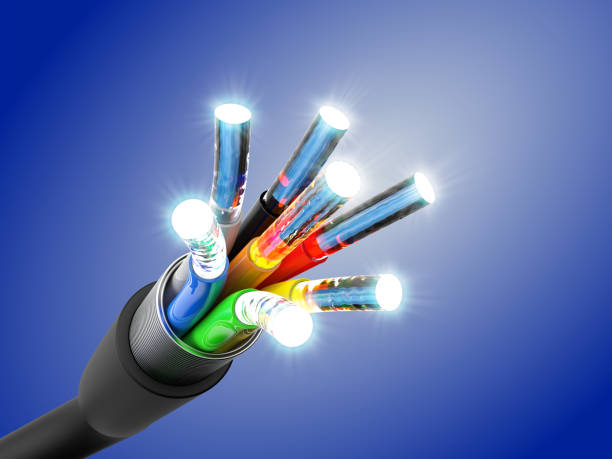
Fiber internet, also known as fiber-optic internet, is a type of broadband connection that uses optical fibers to carry information.
An optical fiber is an extremely thin strand of glass or specialized plastic. Although each fiber is often thinner than a human hair, it can carry an enormous amount of data across long distances.
Unlike older internet technologies that depend on electricity flowing through copper cables, fiber sends digital information as tiny flashes of laser light or light emitted by light-emitting diodes (LEDs).
These flashes travel through the fiber at incredibly high speeds while carrying everything from emails and videos to online games and cloud data.
Because light behaves differently from electricity, fiber internet offers significant advantages in speed, capacity, reliability, and efficiency.
How the Internet Carries Information
Every photo you upload, every video you watch, and every message you send is converted into digital data.
Computers represent this information using binary digits, or bits, consisting of zeros and ones.
These bits must travel from one device to another.
Traditional internet connections transmit these bits as electrical signals through copper wires.
Fiber internet instead converts them into pulses of light.
Each pulse represents digital information, racing through optical fibers until it reaches its destination.
Once the light arrives, specialized equipment converts it back into electrical signals that your computer, smartphone, television, or gaming console can understand.
Although this process happens millions or even billions of times every second, it occurs so quickly that users notice virtually no delay.
The Amazing Speed of Light
One of the biggest reasons fiber internet is so fast is the remarkable speed of light.
Light travels at nearly 300,000 kilometers (186,000 miles) per second in a vacuum. Inside optical fibers, it travels somewhat more slowly because light moves differently through glass than through empty space. Even so, the speed remains incredibly high—roughly two-thirds the speed of light in a vacuum.
This allows information to travel across cities, countries, and even continents in fractions of a second.
Although network equipment, routing decisions, and processing introduce some delay, the speed of light itself enables fiber networks to transmit information far faster than traditional electrical communication systems.
Light Travels Differently Than Electricity
Copper cables rely on moving electrical signals.
As electricity travels through metal, it encounters electrical resistance.
Resistance causes energy loss, heat generation, and signal weakening.
Over long distances, electrical signals gradually degrade.
To keep the signal strong, network providers must install amplifiers or repeaters that regenerate the signal.
Fiber optics work very differently.
Instead of electricity, they guide light through transparent glass.
Because light experiences extremely little energy loss inside high-quality optical fibers, it can travel much farther before needing amplification.
This means stronger signals, fewer interruptions, and much higher performance.
The Science of Total Internal Reflection
One of the greatest engineering achievements behind fiber internet is the use of a physical phenomenon called total internal reflection.
At first glance, it might seem impossible for light to travel through a thin, flexible glass strand without escaping.
The secret lies in the structure of the fiber.
An optical fiber contains two main layers.
The inner core carries the light.
Around it is another layer called the cladding.
The cladding has a slightly lower refractive index than the core.
Whenever light strikes the boundary between these two layers at the proper angle, it reflects completely back into the core instead of escaping.
The light effectively bounces down the fiber thousands or even millions of times every second while remaining trapped inside.
This allows light to travel around gentle curves with very little signal loss.
The result is an efficient pathway capable of carrying enormous amounts of information over great distances.
Fiber Carries Much More Data
Speed is not determined only by how fast signals move.
Equally important is how much information can travel simultaneously.
Imagine two highways.
One has only two lanes.
The other has hundreds of lanes.
Even if vehicles move at the same speed, the wider highway transports far more traffic.
Fiber internet works similarly.
Optical fibers have enormous bandwidth.
Bandwidth refers to the maximum amount of information that can pass through a communication channel during a given time.
Because light has very high frequencies, optical fibers can support vastly greater bandwidth than copper cables.
This allows fiber networks to carry enormous quantities of digital information simultaneously.
Millions of users can share a fiber network while still enjoying high-speed internet connections.
Multiple Colors of Light Increase Capacity
One fascinating advantage of fiber optics is that several different wavelengths—or colors—of light can travel through the same optical fiber simultaneously.
Each wavelength carries its own independent stream of data.
Special devices combine these different light signals before transmission and separate them again at the receiving end.
This technology dramatically increases network capacity without requiring additional cables.
Engineers continuously improve these systems, allowing a single fiber to carry astonishing amounts of information.
Modern long-distance fiber systems can transmit multiple terabits of data every second using this approach.
Fiber Has Lower Latency
Internet speed is often measured in megabits or gigabits per second, but another factor is equally important: latency.
Latency is the time required for information to travel from one point to another.
Lower latency makes online activities feel more responsive.
When you click a webpage, join a video call, or play an online game, low latency helps everything happen almost instantly.
Fiber networks generally produce lower latency than older technologies.
Several factors contribute to this.
Signals move efficiently through optical fibers.
Signal degradation is minimal.
There are fewer amplifiers along the route.
Modern fiber infrastructure is also designed for high-performance communication.
The result is faster response times that users can easily notice.
Fiber Is Less Affected by Electrical Interference
Copper cables can pick up unwanted electrical noise from nearby power lines, motors, lightning, radio transmitters, and electronic devices.
This interference can weaken signals or create communication errors.
Fiber optics avoid this problem because they use light rather than electricity.
Glass fibers do not conduct electricity.
Electromagnetic interference has almost no effect on the light traveling inside them.
This makes fiber internet exceptionally stable and reliable, especially in environments containing significant electrical equipment.
Weather Has Less Impact
Heavy rain, electrical storms, and changing environmental conditions can affect some communication technologies.
Fiber cables themselves are largely immune to lightning-induced electrical surges because they contain no conductive metal for carrying internet signals.
While severe physical damage—such as construction accidents or natural disasters—can still interrupt service, fiber connections generally experience fewer problems caused by electrical weather conditions than copper-based systems.
This contributes to more consistent internet performance.
Fiber Maintains Speed Over Long Distances
As electrical signals travel through copper cables, they become weaker.
The farther they travel, the greater the signal loss.
This limits both speed and distance.
Fiber experiences much lower attenuation, which means the light signal weakens very slowly.
As a result, information can travel tens or even hundreds of kilometers before significant amplification becomes necessary.
For internet providers, this makes fiber highly efficient for connecting neighborhoods, cities, countries, and even continents.
For users, it means more consistent speeds regardless of distance from major network infrastructure.
Symmetrical Upload and Download Speeds
Many traditional broadband services provide fast download speeds but much slower uploads.
This happens because older network technologies were originally designed mainly for television broadcasting and downloading content.
Today’s internet works differently.
People constantly upload videos, join video conferences, store files in cloud services, and share high-resolution photos.
Fiber internet often provides symmetrical speeds.
This means upload speeds can be just as fast as download speeds.
For remote workers, students, businesses, livestreamers, photographers, software developers, and content creators, this makes a dramatic difference.
Uploading large files may take seconds instead of minutes or even hours.
Fiber Supports the Modern Digital World
The internet of today demands far more capacity than the internet of twenty years ago.
Households may have multiple smartphones, laptops, tablets, smart TVs, gaming consoles, security cameras, voice assistants, and connected appliances operating simultaneously.
Each device requires internet bandwidth.
Fiber provides enough capacity to support dozens of active devices without significant performance loss.
Even when multiple family members stream videos, attend virtual meetings, download files, and play online games at the same time, fiber networks can continue delivering smooth performance.
Better Streaming Quality
Modern streaming platforms deliver movies and television shows in Full HD, 4K, and increasingly 8K resolution.
These extremely detailed videos require large amounts of data.
Slow internet connections may pause to buffer or automatically reduce video quality.
Fiber’s high bandwidth allows these large video streams to flow continuously.
The result is smoother playback, sharper images, and fewer interruptions.
Even multiple simultaneous streams can often run without difficulty.
A Better Experience for Online Gaming
Online games constantly exchange information between players and game servers.
Even tiny communication delays can affect gameplay.
Because fiber offers both high speeds and low latency, it creates an excellent environment for competitive gaming.
Players experience quicker responses, smoother multiplayer interactions, and fewer lag spikes.
Although game server quality and home network equipment also influence performance, fiber provides one of the strongest foundations for fast online gaming.
Faster Cloud Computing
Cloud services have become central to both personal and professional computing.
People store photos online, synchronize documents across devices, edit files collaboratively, and run software through cloud platforms.
Businesses increasingly depend on cloud infrastructure for daily operations.
Fiber internet allows these services to work efficiently because data moves rapidly in both directions.
Large backups complete faster, cloud applications respond more quickly, and collaboration becomes smoother.
Fiber Is Built for the Future
Internet demand continues growing every year.
Artificial intelligence, virtual reality, augmented reality, autonomous vehicles, smart cities, remote healthcare, and advanced scientific research all require massive amounts of data.
Fiber infrastructure has tremendous room for future growth.
In many cases, existing fiber cables can support faster internet simply by upgrading the equipment connected to each end.
The glass fibers themselves often remain capable of carrying much more information than current consumer services require.
This future-proof design makes fiber one of the most valuable long-term investments in communication infrastructure.
Is Fiber Internet Always the Fastest?
Fiber is generally the fastest broadband technology available to homes and businesses today.
However, the experience users receive also depends on other factors.
The quality of their home Wi-Fi network can influence speeds.
Older routers may become bottlenecks.
Busy websites or overloaded servers can limit download performance.
Device hardware also matters.
Even if a fiber connection delivers gigabit speeds, an older laptop or smartphone may not fully utilize that bandwidth.
Nevertheless, fiber provides the strongest possible foundation, allowing these other components to perform at their best.
How Fiber Connects the World
Fiber-optic cables stretch beneath oceans, across continents, through cities, and into neighborhoods.
Thousands of kilometers of submarine fiber cables connect countries and carry the overwhelming majority of international internet traffic.
Every day, trillions of digital messages travel through these nearly invisible strands of glass.
Without fiber-optic communication, the modern global internet would not exist in its current form.
International video calls, cloud computing, online banking, scientific collaboration, streaming entertainment, and instant communication all depend on these remarkable networks.
The Future of Internet Speed
Researchers continue improving fiber technology.
Engineers are developing more efficient lasers, advanced optical amplifiers, better signal processing techniques, and increasingly sophisticated methods of transmitting multiple data streams simultaneously.
Scientists are also exploring new optical materials and communication technologies that may further expand the capacity of fiber networks.
Although wireless technologies such as 5G and future 6G networks continue advancing, these systems still rely heavily on fiber infrastructure behind the scenes.
Fiber serves as the high-speed backbone connecting cellular towers, data centers, and internet exchange points around the world.
The Remarkable Science Inside Every Connection
Fiber internet is faster because it takes advantage of one of nature’s most extraordinary phenomena: light. By sending information as pulses of light through incredibly pure glass fibers, it avoids many of the limitations that slow traditional copper cables. Light experiences minimal signal loss, resists electrical interference, supports enormous bandwidth, and can carry vast amounts of information across great distances with exceptional efficiency.
The result is an internet connection that is not only faster but also more reliable, more responsive, and better prepared for the growing demands of the digital age. Every movie streamed without buffering, every crystal-clear video call, every lightning-fast download, and every seamless online experience reflects decades of scientific discovery in optics, physics, and engineering.
As the world becomes increasingly connected, fiber-optic technology will continue to form the invisible foundation of our digital lives, carrying countless beams of light that quietly power communication across the globe.