The internet has become as essential to modern life as electricity and running water. We rely on it to work from home, attend online classes, stream movies, play games, make video calls, and connect with people around the world. But not all internet connections are built the same. Two of the most common types of broadband connections are Fiber Internet and DSL Internet.
At first glance, both services allow you to browse websites, watch videos, and download files. However, the technology behind them is very different, and those differences have a significant impact on speed, reliability, latency, and overall user experience.
Understanding how Fiber and DSL work can help you choose the internet connection that best fits your needs, whether you are a casual web user or someone who depends on fast, reliable internet every day.
What Is Fiber Internet?
Fiber Internet, also known as fiber-optic internet, is a broadband technology that transmits data using pulses of light through extremely thin strands of glass or plastic called optical fibers.
Instead of sending electrical signals, fiber converts digital information into light. These light signals travel through optical fibers at incredibly high speeds while experiencing very little signal loss.
Because light can carry enormous amounts of data over long distances with minimal interference, fiber internet is currently one of the fastest and most reliable internet technologies available for homes and businesses.
Modern fiber networks commonly offer download and upload speeds ranging from hundreds of megabits per second (Mbps) to multiple gigabits per second (Gbps).
What Is DSL Internet?
DSL stands for Digital Subscriber Line. It is an internet technology that uses existing copper telephone lines to transmit digital data.
Unlike older dial-up internet, DSL allows telephone service and internet service to operate simultaneously because they use different frequency ranges on the same copper wire.
DSL became popular because it allowed internet providers to deliver broadband service without installing entirely new cables. Since many homes already had telephone lines, DSL was relatively inexpensive to deploy.
Although DSL represented a major improvement over dial-up connections, it has limitations because copper cables were originally designed for voice communication rather than high-speed internet.
The History of Fiber and DSL
DSL technology began gaining popularity in the late 1990s as broadband internet replaced slow dial-up connections. At the time, DSL allowed households to browse websites much faster while keeping their telephone line available for voice calls.
Fiber-optic communication, however, has a longer scientific history. Researchers began developing optical fiber communication systems during the second half of the twentieth century. As fiber technology improved and installation costs gradually decreased, internet providers started replacing older copper infrastructure with fiber-optic networks.
Today, many countries are expanding fiber networks because they provide significantly greater capacity for the growing demand created by streaming, cloud computing, remote work, and connected devices.
How Fiber Internet Works
Fiber internet begins at the internet service provider’s network, where digital information is converted into tiny pulses of laser or LED light.
These light pulses travel through optical fiber cables.
Inside each fiber is a transparent core that guides light using a physical principle known as total internal reflection. Rather than escaping from the cable, the light continuously reflects within the core, allowing it to travel long distances with minimal signal loss.
At the customer’s home, an optical network terminal converts the incoming light signals back into electrical signals that routers and computers can understand.
Because light travels extremely efficiently through fiber, large amounts of information can move almost instantly.
How DSL Internet Works
DSL internet relies on electrical signals rather than light.
Digital information travels through copper telephone wires between the customer’s home and the provider’s local telephone exchange.
DSL modems separate internet signals from voice signals using different frequencies, allowing both services to function simultaneously.
As electrical signals travel along copper wires, they gradually weaken over distance. This signal attenuation is one of the main reasons DSL speeds decrease the farther a home is located from the provider’s equipment.
Unlike fiber, copper wires are also more vulnerable to electrical interference from nearby cables, weather conditions, and other environmental factors.
The Biggest Difference Between Fiber and DSL
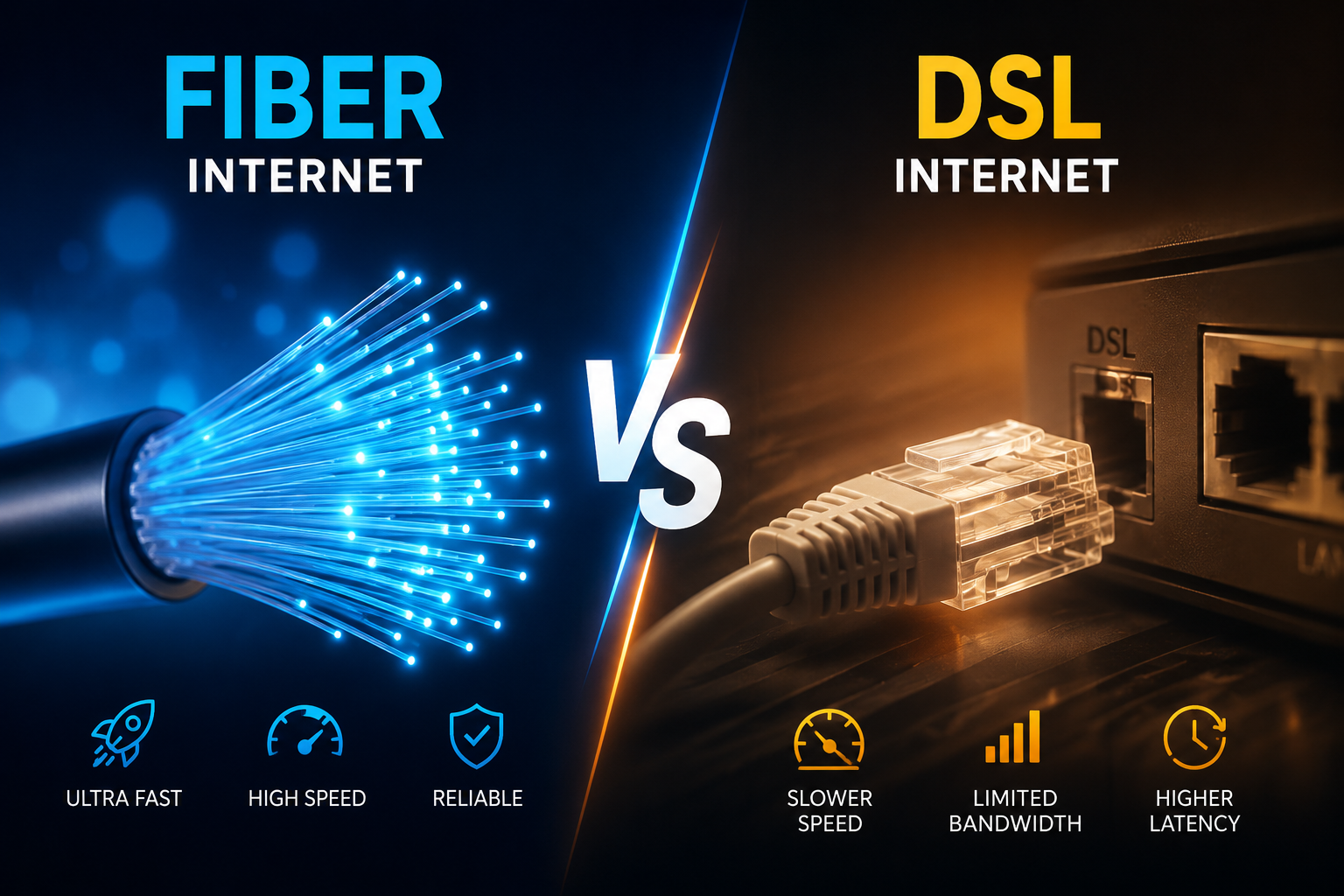
The most important difference lies in the transmission medium.
Fiber uses light traveling through glass or plastic fibers.
DSL uses electrical signals traveling through copper telephone wires.
This difference affects nearly every aspect of internet performance, including speed, latency, reliability, and future scalability.
Because light can carry vastly more information than electrical signals through copper, fiber offers much greater bandwidth.
Speed Comparison
Speed is often the first factor people consider when choosing an internet connection.
Fiber internet is significantly faster than DSL.
Many fiber providers offer speeds of 300 Mbps, 500 Mbps, 1 Gbps, 2 Gbps, or even higher.
Some advanced fiber networks can deliver speeds reaching 10 Gbps for residential customers.
DSL speeds vary considerably depending on the technology and distance from the provider’s equipment.
Typical DSL download speeds range from around 10 Mbps to 100 Mbps, although many customers receive lower speeds depending on line quality and location.
For everyday browsing and email, DSL may be sufficient.
For households with multiple users streaming high-definition video, downloading large files, or working remotely, fiber provides a much smoother experience.
Upload Speed Matters Too
Many people focus only on download speed, but upload speed has become increasingly important.
Uploading affects activities such as:
Video conferencing
Cloud backups
Sharing large files
Livestreaming
Online content creation
Fiber internet usually offers symmetrical speeds, meaning upload and download speeds are similar.
For example, a fiber plan may provide 500 Mbps download and 500 Mbps upload.
DSL connections usually have much slower upload speeds than download speeds.
A DSL plan offering 50 Mbps download might provide only 5 Mbps upload.
This difference becomes noticeable during video calls or when sending large files.
Latency and Responsiveness
Latency measures how long data takes to travel between your device and a destination on the internet.
Lower latency means a faster response.
Fiber generally provides much lower latency than DSL because light travels efficiently through optical fibers with minimal processing delays.
Lower latency improves experiences such as:
Online gaming
Video meetings
Virtual reality
Cloud applications
Remote desktop connections
DSL typically has higher latency because electrical signals encounter more interference and require additional processing.
Although the difference may only be measured in milliseconds, it can noticeably affect real-time applications.
Reliability
Reliability is another major advantage of fiber.
Fiber-optic cables are immune to electromagnetic interference because they transmit light instead of electricity.
Nearby power lines, electrical equipment, and thunderstorms have much less impact on fiber signals.
Copper telephone lines used by DSL are more susceptible to interference.
Moisture, corrosion, aging cables, and electrical noise can all reduce signal quality.
As a result, fiber connections generally remain more stable over time.
Distance Affects DSL More Than Fiber
One of DSL’s greatest limitations is distance.
The farther a home is from the telephone company’s equipment, the weaker the signal becomes.
Long distances often result in slower speeds and reduced reliability.
Fiber experiences much lower signal loss.
Although fiber signals also weaken over extremely long distances, they can travel much farther before requiring amplification.
This makes fiber especially suitable for modern high-speed networks.
Streaming Movies and TV Shows
Streaming services require consistent internet speeds.
Watching videos in 4K or even 8K resolution demands significant bandwidth.
Fiber handles multiple simultaneous streams with ease.
Several family members can watch different high-definition videos while others attend online meetings or play games.
DSL can support streaming as well, but performance depends on the available speed.
Multiple simultaneous streams may cause buffering if the connection is relatively slow.
Online Gaming
Gamers often prioritize low latency and connection stability.
Fiber excels in both areas.
Lower latency produces quicker response times between player actions and game servers.
Fiber’s stable performance also reduces lag spikes that can interrupt gameplay.
DSL is capable of online gaming, but higher latency and occasional fluctuations may affect competitive multiplayer games.
Working from Home
Remote work has become increasingly common.
Video conferencing, cloud collaboration, and virtual private networks require stable internet connections.
Fiber provides smooth video calls with high-quality audio and minimal interruptions.
Large files upload quickly, making collaboration more efficient.
DSL can support remote work for many users, but slower upload speeds may become noticeable during video meetings or cloud backups.
Supporting Smart Homes
Modern homes often contain dozens of internet-connected devices.
Smart TVs
Security cameras
Voice assistants
Thermostats
Doorbells
Smart appliances
Tablets
Phones
Laptops
Gaming consoles
Each device consumes internet bandwidth.
Fiber’s higher capacity allows many connected devices to operate simultaneously without significantly affecting performance.
DSL networks may become congested as more devices compete for limited bandwidth.
Installation Differences
Installing DSL is often simpler because it uses existing telephone wiring already present in many homes.
A technician may only need to activate service and install a DSL modem.
Fiber installation can be more involved.
If fiber infrastructure already exists in the neighborhood, technicians install a fiber line to the home and connect it to an optical network terminal.
In areas without fiber infrastructure, providers must first lay new fiber-optic cables, which requires considerable investment.
Availability
DSL remains widely available because telephone networks have existed for decades.
Many rural communities continue relying on DSL where newer technologies have not yet been deployed.
Fiber availability continues expanding rapidly but is still less common in some regions.
Urban and suburban areas often receive fiber first because installation costs can be spread across many customers.
As governments and telecommunications companies continue investing in broadband infrastructure, fiber coverage continues to grow.
Energy Efficiency
Fiber networks are generally more energy efficient than copper-based systems.
Optical signals experience lower transmission losses, reducing the amount of electrical power needed to maintain long-distance communication.
Modern fiber equipment is also designed for high efficiency while supporting enormous data capacities.
As internet traffic continues increasing worldwide, energy-efficient communication infrastructure becomes increasingly important.
Security Advantages
Fiber offers certain security benefits.
Intercepting optical signals without physically accessing the cable is considerably more difficult than tapping traditional copper lines.
Attempting to access a fiber cable often causes detectable signal disturbances.
While no internet connection is completely immune to cyber threats, the physical design of fiber networks provides additional protection against unauthorized interception.
Maintenance and Durability
Fiber-optic cables are resistant to corrosion because they are made primarily of glass or plastic.
Copper cables can gradually degrade due to oxidation, moisture, and environmental exposure.
Although fiber cables require careful handling during installation because glass fibers are delicate, once installed they often require less maintenance over their operational lifetime.
Future-Proof Technology
Internet demand continues growing every year.
Streaming quality improves.
Cloud computing expands.
Artificial intelligence relies on large amounts of data.
Virtual reality becomes more advanced.
Homes contain increasing numbers of connected devices.
Fiber networks possess enormous capacity for future expansion.
Many existing fiber cables can support much higher speeds simply by upgrading networking equipment rather than replacing the fiber itself.
DSL, however, is approaching the practical limits of what copper telephone lines can deliver.
This makes fiber a more future-ready technology.
Cost Considerations
DSL has traditionally been less expensive because it uses existing telephone infrastructure.
In areas where fiber installation remains costly, DSL may still offer an affordable broadband option.
Fiber prices have become increasingly competitive in many markets.
As deployment expands, the price difference between fiber and DSL continues to shrink.
Considering its much higher performance, many customers find fiber provides better long-term value where available.
Environmental Impact
Fiber infrastructure can contribute to more sustainable communication networks.
Because optical fibers transmit more information using less energy, they can reduce the environmental footprint of large-scale internet systems.
Fiber’s long lifespan also means cables often remain useful for decades with equipment upgrades occurring at network endpoints rather than requiring complete cable replacement.
Is DSL Still a Good Choice?
Despite fiber’s advantages, DSL continues serving millions of households.
For users who mainly browse websites, check email, read news, or watch occasional videos, DSL may provide sufficient performance.
It is especially valuable in locations where fiber has not yet been deployed.
Modern DSL technologies have improved considerably compared to early broadband services, although they cannot match fiber’s highest speeds and capacity.
Is Fiber Worth Upgrading To?
For many households, the answer is yes.
People who regularly stream high-resolution video, work from home, upload large files, participate in video conferences, play online games, or have many connected devices often notice an immediate improvement after switching to fiber.
The increased speed is only part of the benefit.
Lower latency, greater reliability, faster uploads, and room for future internet demands make fiber one of the most capable broadband technologies available today.
Which Internet Technology Is Better?
From a scientific and technological perspective, fiber internet is clearly the more advanced communication technology. By transmitting information as pulses of light through optical fibers, it delivers higher speeds, lower latency, greater reliability, and far more capacity than traditional copper-based DSL connections.
However, “better” also depends on availability, budget, and individual needs. DSL remains a practical solution in many areas where fiber infrastructure has not yet arrived, and for light internet use it can still provide a satisfactory online experience.
As global demand for faster, more reliable connectivity continues to grow, fiber-optic networks are becoming the foundation of the modern internet. They support everything from remote work and cloud computing to smart homes and future technologies that require ever-increasing amounts of data. While DSL played a vital role in bringing broadband to millions of homes, fiber represents the next stage in the evolution of internet communication, carrying information at the speed of light and preparing the digital world for the decades ahead.