Every time you make a phone call, listen to music through wireless earbuds, take a photo with your smartphone, drive a modern car, or visit a hospital for a medical scan, countless tiny electronic chips are quietly working behind the scenes. Although these chips often remain invisible, they perform the essential tasks that make modern technology possible.
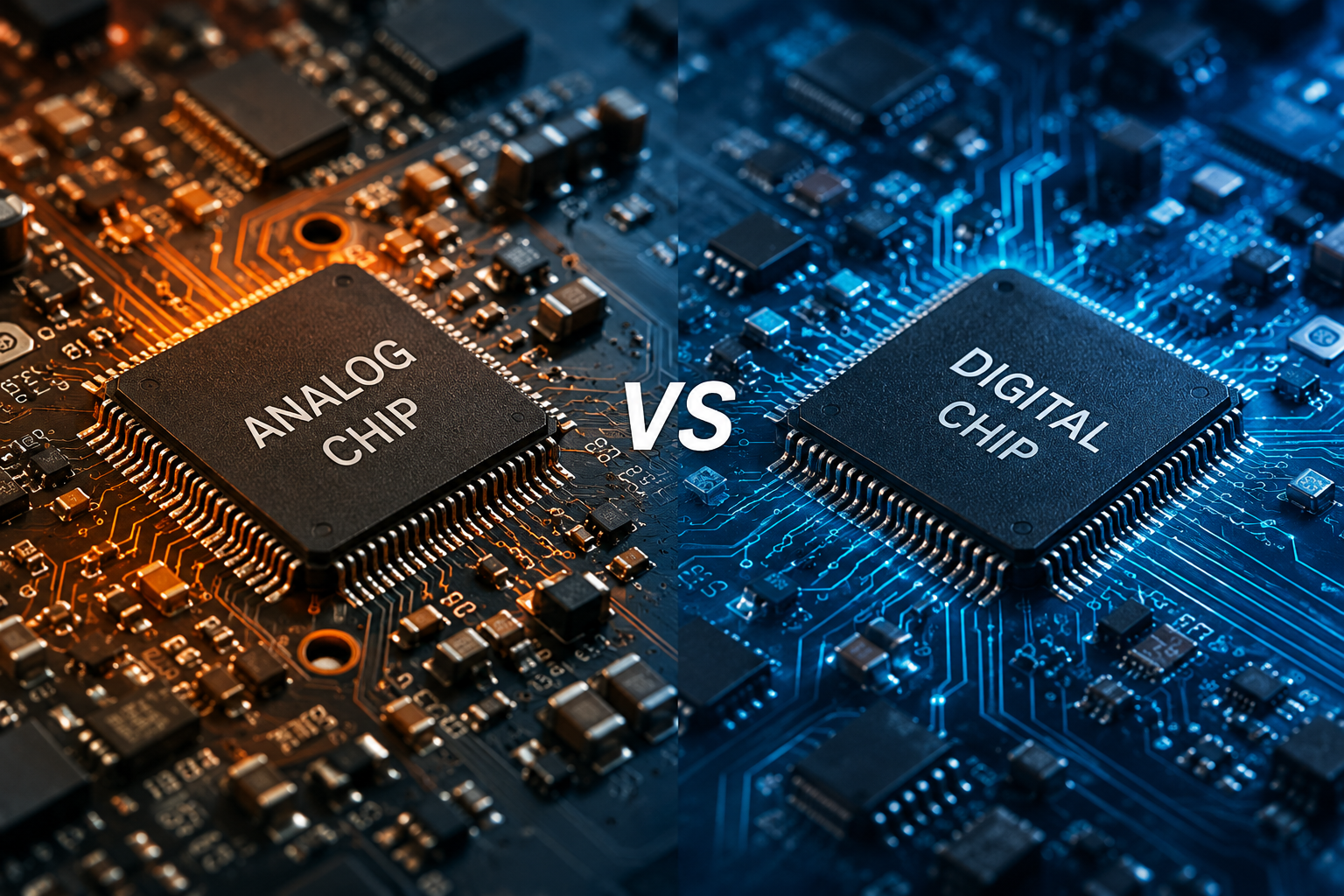
Not all chips, however, work in the same way. Inside nearly every electronic device are two fundamentally different types of integrated circuits: analog chips and digital chips. They often work side by side, yet they process information in completely different ways.
Digital chips are experts at handling numbers, calculations, logic, and software. Analog chips specialize in understanding the real world—capturing sounds, measuring temperatures, detecting light, regulating power, and processing continuously changing electrical signals.
Rather than competing with each other, analog and digital chips complement one another. Together, they bridge the gap between the physical world and the digital universe.
What Is a Chip?
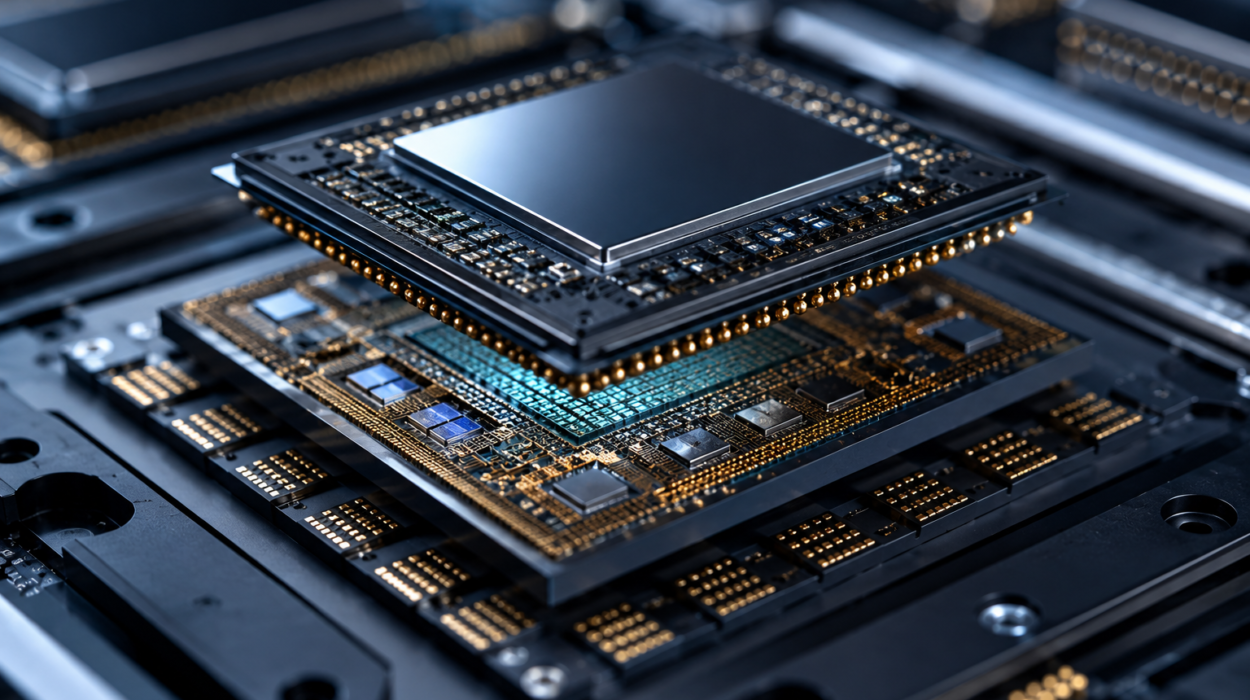
A chip, also called an integrated circuit (IC), is a tiny piece of semiconductor material—usually silicon—that contains thousands, millions, or even billions of microscopic electronic components.
These components include transistors, resistors, capacitors, and tiny electrical connections that work together to perform specific tasks.
Some chips calculate mathematical operations.
Others store memory.
Some control motors.
Others amplify radio signals.
Some regulate electrical power.
Modern electronic devices often contain dozens or even hundreds of specialized chips, each designed for a particular purpose.
Understanding Analog Signals
To understand analog chips, it helps to first understand analog signals.
The natural world is mostly analog.
Temperature changes gradually.
The brightness of sunlight varies continuously throughout the day.
A person’s voice rises and falls smoothly.
Music flows without sudden jumps.
The pressure of your finger on a touchscreen changes continuously.
These are all examples of continuously varying physical quantities.
When converted into electricity, these changes become analog signals, where voltage or current can take on almost any value within a range rather than only a few fixed values.
Analog signals closely resemble the physical phenomena they represent.
What Are Analog Chips?
Analog chips are electronic circuits specifically designed to process continuously changing electrical signals.
Instead of working only with zeros and ones, analog chips handle voltages that can smoothly increase or decrease.
Their job is to interact directly with the real world.
They receive information from sensors, microphones, antennas, cameras, batteries, medical instruments, and many other physical systems.
Because nearly everything outside a computer exists as analog information, analog chips serve as the first point of contact between electronics and reality.
How Analog Chips Work
Imagine speaking into a microphone.
Your voice creates sound waves.
The microphone converts these sound waves into tiny electrical voltages.
These voltages change continuously, matching the loudness and pitch of your voice.
An analog amplifier chip strengthens this weak signal without changing its shape.
Another analog circuit removes unwanted noise.
Additional analog circuits may adjust frequency, filter interference, or prepare the signal for digital processing.
Throughout this process, the signal remains continuously variable.
The chip carefully preserves the fine details contained in the original sound.
Common Functions of Analog Chips
Analog chips perform many essential tasks in modern electronics.
They amplify weak signals coming from microphones, antennas, cameras, and sensors.
They regulate electrical power supplied to processors and memory chips.
They filter unwanted electrical noise.
They generate stable reference voltages.
They measure temperature, pressure, acceleration, humidity, and countless other physical quantities.
They also process radio-frequency signals used in wireless communication technologies such as Wi-Fi, Bluetooth, GPS, and cellular networks.
Without analog chips, electronic devices would struggle to communicate with the physical world.
What Are Digital Signals?
Unlike analog signals, digital signals have only a limited number of possible values.
Most digital electronics use a binary system with only two states:
Low voltage represents 0.
High voltage represents 1.
Every image, song, video, webpage, document, and computer program eventually becomes enormous streams of these binary digits.
Although humans see colorful pictures and hear rich music, computers ultimately process everything as combinations of zeros and ones.
This simple system forms the foundation of modern computing.
What Are Digital Chips?
Digital chips process binary information.
They perform logical operations, mathematical calculations, decision-making, memory storage, and communication using binary data.
These chips contain enormous numbers of transistors acting as tiny electronic switches.
Each transistor rapidly turns on or off, representing the binary digits that computers understand.
Modern processors perform billions or even trillions of these switching operations every second.
This incredible speed allows smartphones, laptops, gaming consoles, servers, and artificial intelligence systems to execute complex tasks almost instantly.
How Digital Chips Work
Suppose you type the word “Science” on your computer.
Each letter is converted into binary numbers.
The processor manipulates these binary values according to software instructions.
The memory stores them.
The graphics processor prepares the display.
Finally, digital information travels to the screen.
Before reaching your eyes, however, analog circuits convert the digital signals into electrical voltages that control millions of tiny pixels.
Even this simple example demonstrates how analog and digital chips constantly cooperate.
Why Computers Prefer Digital Processing
Digital systems offer several important advantages.
Binary signals are highly resistant to electrical noise.
Small disturbances usually do not change whether a signal represents a zero or a one.
Digital information can also be copied repeatedly without losing quality.
A digital photograph copied one thousand times remains identical to the original.
A digital music file does not gradually degrade with repeated playback.
Digital systems are also programmable.
The same processor can perform countless different tasks simply by changing its software.
This flexibility has made digital computing extraordinarily powerful.
The Biggest Difference Between Analog and Digital Chips
The most fundamental distinction lies in how information is represented.
Analog chips work with continuously changing electrical signals.
Digital chips work with discrete binary values.
Analog electronics measure the world as it naturally exists.
Digital electronics transform that information into numbers suitable for computation.
One resembles a smooth flowing river.
The other resembles individual stepping stones crossing that river.
Both approaches are valuable because they solve different kinds of problems.
Real-World Example: A Smartphone
A smartphone beautifully demonstrates the partnership between analog and digital chips.
When you speak during a phone call, your voice reaches the microphone as analog sound waves.
An analog microphone circuit converts these vibrations into electrical signals.
An analog-to-digital converter transforms these signals into binary data.
The digital processor compresses, encrypts, and transmits the information.
At the receiving phone, digital data becomes analog signals again.
The speaker converts those electrical signals back into sound waves.
Throughout this journey, analog and digital chips continuously work together.
Without either one, the conversation could not happen.
Analog-to-Digital Conversion
One of the most important electronic components is the Analog-to-Digital Converter (ADC).
The real world provides analog signals.
Computers require digital information.
An ADC bridges this gap.
It measures an analog voltage many thousands or even millions of times each second.
Each measurement becomes a binary number representing the signal at that moment.
Higher sampling rates and greater precision produce more accurate digital representations.
Digital cameras, microphones, scientific instruments, and medical equipment all rely heavily on ADCs.
Digital-to-Analog Conversion
The opposite process is equally important.
Digital information often needs to return to the physical world.
A Digital-to-Analog Converter (DAC) transforms binary numbers into continuously varying voltages.
Music players use DACs to drive headphones.
Televisions use DACs to generate display signals.
Medical equipment converts digital calculations into analog control signals.
Without DACs, digital devices could neither produce sound nor interact smoothly with many physical systems.
Analog Chips Are Everywhere
Although digital processors often receive more attention, analog chips exist inside nearly every electronic product.
Cars contain analog circuits that monitor engine performance, battery voltage, fuel levels, tire pressure, and braking systems.
Industrial robots depend on analog sensors for precise movement.
Medical devices continuously monitor heartbeat, blood pressure, oxygen levels, and brain activity using analog electronics.
Renewable energy systems use analog circuits to maximize efficiency while safely regulating electrical power.
Even household appliances rely on analog chips for sensing temperature, voltage, and motor performance.
Digital Chips Drive Modern Computing
Digital chips dominate computing because they excel at processing enormous amounts of information.
Central Processing Units (CPUs) execute software instructions.
Graphics Processing Units (GPUs) render images and accelerate artificial intelligence.
Memory chips store data.
Solid-state drives preserve files.
Network processors move information across the internet.
Artificial intelligence accelerators perform trillions of mathematical operations used for machine learning.
These digital chips form the computational heart of modern technology.
Why Analog Chips Cannot Simply Be Replaced
It might seem that increasingly powerful digital processors could eventually replace analog chips entirely.
In reality, this is not possible.
Digital processors cannot directly measure temperature.
They cannot directly hear sound.
They cannot directly detect radio waves.
They cannot directly regulate battery voltage.
Every digital system requires analog interfaces connecting it to the physical world.
As long as humans interact with real environments, analog electronics will remain essential.
Why Digital Chips Cannot Replace Analog Chips
Analog circuits are uniquely suited to handling continuous electrical behavior.
Many analog operations occur naturally without requiring billions of mathematical calculations.
Amplifying a weak radio signal is often far more efficient using analog circuitry than attempting the same task digitally.
Power regulation also benefits from analog design because electrical systems respond continuously rather than digitally.
For these reasons, analog chips remain indispensable despite dramatic advances in digital technology.
Power Consumption
Power efficiency differs depending on the application.
Analog circuits often consume very little power when performing specialized tasks.
Many sensors operate for years on tiny batteries because of efficient analog electronics.
Digital processors, however, may require significant electrical power when executing billions of calculations every second.
Modern chip designers therefore carefully balance analog efficiency with digital flexibility.
Reducing power consumption remains one of the industry’s greatest engineering challenges.
Design Challenges
Designing analog chips is often considered one of the most difficult areas of semiconductor engineering.
Tiny manufacturing variations can significantly affect analog performance.
Electrical noise, temperature changes, and component tolerances all influence circuit behavior.
Analog engineers must carefully account for these physical effects.
Digital design also presents enormous challenges, particularly when integrating billions of transistors onto a single chip.
However, digital circuits generally tolerate manufacturing variations more easily because they rely on distinct binary states.
Manufacturing Differences
Although both chip types are commonly manufactured using silicon, their design priorities differ considerably.
Digital chips prioritize transistor density, computational speed, and memory capacity.
Analog chips prioritize precision, signal quality, low noise, stability, and efficient power handling.
Some advanced semiconductor technologies optimize digital performance.
Others are specifically developed for analog or mixed-signal applications.
Many modern chips combine both approaches on the same silicon die.
Mixed-Signal Chips
Today’s electronics increasingly rely on mixed-signal chips, which integrate analog and digital circuitry into one device.
A smartphone camera chip contains analog circuits capturing light from image sensors.
Digital processors then enhance colors, reduce noise, sharpen details, and compress the image.
Similarly, wireless communication chips include analog radio circuits alongside sophisticated digital signal processors.
Mixed-signal design reduces cost, saves space, improves performance, and lowers power consumption.
It has become one of the most important trends in semiconductor technology.
Analog Chips in Artificial Intelligence
Artificial intelligence depends primarily on digital processors such as GPUs, NPUs, and AI accelerators.
However, AI systems still rely heavily on analog electronics.
Microphones convert speech into electrical signals.
Camera sensors detect light.
Power-management chips regulate energy consumption.
Wireless chips transmit information.
Environmental sensors measure surroundings.
Without analog chips collecting real-world data, artificial intelligence would have little information to analyze.
Analog Chips in Electric Vehicles
Electric vehicles provide another excellent example of cooperation between analog and digital electronics.
Analog chips continuously monitor battery voltage, current, temperature, and motor performance.
Digital processors calculate driving range, optimize charging, manage navigation, and coordinate advanced driver-assistance systems.
Together, these technologies improve efficiency, safety, and reliability.
Medical Devices Depend on Both
Modern healthcare illustrates the importance of both chip types.
An electrocardiogram records tiny electrical signals generated by the heart.
Analog amplifiers strengthen these extremely weak signals.
Analog filters remove interference.
Digital processors analyze heart rhythms and help physicians detect abnormalities.
MRI scanners, ultrasound systems, wearable health monitors, and patient monitoring equipment all rely on similar partnerships between analog and digital electronics.
The Future of Analog and Digital Chips
As technology continues advancing, both analog and digital chips are becoming more sophisticated.
Digital processors are growing faster, more energy-efficient, and increasingly capable of running advanced artificial intelligence.
Analog chips are becoming more precise while consuming less power and integrating more functions onto single devices.
Emerging technologies such as autonomous vehicles, smart factories, space exploration, wearable electronics, quantum computing, and advanced robotics will require even closer collaboration between analog and digital systems.
Rather than replacing one another, the two technologies will continue evolving together.
Which Type of Chip Is More Important?
It is tempting to ask whether analog or digital chips are more important.
Scientifically, the answer is neither.
Each serves a fundamentally different purpose.
Digital chips excel at computation, logic, memory, and software.
Analog chips excel at sensing, measuring, amplifying, filtering, communicating, and managing electrical power.
Modern electronics depend on both.
A powerful processor without analog circuits would be unable to interact with the outside world.
An analog sensor without digital processing could capture information but would lack the intelligence to analyze it.
Together, they form the foundation of virtually every modern electronic device.
Conclusion
Analog and digital chips represent two complementary approaches to processing information. Analog chips understand the continuously changing signals of the physical world, while digital chips transform those signals into binary data that computers can calculate, store, and manipulate with extraordinary speed.
Every smartphone call, satellite communication, medical scan, electric vehicle, smart home device, and artificial intelligence system depends on this partnership. One technology listens to the world; the other thinks about it.
As humanity builds increasingly intelligent machines and explores more ambitious scientific frontiers, analog and digital chips will remain inseparable partners. Their combined capabilities continue to power the remarkable technologies that shape modern life, quietly working together billions of times every second.