Artificial intelligence has advanced at an astonishing pace over the past decade. AI systems can now recognize faces, translate languages, generate realistic images, write computer code, detect diseases, recommend movies, and even hold natural conversations. Behind these remarkable achievements lies an enormous amount of computation. Every prediction an AI model makes, every image it creates, and every sentence it generates requires billions—or even trillions—of mathematical calculations.
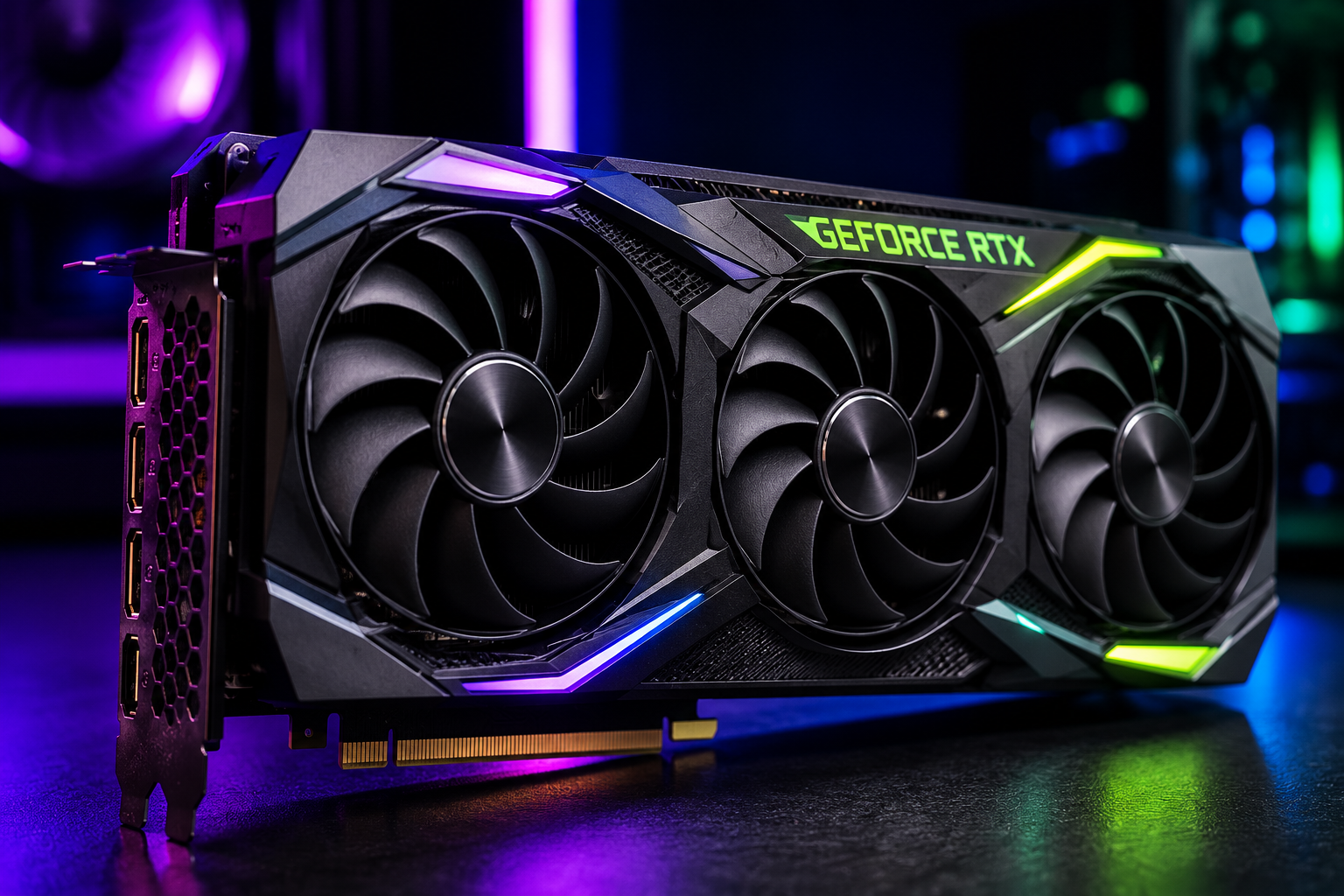
At the center of this computational revolution is a piece of hardware originally designed for a completely different purpose: the Graphics Processing Unit, or GPU.
Once built primarily to render realistic graphics in video games, GPUs have become the workhorses of artificial intelligence. Today, nearly every major AI breakthrough—from large language models and image generators to autonomous vehicles and scientific simulations—depends on GPUs. Their ability to process massive amounts of data simultaneously has fundamentally changed what computers can accomplish.
Understanding why GPUs are so important begins with understanding how artificial intelligence actually works.
What Is a GPU?
A Graphics Processing Unit (GPU) is a specialized processor designed to perform many calculations at the same time. Unlike a traditional Central Processing Unit (CPU), which is optimized to execute a small number of complex tasks quickly, a GPU is built to execute thousands of simpler tasks simultaneously.
The first GPUs were created to speed up computer graphics. Every frame in a video game contains millions of pixels that must be calculated in fractions of a second. Rendering realistic lighting, shadows, textures, and movement requires performing similar mathematical operations over and over again.
Engineers designed GPUs with hundreds, and eventually thousands, of processing cores capable of working in parallel. This architecture turned out to be almost perfectly suited for artificial intelligence, even though AI was not the original goal.
Today, GPUs power everything from gaming PCs and smartphones to supercomputers and massive AI data centers.
Why Artificial Intelligence Requires So Much Computing Power
Artificial intelligence learns by analyzing enormous amounts of data.
Imagine teaching a computer to recognize cats in photographs. Instead of giving the computer a simple rule like “cats have whiskers,” modern AI systems examine millions of labeled images. During training, the AI repeatedly compares its predictions with the correct answers and adjusts billions of internal parameters to improve its accuracy.
Each adjustment requires countless mathematical operations involving large matrices of numbers.
Modern AI models contain millions, billions, or even trillions of parameters. Every training step involves multiplying and adding vast arrays of numbers repeatedly.
A single training run for a large AI model can require quadrillions of mathematical operations.
Without highly parallel hardware, completing these calculations would take years.
The Difference Between CPUs and GPUs
Although CPUs and GPUs are both processors, they are designed with different priorities.
A CPU acts like an expert problem solver. It excels at handling diverse tasks, making decisions, managing operating systems, running applications, and responding quickly to changing instructions. Most CPUs contain a relatively small number of powerful cores optimized for flexibility.
A GPU approaches problems differently.
Instead of focusing on one complicated task at a time, it divides work among thousands of smaller cores. Each core performs similar calculations simultaneously.
Imagine cleaning a football stadium.
A CPU is like one highly skilled worker cleaning one section after another.
A GPU is like thousands of workers cleaning thousands of seats simultaneously.
Both eventually finish the job, but the GPU completes highly repetitive work dramatically faster.
Artificial intelligence relies heavily on precisely this kind of repetitive numerical computation.
Parallel Processing: The Secret Behind GPU Speed
The greatest strength of a GPU is parallel processing.
Many AI calculations can be performed independently.
Suppose an AI model must multiply two giant matrices containing millions of numbers.
Rather than assigning one processor to perform every multiplication sequentially, a GPU divides the work among thousands of cores.
Each core computes part of the result at the same time.
Instead of waiting for one calculation to finish before beginning the next, thousands occur simultaneously.
This massive parallelism dramatically reduces computation time.
Large neural networks often require billions of matrix multiplications, making parallel processing essential for practical AI.
Understanding Neural Networks
Modern AI relies heavily on artificial neural networks.
These mathematical systems are loosely inspired by networks of biological neurons in the brain, although they operate very differently from actual brain cells.
Neural networks consist of layers of interconnected mathematical units.
Each connection has a numerical weight.
During training, the network continuously adjusts these weights to improve its predictions.
Every layer performs numerous matrix multiplications and additions.
As models become larger, the number of calculations grows rapidly.
Since these operations can be executed simultaneously, GPUs are exceptionally well suited for neural networks.
Matrix Multiplication: The Heart of AI Computation
Although AI appears intelligent on the surface, much of its computation ultimately comes down to matrix mathematics.
Matrices are rectangular arrays of numbers.
Nearly every modern AI model performs countless matrix multiplications while processing information.
Whether generating text, recognizing speech, identifying objects, or predicting protein structures, AI repeatedly multiplies enormous matrices.
Matrix multiplication is highly parallel.
Each element of the resulting matrix can often be calculated independently.
GPUs exploit this independence by assigning thousands of cores to compute different portions simultaneously.
This capability is one of the primary reasons GPUs outperform CPUs in AI applications.
Training AI Models
Training is the process through which an AI model learns from data.
At first, the model makes poor predictions.
It compares its outputs with the correct answers and calculates an error.
Using optimization algorithms, it adjusts its internal parameters to reduce future errors.
This cycle repeats millions or billions of times.
Every iteration involves forward computation through the neural network, error calculation, and backward propagation to update parameters.
Each stage requires enormous amounts of matrix computation.
GPUs reduce training times from months to weeks, weeks to days, and sometimes days to mere hours.
Without GPU acceleration, many modern AI systems would simply be impractical to train.
AI Inference Also Benefits from GPUs
Training receives much attention because it is computationally intensive, but inference is equally important.
Inference occurs when a trained AI model makes predictions.
When you ask an AI chatbot a question, request image generation, translate text, or use voice recognition, the model performs inference.
Although inference usually requires fewer calculations than training, it must often happen extremely quickly.
Millions of users may access an AI service simultaneously.
GPUs enable servers to process many requests in parallel while maintaining low response times.
This makes real-time AI applications possible.
Tensor Cores: Hardware Designed Specifically for AI
Modern AI GPUs include specialized hardware called Tensor Cores.
Unlike traditional GPU cores, Tensor Cores are specifically engineered to accelerate matrix operations used in deep learning.
Rather than performing individual arithmetic operations one by one, Tensor Cores execute many matrix calculations simultaneously using specialized circuitry.
This dramatically increases AI performance while reducing energy consumption.
Because deep learning depends heavily on matrix multiplication, Tensor Cores have become one of the most important innovations in AI hardware.
They allow modern GPUs to perform trillions of AI calculations every second.
Memory Bandwidth Matters
Raw computing power alone is not enough.
AI models constantly move enormous amounts of data between memory and processing units.
If processors must wait for data to arrive, performance suffers.
Modern AI GPUs therefore include extremely high memory bandwidth.
High-speed memory technologies allow data to flow rapidly to thousands of processing cores.
This continuous flow keeps GPU cores busy rather than idle.
Efficient memory systems are one reason why AI accelerators perform far better than simply adding more ordinary processor cores.
Why AI Models Keep Getting Bigger
Artificial intelligence has steadily grown in size.
Early neural networks contained only a few thousand parameters.
Modern language models contain hundreds of billions of parameters.
Larger models can often recognize more complex patterns, understand broader contexts, and produce more capable outputs.
However, increasing model size also increases computational demands.
Training today’s largest AI models requires thousands of GPUs working together for weeks or months.
Without GPU clusters, building these advanced systems would be nearly impossible.
Multiple GPUs Working Together
One GPU is powerful.
Thousands of GPUs working together are extraordinary.
Modern AI data centers connect GPUs using extremely fast communication networks.
Each GPU processes part of the model or part of the training data.
The results are exchanged rapidly between processors.
This distributed approach allows AI systems to scale far beyond the capabilities of any individual processor.
Some of the world’s largest AI training systems contain tens of thousands of GPUs operating simultaneously.
Together they perform computations measured in exaflops—quintillions of floating-point operations every second.
Floating-Point Calculations and AI
AI relies heavily on floating-point arithmetic.
Floating-point numbers allow computers to represent fractions and extremely large or extremely small values efficiently.
Neural networks perform vast numbers of floating-point multiplications and additions.
GPUs are optimized for these operations.
Many AI applications can even use lower numerical precision without significantly affecting accuracy.
Modern GPUs exploit this by supporting formats such as FP16, BF16, and other reduced-precision representations.
Lower precision allows more calculations to be completed each second while using less memory and less energy.
Why GPUs Are More Energy Efficient for AI
Training AI consumes considerable electricity.
Performing calculations inefficiently would dramatically increase energy costs.
Because GPUs execute many operations simultaneously, they often complete AI workloads using less energy per calculation than CPUs.
Finishing tasks faster also means systems spend less time running at maximum power.
Although large AI clusters still require substantial electricity, GPU acceleration significantly improves overall computational efficiency.
Researchers continue developing architectures that provide even greater performance while reducing energy consumption.
GPUs and Scientific Discovery
GPU acceleration extends far beyond chatbots and image generators.
Scientists use GPUs to study climate change, simulate weather systems, analyze astronomical observations, discover new materials, model earthquakes, predict protein structures, and accelerate medical research.
In biology, GPUs help researchers analyze DNA sequences and understand complex cellular processes.
In physics, they simulate particle interactions and model galaxies.
In chemistry, they accelerate molecular simulations that would otherwise require impractical amounts of computation.
These advances demonstrate that GPUs are transforming scientific research as well as artificial intelligence.
GPUs in Everyday Technology
Many people use GPU-powered AI every day without realizing it.
Smartphone cameras use AI to improve photographs.
Voice assistants recognize speech using neural networks.
Streaming services recommend movies based on machine learning.
Navigation apps estimate traffic using predictive AI models.
Online translators convert languages almost instantly.
Spam filters identify unwanted emails.
Medical imaging systems help detect disease.
Even modern video games use AI-enhanced graphics powered by GPUs.
Behind these familiar experiences lies a remarkable amount of accelerated computation.
Challenges of GPU-Based AI
Despite their enormous advantages, GPUs also present challenges.
High-performance AI GPUs are expensive.
They require sophisticated cooling systems because they generate substantial heat during intensive workloads.
Large AI data centers consume significant amounts of electricity.
Manufacturing advanced GPUs is technologically demanding, requiring cutting-edge semiconductor fabrication.
As demand for AI hardware grows worldwide, ensuring sufficient production capacity has become a major challenge for the semiconductor industry.
Researchers are therefore exploring new hardware architectures that could further improve efficiency.
The Future of AI Acceleration
GPU technology continues evolving rapidly.
Each new generation delivers more computing power, greater memory bandwidth, improved energy efficiency, and specialized AI hardware.
Researchers are also developing dedicated AI accelerators, neuromorphic processors inspired by biological brains, optical computing systems that use light instead of electricity, and quantum computing technologies that may eventually complement conventional hardware for certain specialized problems.
Even as new technologies emerge, GPUs are expected to remain central to artificial intelligence for years to come because of their flexibility, mature software ecosystems, and unmatched ability to accelerate parallel computation.
Why GPUs Changed the AI Revolution
Artificial intelligence did not become practical simply because researchers developed better algorithms. It also became possible because computing hardware advanced dramatically. GPUs provided the massive parallel processing power needed to train increasingly sophisticated neural networks on enormous datasets within realistic timeframes.
By accelerating matrix calculations, supporting thousands of simultaneous operations, delivering high memory bandwidth, and incorporating specialized AI hardware such as Tensor Cores, GPUs transformed artificial intelligence from an academic research field into a technology that powers countless real-world applications.
Every conversation with an AI assistant, every AI-generated image, every speech recognition system, and every recommendation engine reflects billions of mathematical operations happening behind the scenes. GPUs perform these calculations with remarkable speed, enabling machines to learn, reason, and assist humans in ways that were once considered science fiction.
As artificial intelligence continues to evolve, GPUs will remain one of the most important technologies driving its progress, providing the computational foundation that allows increasingly capable AI systems to solve problems, accelerate scientific discovery, and reshape the future of technology.