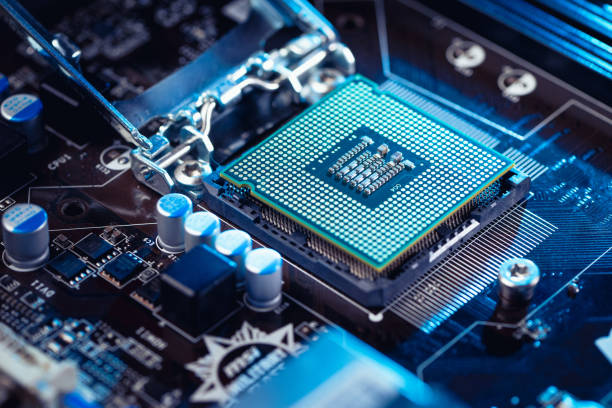
Every time you unlock your smartphone, launch a video game, edit a photo, stream a movie, or ask an AI assistant a question, one tiny piece of hardware quietly performs billions of calculations in the background. That remarkable component is the Central Processing Unit, better known as the CPU.
Often called the “brain” of a computer, the CPU is responsible for executing instructions, making decisions, performing calculations, and coordinating nearly every operation inside a digital device. Yet modern CPUs are far more than simple calculators. They are among the most sophisticated machines humanity has ever created, containing billions of microscopic transistors packed into an area no larger than a postage stamp.
Designing a modern CPU is an extraordinary scientific and engineering challenge. It combines physics, electrical engineering, computer architecture, materials science, semiconductor manufacturing, and software optimization. Every transistor, wire, circuit, and logic gate must work together with astonishing precision while consuming as little power as possible.
The processors found in today’s laptops, desktops, smartphones, gaming consoles, servers, and supercomputers are the result of decades of innovation. Behind their sleek metal covers lies an incredibly complex world where billions of electronic switches operate at speeds measured in gigahertz, processing trillions of operations every second.
Understanding how modern CPUs are designed not only reveals the genius of modern engineering but also explains why today’s computers have become so powerful, efficient, and intelligent.
What Is a CPU?
A Central Processing Unit is the primary processor responsible for executing computer programs. It interprets instructions stored in memory, performs arithmetic and logical operations, moves data between different parts of the system, and controls how software interacts with hardware.
Every program—from a web browser to a video editor—ultimately becomes a long sequence of machine instructions. The CPU reads these instructions one by one, processes them, and produces the results that users see on their screens.
Although graphics processors (GPUs), neural processing units (NPUs), and other specialized chips have become increasingly important, the CPU remains the central coordinator that manages nearly every aspect of a computing system.
The Design Philosophy of Modern CPUs
Modern CPU design is no longer focused solely on increasing raw speed. Earlier generations of processors improved performance mainly by increasing clock frequency, allowing the processor to complete more cycles each second. However, as clock speeds rose, power consumption and heat generation increased dramatically.
Today, CPU designers balance several competing goals at the same time. They aim to maximize performance while minimizing energy use, reducing heat output, improving reliability, maintaining security, and ensuring compatibility with existing software.
This balancing act influences every design decision, from the arrangement of transistors to the organization of memory and the number of processing cores.
It All Begins With an Instruction Set Architecture
Before engineers design the physical chip, they define the processor’s Instruction Set Architecture, or ISA.
The ISA serves as the interface between hardware and software. It specifies the instructions that the processor understands, the available registers, memory operations, arithmetic functions, and many other features that programmers and operating systems rely on.
Different CPU families use different instruction sets. The x86 architecture, developed over decades, powers most desktop and laptop computers, while the ARM architecture is widely used in smartphones, tablets, and an increasing number of laptops and servers because of its high energy efficiency.
Although two processors may look completely different internally, they can run the same software if they implement the same instruction set.
Designing the Microarchitecture
Once the instruction set has been chosen, engineers design the processor’s microarchitecture.
The microarchitecture determines how the CPU actually executes instructions. It defines the internal organization of execution units, caches, pipelines, scheduling logic, branch prediction systems, memory interfaces, and communication pathways.
Different CPUs using the same instruction set can have dramatically different microarchitectures. This explains why two processors capable of running identical software may differ greatly in speed, efficiency, and power consumption.
Microarchitecture is where much of the innovation in modern processor design takes place.
Building Everything From Transistors
At the lowest level, every CPU consists of transistors.
A transistor is an electronic switch that can turn electrical current on or off. By combining enormous numbers of these switches, engineers create logic gates capable of performing mathematical and logical operations.
Modern processors contain astonishing numbers of transistors.
High-end desktop CPUs may contain tens of billions of transistors, while advanced AI processors and data center chips can contain well over one hundred billion transistors.
Each transistor is incredibly small, measured in nanometers. Manufacturing improvements have allowed more transistors to fit into the same area, increasing computing power while often improving energy efficiency.
Logic Gates: The Building Blocks of Computation
Individual transistors perform only very simple switching operations.
When combined into logic gates such as AND, OR, NOT, NAND, NOR, XOR, and XNOR gates, they become capable of processing binary information.
These logic gates are assembled into larger circuits that perform arithmetic calculations, compare numbers, move data, and make decisions.
Millions of interconnected logic gates eventually form complete processing units capable of executing complex computer programs.
Binary: The Language of CPUs
Modern processors operate using binary numbers.
Binary uses only two digits: 0 and 1.
These two values correspond to electrical states inside the processor, where transistors are either conducting current or not conducting current.
Although humans think in decimal numbers, computers perform all calculations using combinations of binary digits.
Everything stored inside a computer—including text, images, music, videos, and software—is ultimately represented as binary data.
The Clock: Keeping Everything Synchronized
Inside every CPU is a timing system known as the clock.
The clock generates a steady stream of pulses that synchronize operations throughout the processor.
Clock speed is measured in hertz, with modern processors typically operating at several gigahertz, meaning billions of cycles per second.
Each clock cycle allows various parts of the processor to perform specific tasks.
However, clock speed alone does not determine overall performance. Modern CPUs perform many operations simultaneously, making architecture and efficiency just as important as frequency.
The Fetch-Decode-Execute Cycle
Every CPU continuously performs a sequence known as the fetch-decode-execute cycle.
First, the processor fetches an instruction from memory.
Next, it decodes the instruction to determine which operation is required.
Finally, it executes the instruction and stores the result if necessary.
This process repeats billions of times every second.
Although this description sounds simple, modern CPUs optimize nearly every step to execute multiple instructions simultaneously.
Instruction Pipelines
One of the most important innovations in CPU design is pipelining.
Instead of waiting for one instruction to finish before starting the next, modern processors divide instruction execution into multiple stages.
While one instruction is being executed, another may already be decoded, and another may be fetched from memory.
This assembly-line approach dramatically increases overall throughput.
Pipeline design has become increasingly sophisticated, allowing modern processors to keep many instructions moving through different stages at the same time.
Superscalar Processing
Modern CPUs often execute multiple instructions during a single clock cycle.
This capability is known as superscalar execution.
Instead of containing only one execution unit, modern processors include multiple arithmetic units, floating-point units, vector processors, and load/store units.
Sophisticated scheduling hardware determines which instructions can safely execute in parallel.
This parallelism significantly improves performance without increasing clock speed.
Out-of-Order Execution
Computer programs are usually written as sequences of instructions.
However, many instructions are independent and do not actually depend on previous results.
Modern CPUs analyze instruction streams dynamically and execute independent instructions before earlier ones if doing so improves efficiency.
This technique is called out-of-order execution.
Although instructions may execute in a different order internally, the processor ensures that the final results remain exactly the same as if they had been executed sequentially.
This dramatically improves processor utilization.
Branch Prediction
Programs frequently make decisions.
An application might check whether a file exists, determine whether a user entered the correct password, or evaluate countless other conditions.
These decisions create branches in program execution.
Waiting until every branch is resolved would slow the processor considerably.
Modern CPUs therefore predict which path a program is likely to follow.
Highly sophisticated branch predictors analyze previous behavior and often achieve prediction accuracies exceeding 95 percent for many workloads.
Accurate prediction allows the processor to continue executing instructions without interruption.
Speculative Execution
Branch prediction enables another important optimization called speculative execution.
The processor begins executing instructions before it knows whether they will actually be needed.
If the prediction proves correct, valuable time is saved.
If the prediction is incorrect, the speculative results are discarded, and execution resumes along the correct path.
Although speculative execution greatly improves performance, researchers have also shown that it can introduce certain security vulnerabilities if not carefully managed.
CPU Cores
Early processors contained only a single processing core.
Modern CPUs contain multiple independent cores capable of executing different programs or threads simultaneously.
Each core functions as a complete processor with its own execution units, registers, and often dedicated cache memory.
Multi-core designs improve performance by allowing software to divide work among several cores.
Applications such as video editing, scientific simulations, software development, and gaming benefit greatly from multiple processing cores.
Simultaneous Multithreading
Many CPUs support simultaneous multithreading, commonly abbreviated as SMT.
This technology allows one physical core to execute instructions from multiple software threads at the same time.
Instead of leaving execution resources idle when one thread stalls, another thread can use those resources.
This improves overall processor efficiency, particularly in workloads involving frequent memory accesses.
Cache Memory
Accessing main system memory takes much longer than performing calculations inside the CPU.
To reduce this delay, processors include several layers of extremely fast memory known as caches.
The smallest and fastest cache, called L1 cache, sits closest to the execution units.
L2 cache provides additional storage with slightly higher latency.
Many processors also include a larger shared L3 cache that serves multiple cores.
Some advanced processors even include additional cache layers.
Effective cache design is essential because reducing memory delays can dramatically improve overall performance.
Registers
Registers are the fastest storage locations inside a CPU.
They temporarily hold data currently being processed.
Arithmetic calculations, memory addresses, and intermediate results are stored in registers before being written elsewhere.
Because registers are located directly inside each processing core, they can be accessed almost instantly.
Floating-Point Units
Not all calculations involve whole numbers.
Scientific computing, engineering, artificial intelligence, graphics, and video processing require floating-point arithmetic capable of representing very large and very small numbers with fractional values.
Modern CPUs include specialized floating-point units designed specifically for these operations.
These units perform complex mathematical calculations with remarkable speed and precision.
Vector Processing
Many applications repeatedly perform the same mathematical operation on large collections of data.
Image processing, video encoding, scientific simulations, and machine learning often involve this kind of workload.
Modern CPUs include vector processing units capable of applying one instruction to multiple data values simultaneously.
This approach greatly accelerates many computational tasks.
Power Efficiency
One of the greatest challenges in CPU design is reducing power consumption.
Every switching transistor consumes energy and produces heat.
As processors became faster, simply increasing clock speed became impractical because power usage rose rapidly.
Modern CPUs therefore employ sophisticated power management techniques.
Unused processor sections may temporarily shut down.
Clock frequencies automatically increase during demanding workloads and decrease during lighter tasks.
Voltage levels continuously adjust according to computational requirements.
These techniques allow processors to deliver high performance while extending battery life in portable devices.
Heat Management
Power consumption inevitably generates heat.
Excessive heat can damage electronic components or reduce performance.
CPU designers carefully manage thermal behavior through efficient circuit design, improved materials, intelligent scheduling, and advanced manufacturing processes.
Computer systems further dissipate heat using heat spreaders, heatsinks, fans, liquid cooling systems, and thermal interface materials.
Thermal management has become a critical part of processor engineering.
Security Built Into the Hardware
Modern CPUs incorporate numerous hardware security features.
Memory protection mechanisms help prevent unauthorized access to sensitive data.
Secure execution environments isolate confidential computations.
Encryption acceleration improves data protection.
Random number generators support cryptographic applications.
Hardware designers also continually update processor architectures to reduce vulnerabilities discovered through ongoing security research.
Artificial Intelligence Inside CPU Design
Artificial intelligence increasingly influences processor design itself.
Machine learning algorithms help engineers optimize circuit layouts, improve power efficiency, predict manufacturing issues, and automate portions of chip design.
Some modern CPUs also include dedicated AI acceleration hardware capable of executing neural network operations much faster than traditional execution units.
These specialized engines enable faster speech recognition, image processing, language translation, and generative AI applications.
Designing a CPU Is a Massive Team Effort
Creating a modern processor requires collaboration among thousands of engineers across multiple disciplines.
Computer architects design processor behavior.
Circuit designers develop electronic components.
Verification engineers test billions of possible operating conditions.
Software developers create compilers and firmware.
Manufacturing specialists develop semiconductor fabrication processes.
Packaging engineers design methods for connecting microscopic chips to larger electronic systems.
The complete development process often takes several years before a processor reaches consumers.
Manufacturing the Processor
After design is complete, the processor enters fabrication.
Manufacturing begins with extremely pure silicon wafers.
Using advanced photolithography, manufacturers project intricate circuit patterns onto the silicon. Layers of materials are deposited, etched, and modified to create billions of interconnected transistors and metal wiring layers.
The completed wafers are then tested, cut into individual chips, packaged, and tested again before shipping.
Modern semiconductor fabrication facilities are among the most technologically advanced manufacturing environments ever built, requiring extraordinary cleanliness and precision.
Continuous Testing and Verification
A CPU must operate correctly under an enormous range of conditions.
Engineers perform extensive simulations before manufacturing begins.
After fabrication, processors undergo functional testing, electrical testing, thermal testing, stress testing, and long-term reliability testing.
Even extremely rare errors must be identified because billions of processors may eventually be manufactured.
Verification often consumes a substantial portion of the entire CPU development process.
The Future of CPU Design
Processor technology continues evolving rapidly.
Engineers are developing new chip architectures, advanced packaging technologies, three-dimensional chip stacking, chiplet-based designs, improved interconnects, and increasingly specialized computing units.
Research into quantum computing, optical computing, neuromorphic processors, and new semiconductor materials may eventually transform computing beyond today’s silicon-based designs.
Meanwhile, conventional CPUs continue improving through smarter architectures, greater efficiency, enhanced security, and tighter integration with AI accelerators and graphics processors.
The Remarkable Achievement Behind Every Processor
Modern CPUs represent one of humanity’s greatest engineering accomplishments. Hidden beneath a small metal package lies an astonishing world where billions of microscopic transistors cooperate with extraordinary precision, executing billions of instructions every second while consuming only a modest amount of power.
Every feature of a modern processor—from branch prediction and out-of-order execution to cache hierarchies and multi-core architectures—exists because countless engineers spent decades solving incredibly complex problems. The result is a machine capable of powering everything from smartphones and laptops to spacecraft, medical equipment, cloud data centers, and some of the world’s fastest supercomputers.
As technology continues to advance, CPUs will become even more powerful, efficient, and intelligent. Yet their fundamental purpose will remain unchanged: transforming streams of binary instructions into the digital experiences that define modern life. Behind every click, every search, every scientific discovery, and every breakthrough in artificial intelligence, the CPU continues its silent work—an extraordinary masterpiece of science and engineering that has become the beating heart of the digital world.