For decades, passwords have been the digital keys to our online lives. Every email account, social media profile, banking app, shopping website, and cloud service has asked us to create one. We have been told to make passwords long, complex, and unique. We have been warned not to reuse them across different websites. Yet despite years of advice, passwords remain one of the weakest links in online security.
Most people have experienced the frustration of forgetting a password, resetting it through email, or trying several combinations before finally getting it right. At the same time, cybercriminals have become increasingly skilled at stealing passwords through phishing scams, malware, and massive data breaches.
As our digital lives have expanded, it has become clear that passwords were never designed for the level of security today’s internet demands.
That is why many of the world’s largest technology companies are moving toward a new method called passkeys. Companies behind billions of user accounts—including smartphone makers, web browsers, operating systems, and online services—are gradually replacing passwords with a system that is easier to use while providing significantly stronger security.
This shift is not simply another technology trend. It represents one of the biggest changes in online authentication since passwords became common decades ago.
The Problem With Passwords
Passwords seem simple. You create a secret combination of letters, numbers, and symbols, and anyone who knows that secret can access your account.
The problem is that humans are not very good at creating or remembering strong passwords.
Many people choose passwords based on birthdays, names, favorite sports teams, pets, or simple keyboard patterns. Others reuse the same password across dozens of websites because remembering hundreds of unique passwords is nearly impossible.
If just one website suffers a data breach and attackers obtain your password, they often try that same password on many other websites. This technique, known as credential stuffing, has become one of the most common ways cybercriminals compromise online accounts.
Even strong passwords have weaknesses. A password can be stolen if someone tricks you into typing it into a fake website. Malware can secretly record what you type on your keyboard. Criminals can sometimes guess weak passwords using automated software that tries millions of combinations every second.
In other words, the biggest weakness of passwords is that they are shared secrets. Both you and the website know the password, which means anyone else who learns that secret can pretend to be you.
The Rise of Cyberattacks
Modern cybercrime has become highly organized.
Criminal groups operate across international borders, targeting businesses, governments, hospitals, schools, and individual users. Their methods have become increasingly sophisticated.
Phishing emails often appear almost identical to legitimate messages from banks, online stores, or trusted companies. Fake login pages can closely resemble the real websites they imitate. Even experienced internet users can occasionally be deceived.
Data breaches have exposed billions of usernames and passwords over the past two decades. Once stolen, these credentials are often sold or traded among cybercriminals.
As online threats continue to evolve, technology companies have realized that relying on passwords alone is no longer enough.
What Is a Passkey?
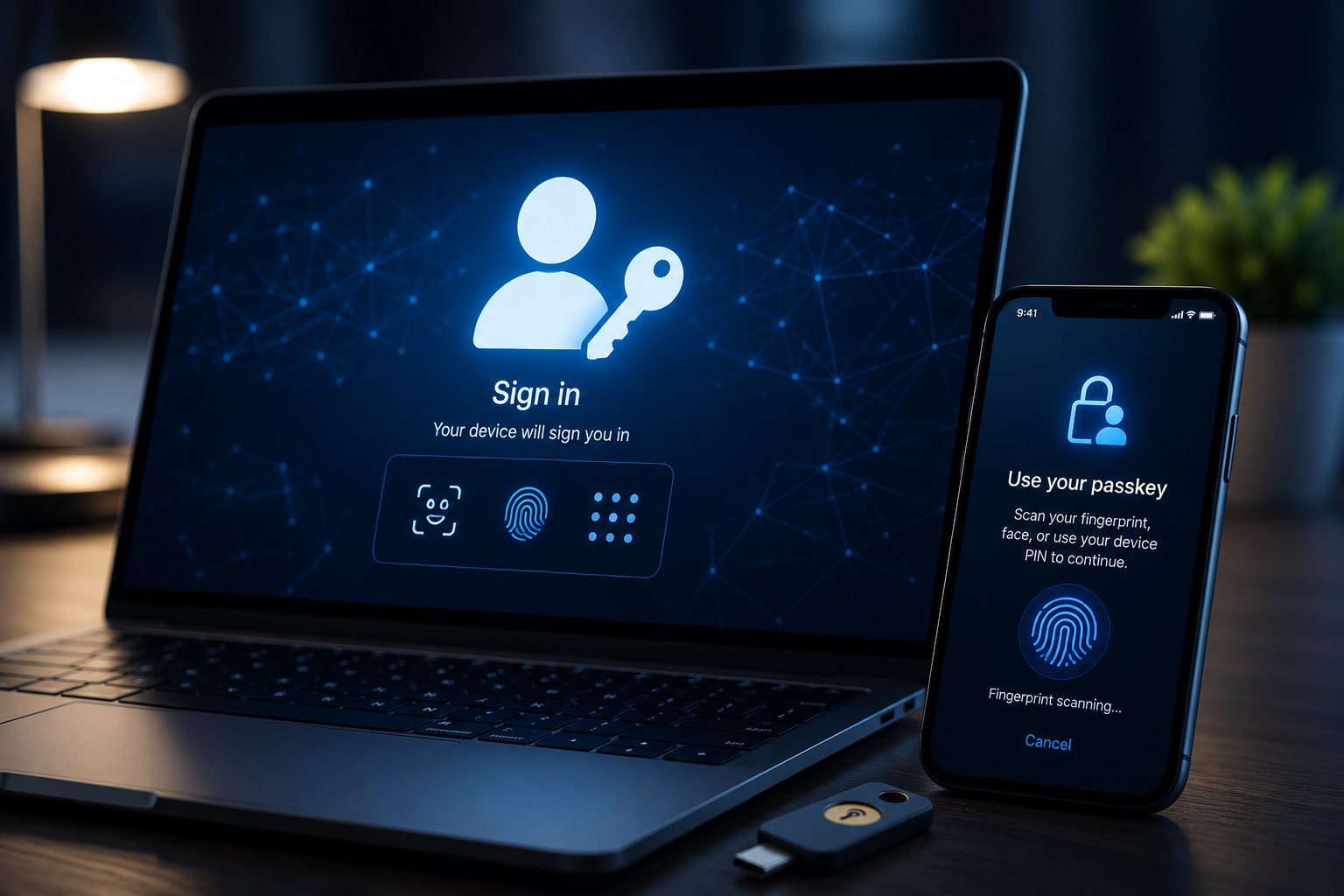
A passkey is a modern method of signing in to online accounts without entering a traditional password.
Instead of asking you to remember a secret word or phrase, a passkey allows your device to verify your identity using something you already use every day.
This might include your fingerprint, facial recognition, or your device’s screen lock PIN.
From the user’s perspective, signing in feels remarkably simple.
Instead of typing a complicated password, you unlock your device just as you normally would.
Behind the scenes, however, something much more sophisticated is happening.
How Passkeys Work
Passkeys rely on a branch of cryptography known as public-key cryptography.
When you create a passkey for a website or app, your device generates two mathematically related cryptographic keys.
One is called the private key.
The other is called the public key.
The public key is safely shared with the website.
The private key never leaves your device.
Whenever you sign in, the website sends a unique cryptographic challenge.
Your device uses the private key to create a secure digital response proving that you own the correct key.
The website verifies this response using the public key it already has.
Because the private key never leaves your device, attackers cannot steal it from the website.
Even if the website suffers a major data breach, criminals obtain only the public key, which cannot be used to impersonate you.
This design dramatically improves security.
Why Passkeys Are More Secure
One of the greatest strengths of passkeys is that they eliminate many of the attacks that commonly target passwords.
Since there is no password to type, phishing websites cannot trick you into revealing it.
Even if you accidentally visit a fake website, your device checks whether the website matches the one that originally created the passkey. If it does not match, authentication simply does not occur.
This built-in protection makes phishing attacks much less effective.
Passkeys also prevent password reuse because every passkey is unique to a specific website or app.
There is no single password that can be copied across multiple accounts.
In addition, passkeys cannot be guessed through brute-force attacks because there is no human-created password to predict.
The Science Behind Public-Key Cryptography
Public-key cryptography is one of the most important advances in modern computer security.
Its mathematical foundation allows two related keys to perform complementary roles without revealing one another.
The public key can safely be shared with anyone.
The private key remains secret.
Although these keys are mathematically connected, calculating the private key from the public key is computationally impractical using current technology when properly implemented.
This remarkable property allows secure authentication without transmitting secret information across the internet.
The same cryptographic principles also protect secure websites, encrypted communications, digital certificates, and many online financial transactions.
Biometrics and Passkeys
Many people assume that passkeys are simply another name for fingerprints or facial recognition.
That is not entirely correct.
Biometric authentication is usually just the method your device uses to confirm that you are the legitimate owner.
Your fingerprint or face generally stays on your device rather than being sent to websites.
Once your device verifies your identity, it unlocks the private cryptographic key needed to complete the authentication process.
In this way, biometrics provide convenience while cryptography provides security.
Device Security Matters
Because the private key remains on your device, protecting that device becomes extremely important.
Modern smartphones, tablets, and computers often include specialized security hardware designed to safeguard cryptographic keys.
These secure components isolate sensitive information from the rest of the operating system.
Even if malicious software infects part of the device, accessing the protected keys remains much more difficult.
Regular software updates, strong device locks, and good cybersecurity habits continue to play an essential role.
Why Signing In Becomes Easier
Security often comes at the cost of convenience.
Passwords have long forced users to choose between the two.
Complex passwords improve security but become difficult to remember.
Simple passwords are easier to remember but much less secure.
Passkeys largely remove this trade-off.
Instead of memorizing dozens or even hundreds of passwords, users simply unlock their own devices.
The login process becomes faster, simpler, and less frustrating.
Many people no longer need to worry about forgotten passwords or repeated password reset emails.
Passkeys Across Multiple Devices
Modern technology companies recognize that people own multiple devices.
Someone might use a smartphone, laptop, desktop computer, and tablet throughout the day.
Passkeys can often be securely synchronized across trusted devices using encrypted cloud services provided by operating system vendors.
This allows users to sign in from different devices without manually transferring cryptographic information.
Synchronization methods vary depending on the operating system and ecosystem being used, but the goal remains the same: strong security combined with everyday convenience.
What Happens If You Lose Your Device?
A common concern is what happens if the phone or computer containing your passkeys is lost.
Technology companies have designed recovery systems to address this possibility.
Many users synchronize passkeys across multiple trusted devices.
Others can restore access through secure account recovery procedures.
Exactly how recovery works depends on the service provider and device ecosystem.
Importantly, recovery systems are designed to balance convenience with protection against unauthorized access.
Why Major Tech Companies Support Passkeys
Large technology companies have invested heavily in passkeys because online security affects everyone.
Every successful phishing attack, account takeover, or password breach damages user trust.
Supporting passkeys helps reduce fraud while making login experiences smoother.
Instead of constantly helping users reset forgotten passwords, companies can focus on improving other parts of their services.
For users, fewer passwords also mean fewer opportunities for mistakes.
The Role of Industry Standards
Passkeys work across many platforms because technology companies collaborated on common standards rather than creating incompatible systems.
These standards define how devices, websites, and applications securely exchange authentication information.
By using shared specifications, developers can build services that work across different operating systems, browsers, and hardware manufacturers.
This cooperation helps ensure that passkeys remain useful regardless of which devices people choose.
Are Passwords Disappearing Completely?
Not yet.
Many websites continue to rely on traditional passwords because updating authentication systems takes time.
Some services now offer both passwords and passkeys, allowing users to choose.
Others are gradually encouraging customers to switch.
For the foreseeable future, passwords and passkeys will likely coexist.
However, the long-term direction is becoming increasingly clear.
As more websites adopt passkeys, traditional passwords may gradually become less common.
Are Passkeys Perfect?
No security technology is perfect.
Passkeys greatly reduce many common threats, but they do not eliminate every cybersecurity risk.
Attackers may still attempt social engineering, malware infections, device theft, or account recovery scams.
Good digital security still requires software updates, careful browsing habits, skepticism toward unexpected messages, and protection of personal devices.
Passkeys strengthen authentication, but they are only one part of a broader cybersecurity strategy.
The Future of Online Authentication
The internet has changed dramatically since passwords first became widespread.
People now manage online banking, healthcare, education, work, shopping, entertainment, and personal communication through connected devices.
Protecting these digital identities has become more important than ever.
Passkeys represent a shift away from relying on human memory toward relying on advanced cryptography and secure hardware.
Instead of expecting people to create increasingly complicated passwords, technology is taking on more of the responsibility for keeping accounts safe.
This approach reflects decades of progress in computer science, cryptography, and cybersecurity research.
A New Era Beyond Passwords
Passwords served the internet well for many years, but they were never designed for a world where billions of people maintain countless online accounts. As cyber threats have grown more sophisticated, the limitations of passwords have become impossible to ignore.
Passkeys offer a fundamentally different approach. By using public-key cryptography, secure hardware, and device-based authentication, they reduce many of the weaknesses that have plagued passwords for decades. They make signing in faster while making it significantly harder for attackers to steal account credentials.
The transition will not happen overnight, and passwords will remain part of the online world for some time. Yet the growing adoption of passkeys signals a major evolution in digital security. As more websites and services embrace this technology, the simple act of logging in may become both easier and far more secure, helping create an internet where protecting your identity no longer depends on remembering one more password.