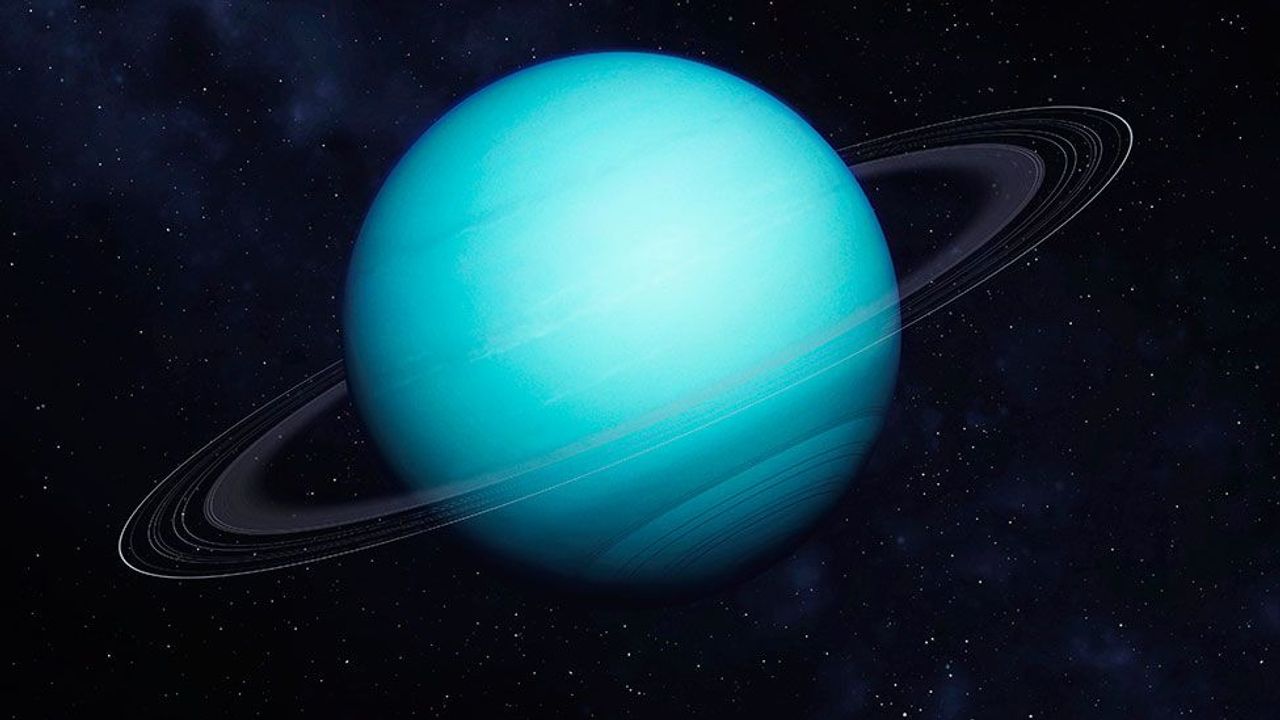
Far beyond the warmth of the Sun, beyond the familiar worlds of Mars, Jupiter, and Saturn, lies a mysterious planet that immediately captures attention with its unusual color. Unlike the rusty red of Mars or the golden clouds of Saturn, Uranus glows with a soft blue-green hue, giving it one of the most distinctive appearances in the Solar System.
For centuries, people have wondered why Uranus has this beautiful color. Is it covered by blue oceans? Is its atmosphere made of a unique gas? Does sunlight somehow change as it reaches the distant planet?
The answer is even more fascinating than these ideas. Uranus owes its blue-green appearance to the way its atmosphere interacts with sunlight. The planet’s color is not painted onto its surface—it is created by physics, chemistry, and the behavior of light itself.
Understanding why Uranus is blue-green also reveals how scientists study planets that are billions of kilometers away without ever touching them.
A Giant World Unlike Earth
Uranus is the seventh planet from the Sun and the third-largest planet in the Solar System by diameter. It belongs to a group of planets known as ice giants, along with its neighbor Neptune.
Although the name “ice giant” may sound as if Uranus is a giant frozen snowball, that is not quite correct. Most of the planet is actually made of hot, dense fluids composed mainly of water, ammonia, and methane under enormous pressure. Deep inside, temperatures reach thousands of degrees Celsius despite the planet’s great distance from the Sun.
Above this deep interior lies a thick atmosphere made mostly of hydrogen and helium, with a much smaller amount of methane. Even though methane makes up only a small percentage of the atmosphere, it plays an incredibly important role in determining the planet’s color.
Sunlight Contains Every Color
To understand Uranus’s color, it helps to first understand sunlight.
Although sunlight appears white to our eyes, it actually contains all the colors of the visible spectrum. When sunlight passes through a prism or raindrops, it spreads into the familiar rainbow of red, orange, yellow, green, blue, indigo, and violet.
When sunlight reaches a planet, not every color is reflected back into space equally.
Some colors are absorbed.
Some are scattered.
Others are reflected toward our eyes and telescopes.
The combination of the reflected colors determines how the planet appears.
Methane Is the Key
The main reason Uranus looks blue-green is methane gas in its upper atmosphere.
Methane has a remarkable property. It absorbs light at certain wavelengths, especially in the red portion of the visible spectrum.
When sunlight reaches Uranus, much of the red light disappears because methane molecules absorb it before it can escape back into space.
Meanwhile, blue and green wavelengths are absorbed much less efficiently.
These colors continue bouncing through the atmosphere and are reflected back into space.
As a result, when astronomers observe Uranus, they receive much more blue and green light than red light.
This imbalance gives the planet its famous blue-green appearance.
The Science of Light Absorption
Every molecule interacts with light in its own unique way.
Methane molecules absorb light because their atoms can vibrate in response to specific wavelengths. These vibrations allow methane to capture energy from red light while allowing many shorter wavelengths to pass through or scatter.
Scientists call these unique absorption patterns spectral fingerprints.
By studying the light reflected from Uranus with instruments called spectrometers, astronomers can identify methane even from billions of kilometers away.
This technique is one of the most powerful tools in planetary science. It allows researchers to determine the composition of planetary atmospheres without physically collecting samples.
Why Isn’t Uranus Completely Blue?
If methane mainly removes red light, why doesn’t Uranus appear deep blue instead of blue-green?
The answer lies in the complexity of its atmosphere.
The atmosphere contains tiny particles, hazes, and clouds that scatter sunlight in different ways.
Hydrogen molecules also scatter light, though not as strongly as Earth’s atmosphere scatters blue light.
Cloud layers made from frozen methane crystals influence the reflected colors as well.
Together, these effects slightly increase the amount of green light that reaches observers.
The result is the gentle blue-green color that makes Uranus so distinctive.
A World Wrapped in Clouds
Although Uranus often appears smooth and featureless in ordinary photographs, its atmosphere is actually dynamic.
Powerful winds race through the atmosphere at speeds exceeding hundreds of kilometers per hour.
Clouds form from methane ice in the extremely cold upper atmosphere.
Large storms occasionally appear, especially when the planet approaches its equinoxes.
Modern telescopes and spacecraft have revealed far more atmospheric activity than astronomers once expected.
Even though these clouds constantly change, the methane-rich atmosphere remains responsible for the planet’s overall color.
How Cold Is Uranus?
Uranus is one of the coldest planets in the Solar System.
The average temperature near the tops of its clouds is approximately 49 kelvins, or about −224°C (−371°F).
At these incredibly low temperatures, methane can freeze into tiny ice crystals that become part of the cloud layers.
Despite its freezing atmosphere, the deeper parts of Uranus remain much hotter because of immense pressure inside the planet.
Does Uranus Have a Blue Ocean?
Its blue-green appearance sometimes makes people imagine vast oceans covering Uranus.
In reality, there is no solid surface and no liquid ocean like Earth’s.
If a spacecraft tried to land, it would descend through thicker and thicker layers of gas before eventually reaching dense, hot fluids under crushing pressure.
The blue-green color comes entirely from the atmosphere, not from a visible surface.
How Scientists Know the Atmosphere Contains Methane
No human has visited Uranus, yet scientists know a surprising amount about its atmosphere.
They use several methods to study the planet.
Powerful telescopes observe the planet across visible, infrared, and ultraviolet wavelengths.
Spectroscopy measures exactly which wavelengths of light are absorbed.
Laboratory experiments compare those absorption patterns with known gases.
Computer models simulate how light behaves inside the atmosphere.
Together, these techniques consistently show that methane is responsible for absorbing red light.
The evidence comes from decades of independent observations and has become one of the best-understood features of Uranus.
Voyager 2 Changed Everything
For many years, astronomers could only study Uranus through telescopes.
That changed in 1986, when NASA’s Voyager 2 became the first—and so far only—spacecraft to fly past Uranus.
The spacecraft sent back thousands of images and measurements that transformed our understanding of the planet.
Voyager 2 confirmed the presence of methane, measured atmospheric temperatures, studied magnetic fields, discovered new moons and rings, and revealed details of the planet’s cloud structure.
Although the images showed a relatively plain blue-green world, later observations with more advanced telescopes uncovered subtle cloud patterns and weather systems hidden within the atmosphere.
Why Neptune Looks Different
At first glance, Uranus and Neptune appear almost identical.
Both are ice giants.
Both contain hydrogen, helium, and methane.
Both owe much of their color to methane absorbing red light.
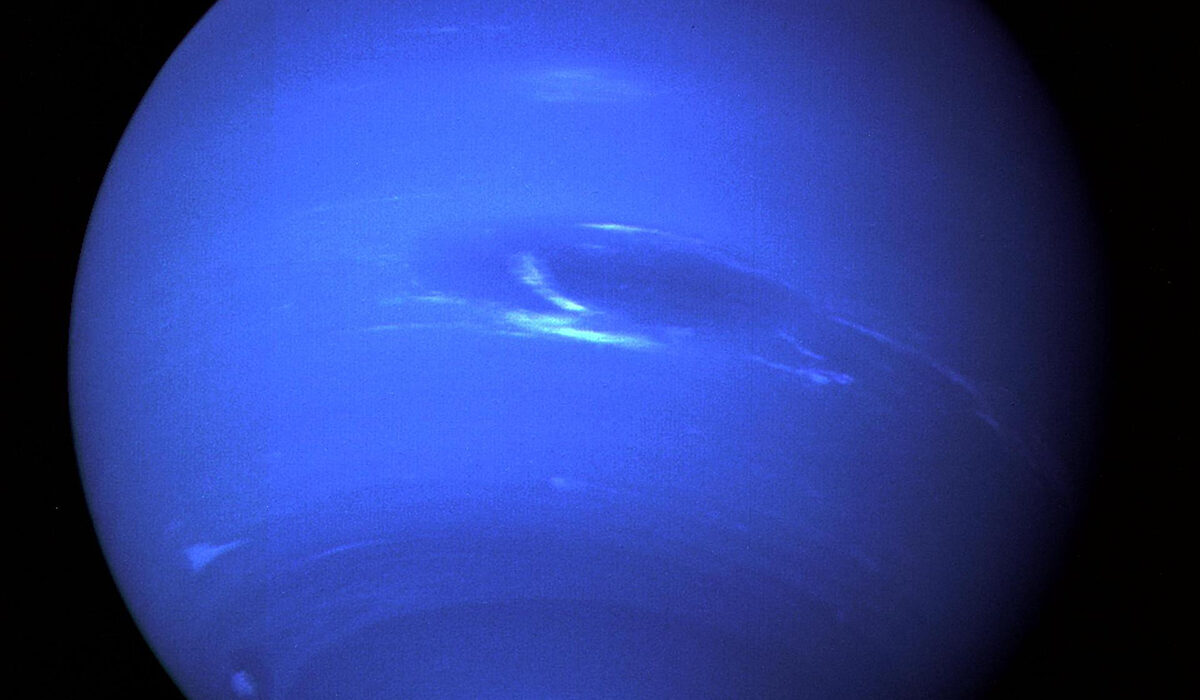
Yet Neptune usually appears deeper blue than Uranus.
For many years, scientists debated why these neighboring planets looked different.
Recent research suggests that Uranus has a thicker layer of atmospheric haze than Neptune.
This haze scatters sunlight differently, making Uranus appear lighter and slightly greener.
Neptune’s atmosphere contains less of this haze and stronger atmospheric activity, allowing its deeper blue color to stand out more clearly.
The difference is subtle but scientifically important because it helps researchers understand how planetary atmospheres evolve.
The Role of Atmospheric Haze
The tiny particles floating high above Uranus are almost invisible individually.
Together, however, they significantly influence the planet’s appearance.
These particles scatter incoming sunlight before it reaches deeper atmospheric layers.
Some light reflects directly from the haze.
Some continues downward before bouncing back upward.
This complicated journey changes the mixture of colors that eventually escapes into space.
Without these haze particles, Uranus might look noticeably different.
Their presence helps create the soft pastel appearance that distinguishes the planet from Neptune.
Can Human Eyes See Uranus’s Color?
If someone could safely observe Uranus from nearby space, they would indeed see its blue-green color.
However, it might not appear quite as vivid as images processed by scientists.
Many published photographs have their colors enhanced slightly to highlight atmospheric details.
Even so, the natural color of Uranus is genuinely blue-green.
It is not an artificial effect created by cameras.
The unusual color exists because the atmosphere truly reflects more blue and green light than red.
Does the Color Ever Change?
The overall blue-green appearance of Uranus remains remarkably stable.
However, subtle changes do occur.
As Uranus slowly travels around the Sun, different parts of the atmosphere receive varying amounts of sunlight.
Seasonal changes influence cloud formation and atmospheric circulation.
Large storms may temporarily brighten certain regions.
Even with these variations, methane continues absorbing red light, so the planet never loses its characteristic color.
Why Understanding Color Matters
A planet’s color is far more than a beautiful feature.
It provides valuable scientific information.
By studying color, astronomers learn about atmospheric chemistry, cloud composition, particle sizes, temperatures, and weather.
The same techniques used to study Uranus are now helping scientists investigate planets orbiting distant stars.
When astronomers detect unusual colors in the atmospheres of exoplanets, they can estimate which gases may be present without directly visiting those worlds.
In this way, Uranus serves as a natural laboratory for understanding planets across the galaxy.
A Beautiful Lesson from Physics and Chemistry
The blue-green color of Uranus is a reminder that appearances often have remarkable scientific explanations.
The planet is not blue-green because of oceans, forests, or frozen landscapes. Instead, its color emerges from the interaction between sunlight and methane molecules high in its atmosphere. As red wavelengths are absorbed, blue and green light remain to travel back into space, giving Uranus its calm, distinctive glow.
This simple process combines some of the most fundamental ideas in physics and chemistry: the nature of light, the behavior of molecules, and the way electromagnetic radiation interacts with matter. From billions of kilometers away, scientists can decode these interactions and reveal the composition of a world that no human has ever visited.
Uranus may seem quiet and distant, but its gentle blue-green color tells a story of invisible gases, frozen clouds, atmospheric haze, and sunlight crossing nearly three billion kilometers of space. Every time astronomers look at this remarkable planet, they are not merely admiring its beauty—they are reading the scientific signature written into its light.