Imagine a world where no one dies waiting for a life-saving organ transplant. A world where a damaged heart can be replaced with a new one grown from a patient’s own cells, where failing kidneys no longer mean years of dialysis, and where doctors can repair injured organs without worrying about donor shortages or organ rejection. For decades, this vision belonged to the realm of science fiction. Today, thanks to remarkable advances in biology, tissue engineering, and regenerative medicine, it is becoming an exciting scientific possibility.
Lab-grown organs represent one of the most ambitious goals in modern medicine. Researchers around the world are working to create functional human tissues and organs in laboratories that could someday replace damaged or diseased organs. Although scientists have already made impressive progress, creating fully functional organs suitable for transplantation remains one of the greatest challenges in biomedical science.
The future of lab-grown organs is filled with promise, but it is also a story of patience, careful research, and scientific innovation. Every new discovery brings medicine one step closer to changing millions of lives.
Understanding Lab-Grown Organs
Lab-grown organs are organs or organ-like structures that scientists create using living cells outside the human body. Instead of relying on donated organs from another person, researchers attempt to grow new tissues using biological materials, advanced engineering techniques, and sometimes three-dimensional printing technologies.
The ultimate goal is to create organs that behave just like natural human organs. These organs would need to contain the right types of cells arranged in the correct structure, receive an adequate blood supply, communicate with the body’s nervous and immune systems when necessary, and perform all the functions of the original organ.
Growing a simple layer of skin is far easier than growing a heart, liver, or kidney. Complex organs contain billions of cells organized into intricate networks of blood vessels, supporting tissues, and specialized structures. Reproducing this complexity in the laboratory remains one of medicine’s greatest scientific challenges.
Why the World Needs Lab-Grown Organs
Organ failure affects millions of people worldwide every year. Diseases, injuries, congenital conditions, and aging can all damage vital organs beyond repair. In many cases, transplantation is the only effective treatment.
Unfortunately, there are far fewer donated organs than patients who need them. Many people spend months or years on transplant waiting lists, and some die before a suitable organ becomes available.
Even when a donor organ is found, transplantation is not always straightforward. The recipient’s immune system may recognize the new organ as foreign and attempt to attack it, a process known as organ rejection. To reduce this risk, transplant recipients usually need lifelong medications that suppress the immune system. These drugs increase susceptibility to infections and can cause significant side effects.
Lab-grown organs could potentially solve many of these problems. If an organ is created using a patient’s own cells, the immune system may be much less likely to reject it, reducing the need for long-term immunosuppressive treatment.
The Science Behind Growing Organs
Creating a living organ is far more complicated than building a machine. Every organ consists of numerous specialized cell types working together in a highly organized way.
Scientists typically begin with living human cells. These may come directly from the patient or from stem cells that can develop into many different types of tissues.
The cells are encouraged to multiply under carefully controlled laboratory conditions. They are supplied with nutrients, oxygen, growth factors, and environmental conditions that mimic those inside the human body.
To guide the cells into forming an organ, researchers often use a biological framework called a scaffold. This scaffold provides structural support while cells attach, grow, and organize themselves into complex tissues.
Over time, the cells interact with one another, producing their own biological materials and gradually forming increasingly sophisticated tissue.
The Extraordinary Role of Stem Cells
Stem cells have become one of the most important tools in regenerative medicine because they possess the remarkable ability to develop into many specialized cell types.
Embryonic stem cells have broad developmental potential, while adult stem cells exist naturally in certain tissues and help repair damage throughout life.
One of the most important breakthroughs came with the development of induced pluripotent stem cells, often called iPS cells. Scientists can create these cells by reprogramming ordinary adult cells, such as skin cells, into a state where they can develop into many different kinds of cells.
This discovery transformed regenerative medicine because it allows researchers to generate patient-specific cells without relying on embryonic tissue.
These reprogrammed cells provide a powerful foundation for growing personalized tissues and, potentially, entire organs.
Tissue Engineering: Building Living Structures
Tissue engineering combines biology, engineering, materials science, and medicine to create functional tissues.
Researchers design scaffolds from natural or synthetic materials that temporarily support growing cells. Some scaffolds gradually dissolve as new tissue forms, leaving behind only living biological structures.
Scientists carefully control the scaffold’s shape, strength, flexibility, and microscopic architecture so that cells grow in the correct arrangement.
Different organs require different engineering strategies. Bone demands rigidity, cartilage requires flexibility, blood vessels need elasticity, and heart muscle must contract rhythmically.
The closer researchers can imitate nature, the more likely the engineered tissue will function properly.
The Rise of Bioprinting
One of the most exciting developments in regenerative medicine is three-dimensional bioprinting.
Unlike ordinary 3D printers that use plastic or metal, bioprinters deposit layers of living cells mixed with specialized biological materials known as bioinks.
Using computer-guided precision, scientists can position different cell types exactly where they belong within a developing tissue.
Researchers have already produced experimental skin, cartilage, blood vessels, and simple tissue structures using bioprinting.
Although printing a complete human organ remains beyond current clinical capabilities, continuous improvements in printing technology, biomaterials, and cell biology are bringing researchers closer to that goal.
Growing Miniature Organs
While scientists work toward growing full-sized organs, they have already achieved remarkable success in producing miniature organ-like structures called organoids.
Organoids are tiny three-dimensional tissues grown from stem cells that resemble simplified versions of real organs. Scientists have created organoids that mimic aspects of the brain, liver, lungs, kidneys, intestines, pancreas, and several other organs.
Although organoids cannot replace full-sized organs, they provide valuable models for studying human development and disease.
Researchers use them to investigate genetic disorders, infectious diseases, cancer, and responses to potential medications.
These miniature organs have become powerful tools for medical research and may reduce reliance on animal testing in certain areas.
Creating Blood Vessels
One of the greatest obstacles in growing large organs is developing an effective blood supply.
Every living cell requires oxygen and nutrients delivered through an extensive network of blood vessels. Without circulation, cells deep inside a large organ quickly die.
Creating these complex vascular networks remains one of the biggest engineering challenges.
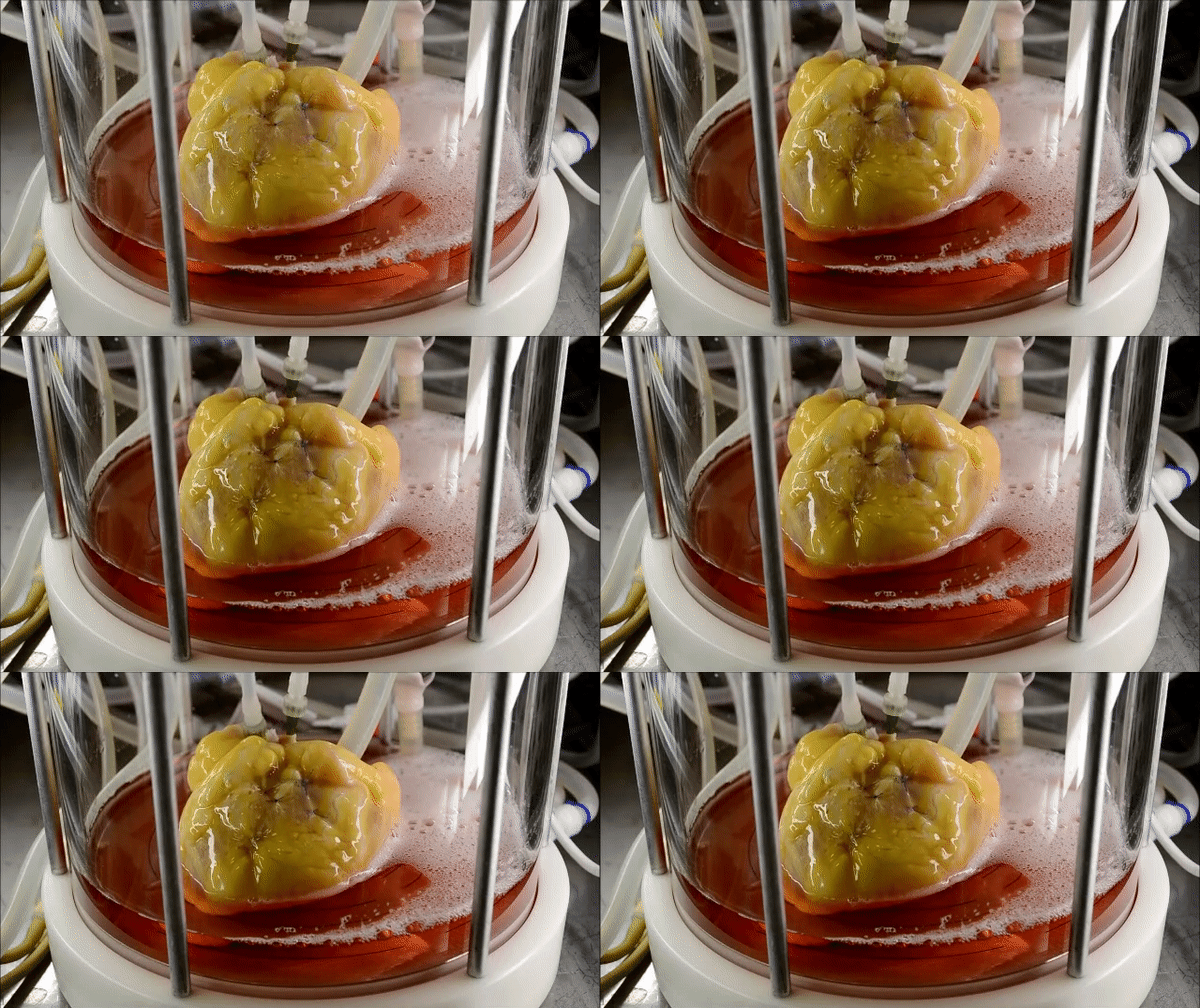
Researchers are exploring numerous approaches, including bioprinting tiny blood vessels, encouraging natural vessel growth, and using existing biological frameworks from donor organs after removing their original cells.
Progress in vascular engineering is considered essential before fully functional lab-grown organs become a routine clinical reality.
Decellularization: Using Nature’s Blueprint
An innovative technique known as decellularization takes advantage of organs that already possess the correct structure.
Scientists remove nearly all living cells from a donated organ while preserving its extracellular matrix, the natural framework that supports tissues.
This biological scaffold retains the organ’s original shape, blood vessel architecture, and microscopic organization.
Researchers then introduce new cells, ideally from the future recipient, allowing the scaffold to become repopulated with living tissue.
This strategy combines nature’s structural design with personalized regenerative medicine.
Although still experimental for many organs, decellularization has shown encouraging results in laboratory studies.
Progress in Growing Individual Tissues
Not every medical breakthrough requires growing an entire organ.
Scientists have already developed laboratory-grown tissues that are used in selected clinical situations.
Engineered skin has become an important treatment for some severe burns and other injuries.
Researchers have also developed experimental cartilage, bladder tissue, sections of blood vessels, corneal tissues, and components of the trachea under carefully controlled circumstances.
These successes demonstrate that regenerative medicine is steadily moving from laboratory research toward clinical application, although many approaches remain under investigation.
The Challenge of Growing Complex Organs
Some organs are significantly more difficult to recreate than others.
The liver contains numerous specialized cell populations performing hundreds of metabolic functions.
The kidney filters blood through millions of microscopic units called nephrons while precisely regulating water, salts, and waste products.
The heart requires synchronized electrical activity and powerful muscular contractions throughout life.
The brain contains billions of interconnected neurons forming extraordinarily complex communication networks.
Reproducing these sophisticated biological systems demands advances across multiple scientific disciplines.
Scientists must understand not only the individual cells but also how they organize, communicate, repair themselves, and respond to changing conditions inside the body.
Personalized Medicine Through Lab-Grown Organs
One of the greatest promises of regenerative medicine is personalized healthcare.
Instead of creating one standard organ for everyone, future treatments may produce organs specifically designed for each individual patient.
Using the patient’s own cells could reduce immune rejection while preserving compatibility with the body’s biological systems.
Doctors may someday collect a small skin sample, reprogram its cells into stem cells, grow the required organ, and transplant it back into the same patient.
Although this vision has not yet become routine medical practice, ongoing research continues to move in that direction.
Lab-Grown Organs for Drug Testing
Even before fully transplantable organs become available, laboratory-grown tissues are already changing pharmaceutical research.
Many experimental drugs fail because animal studies cannot perfectly predict human responses.
Human organoids and engineered tissues provide more realistic models for testing safety and effectiveness.
Scientists can expose lab-grown liver tissue to new medications to evaluate toxicity or study how kidney tissues process drugs.
Cancer researchers can sometimes grow organoids from a patient’s own tumor, helping investigate which treatments might work best.
This approach has the potential to improve drug development while reducing costs and accelerating medical research.
Artificial Intelligence and Organ Engineering
Artificial intelligence is beginning to play an increasingly important role in regenerative medicine.
Machine learning systems can analyze enormous biological datasets, identify patterns in cell behavior, optimize tissue growth conditions, and assist in designing complex scaffolds.
AI may also help predict how cells will organize themselves during tissue development or identify the best combinations of growth factors for different organs.
Rather than replacing scientists, artificial intelligence serves as a powerful tool that helps researchers solve exceptionally complex biological problems.
Ethical Questions
The development of lab-grown organs raises important ethical questions alongside scientific opportunities.
Researchers must ensure that new technologies are tested thoroughly for safety and effectiveness before clinical use.
Issues surrounding access, affordability, and fair distribution also deserve careful consideration.
Scientists, physicians, ethicists, policymakers, and the public all play important roles in shaping responsible guidelines for regenerative medicine.
Thoughtful oversight helps ensure that these technologies benefit society while protecting patients.
Economic and Global Impact
If lab-grown organs become widely available in the future, their impact could extend far beyond individual patients.
Healthcare systems might reduce the enormous costs associated with long-term organ failure, repeated hospitalizations, and lifelong dialysis.
Organ shortages could become less severe, allowing more patients to receive timely treatment.
Scientific advances could stimulate new industries involving biotechnology, biomaterials, medical manufacturing, and precision medicine.
At the same time, ensuring that these treatments remain accessible across different countries and healthcare systems will be an important challenge.
Current Limitations
Despite remarkable progress, scientists emphasize that growing fully functional transplantable organs remains an ongoing area of research.
Many experimental organs function only partially or survive for limited periods in laboratory settings.
Researchers continue working to solve challenges involving vascularization, long-term stability, immune compatibility, mechanical strength, and large-scale manufacturing.
Clinical trials are carefully evaluating new regenerative approaches, but widespread transplantation of complex lab-grown organs has not yet become routine medical practice.
Scientific progress often occurs gradually, with each discovery building upon years of previous research.
What the Future May Look Like
The coming decades may transform regenerative medicine in ways that are difficult to imagine today.
Hospitals could eventually maintain specialized laboratories capable of growing personalized tissues for patients awaiting surgery.
Severely injured organs might be repaired rather than replaced.
People with chronic diseases could receive engineered tissues before permanent damage occurs.
Drug development may increasingly rely on patient-specific organoids instead of traditional laboratory models.
Researchers may also combine gene editing, stem cell biology, bioprinting, advanced biomaterials, and artificial intelligence to create increasingly sophisticated regenerative therapies.
Although many scientific hurdles remain, progress over the past few decades suggests that these possibilities are becoming more realistic with continued research.
The Importance of Continued Research
Every advance in regenerative medicine builds upon decades of work in biology, chemistry, engineering, genetics, materials science, and clinical medicine.
Growing a functioning human organ requires understanding not just individual cells but also the remarkable complexity of living systems.
Each new experiment contributes valuable knowledge, even when immediate success is not achieved.
The collaborative efforts of scientists, engineers, physicians, and patients continue to drive this field forward, bringing new hope to millions of people affected by organ disease.
A Future Built on Science and Hope
The future of lab-grown organs represents one of the most inspiring frontiers in modern medicine. It reflects humanity’s determination to solve one of healthcare’s greatest challenges: replacing damaged organs with living tissues created through science rather than waiting for scarce donor organs.
Although fully functional laboratory-grown hearts, kidneys, livers, and lungs are not yet a routine part of clinical care, the progress already achieved demonstrates the extraordinary potential of regenerative medicine. Advances in stem cells, tissue engineering, bioprinting, organoids, biomaterials, and personalized medicine continue to move the field forward.
The road ahead will require careful research, rigorous testing, ethical responsibility, and global collaboration. Yet every breakthrough brings medicine closer to a future where organ failure is no longer a life-ending diagnosis but a treatable condition. Lab-grown organs may one day transform transplantation, reduce human suffering, and redefine what is possible in healthcare, offering hope that future generations could live longer, healthier lives because science learned not only how to heal the body but also how to grow the very organs that sustain it.