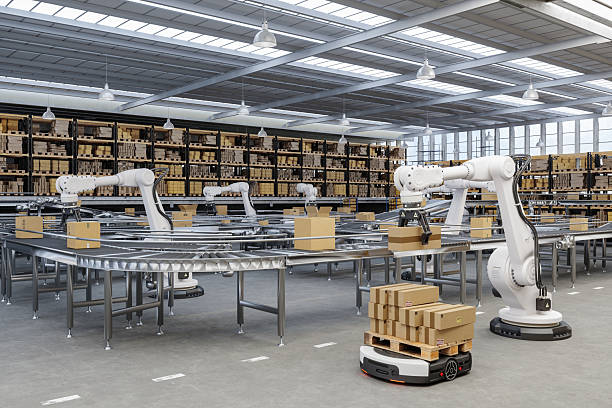
Walk into a modern warehouse, and you may notice something extraordinary. Instead of workers rushing through endless aisles pushing heavy carts, dozens—or even hundreds—of small robots quietly glide across the floor. Robotic arms pick products from shelves with remarkable precision. Conveyor systems transport packages automatically, while cameras and sensors constantly monitor every movement. It may seem like a scene from a science fiction movie, but it is already a reality in warehouses around the world.
Warehouse robots are transforming how goods are stored, picked, packed, sorted, and shipped. They help businesses process thousands of orders every hour with greater speed and accuracy than ever before. As online shopping continues to grow, warehouses have become increasingly dependent on robotic technology to keep up with customer demand.
But how do these robots actually work? How do they know where to go? How can they avoid collisions? How do they identify the correct product among millions of items? The answers lie in a fascinating combination of mechanics, sensors, artificial intelligence, computer vision, and advanced software working together seamlessly.
What Are Warehouse Robots?
Warehouse robots are automated machines designed to perform tasks involved in storing, moving, picking, sorting, and packaging goods inside warehouses and distribution centers. Unlike traditional industrial robots that remain fixed in one location, many warehouse robots are mobile and can travel independently throughout an entire facility.
These robots are built to assist or automate repetitive, physically demanding, and time-sensitive tasks. Rather than replacing every human worker, they often work alongside people, handling heavy lifting, long-distance transportation, or repetitive movements while humans focus on supervision, quality control, maintenance, and complex decision-making.
Modern warehouse robots come in many different forms. Some resemble small flat platforms that carry shelves across the warehouse floor. Others have robotic arms capable of grasping products of different shapes and sizes. Some are tall automated vehicles designed to transport pallets, while others move packages through sophisticated sorting systems.
Although their appearances differ, all warehouse robots share the same fundamental goal: moving products efficiently and accurately from storage to shipment.
Why Warehouses Use Robots
Modern warehouses process enormous numbers of products every day. An online retailer may stock millions of different items, ranging from books and clothing to electronics and groceries.
Customers expect fast deliveries, sometimes within hours of placing an order. Meeting these expectations requires warehouses to locate products quickly, transport them efficiently, package them correctly, and prepare them for shipping without unnecessary delays.
Humans can perform these tasks, but walking several kilometers each day through massive warehouses is physically exhausting and time-consuming.
Robots solve many of these challenges by reducing unnecessary movement, increasing efficiency, minimizing errors, and operating continuously with consistent performance.
This does not mean robots never make mistakes. Instead, well-designed robotic systems help reduce human error while making warehouse operations more predictable and reliable.
The Brain Behind Warehouse Robots
Every warehouse robot depends on software that acts as its “brain.”
This software receives instructions, plans routes, monitors sensors, communicates with other machines, and makes decisions in real time.
At the center of many automated warehouses is a Warehouse Management System, often called a WMS. This software keeps track of every product inside the warehouse.
The system knows where each item is stored, how many are available, when new shipments arrive, and which customer orders need to be fulfilled.
When a customer places an order, the WMS determines which products must be collected.
It then communicates with warehouse robots, assigning tasks based on location, workload, battery level, and traffic conditions inside the warehouse.
Each robot receives detailed instructions, including where to travel, which item to collect, and where to deliver it next.
How Robots Know Where They Are
One of the greatest challenges for warehouse robots is navigation.
Unlike cars driving outdoors, warehouse robots usually cannot rely on GPS because satellite signals are weak or unavailable inside large buildings.
Instead, they use a combination of technologies to determine their position.
Many robots create detailed digital maps of the warehouse.
Using lasers, cameras, depth sensors, and wheel measurements, they continuously compare their surroundings with these maps.
This process allows robots to estimate their location with remarkable accuracy.
Some warehouses also place special visual markers, QR codes, magnetic strips, or reflective targets on floors or ceilings to help robots determine their exact position.
As robots move, they constantly update their location, ensuring they know exactly where they are within the warehouse.
Sensors Help Robots Understand Their Environment
Robots cannot simply move blindly through a warehouse.
They need to detect shelves, walls, workers, forklifts, and other robots.
To accomplish this, warehouse robots use multiple sensors that continuously gather information about their surroundings.
Laser scanners measure distances to nearby objects.
Cameras capture visual information.
Depth sensors estimate three-dimensional shapes.
Ultrasonic sensors detect obstacles using sound waves.
Infrared sensors help identify nearby objects under certain conditions.
Wheel encoders measure how far the robot has traveled.
Some advanced robots also combine information from several sensors at once, creating a more complete understanding of their environment.
This process is known as sensor fusion, allowing robots to make more reliable decisions than they could using a single sensor alone.
Mapping the Warehouse
Before robots begin working, many warehouses are carefully mapped.
The digital map contains storage racks, workstations, charging stations, loading docks, safety zones, and travel pathways.
As robots operate, they continuously compare sensor data with this map.
If temporary obstacles appear, such as a worker carrying boxes or a parked forklift, the robot adjusts its route while maintaining awareness of its original destination.
Some highly advanced robots can even update their maps automatically when permanent changes occur inside the warehouse.
This ability allows robotic systems to adapt as warehouse layouts evolve.
Planning the Best Route
Once a robot knows where it is and where it needs to go, it must calculate the safest and fastest route.
The robot’s navigation software considers many factors.
It avoids blocked paths.
It accounts for one-way travel lanes.
It prevents congestion.
It coordinates with other robots.
It may even prioritize urgent customer orders.
Rather than simply moving in a straight line, robots continuously recalculate their paths whenever conditions change.
If another robot temporarily blocks an aisle, the system automatically selects an alternative route.
This dynamic planning helps maintain smooth warehouse operations even during busy periods.
Avoiding Collisions
One of the most important safety features of warehouse robots is collision avoidance.
As robots move, sensors constantly scan their surroundings.
If a worker suddenly steps into the robot’s path, the robot immediately slows down or stops.
If another robot approaches, both machines coordinate their movements to avoid contact.
Modern warehouses often contain hundreds of robots moving simultaneously without crashing into one another.
This coordination is possible because robots continuously exchange information with central management systems or directly with nearby robots.
Their software predicts potential collisions before they happen and adjusts movement accordingly.
Safety remains a top priority, especially in warehouses where robots and humans work together.
Picking Products
Finding a product inside a warehouse is only part of the job.
The robot must also retrieve it correctly.
Some warehouse robots carry entire shelves to human workers.
Instead of workers walking through the warehouse searching for products, robots bring the shelves directly to packing stations.
This greatly reduces unnecessary walking and speeds up order processing.
Other robots use robotic arms equipped with grippers.
These arms identify the correct item using cameras and artificial intelligence.
The robot estimates the product’s shape, position, size, and orientation before selecting the best way to grasp it.
Different products require different gripping techniques.
Soft packages may be lifted using suction cups.
Boxes may be grasped using mechanical fingers.
Fragile objects require careful handling to avoid damage.
Advanced robotic systems automatically adjust their grip depending on the object.
Computer Vision Helps Robots See
Warehouse robots rely heavily on computer vision, a branch of artificial intelligence that enables machines to interpret images.
High-resolution cameras capture pictures of shelves and products.
Computer vision algorithms identify labels, barcodes, packaging shapes, and product positions.
Some systems can recognize thousands of different products with remarkable accuracy.
They distinguish between similar-looking boxes using printed labels, dimensions, colors, or barcode information.
Computer vision also helps robots inspect products for visible damage before shipment.
Artificial Intelligence Improves Decision Making
Artificial intelligence allows warehouse robots to become more efficient over time.
Instead of following only fixed instructions, AI systems analyze large amounts of operational data.
They learn which routes are usually faster.
They predict busy periods.
They optimize storage locations.
They improve picking accuracy.
Machine learning algorithms may analyze millions of completed orders to discover more efficient warehouse layouts.
Frequently purchased products can be stored closer to packing stations, reducing travel time.
AI can also predict equipment maintenance needs before failures occur, reducing unexpected downtime.
Robotic Arms and Precision Movement
Robotic arms used in warehouses contain multiple joints that function similarly to a human shoulder, elbow, and wrist.
Electric motors precisely control each joint.
Software calculates exactly how every joint must move so the robot’s hand reaches the desired position.
This process requires complex mathematics involving geometry and motion planning.
Even small positioning errors could cause products to be dropped or damaged.
Modern robotic arms achieve remarkable precision, allowing them to pick objects only a few centimeters wide.
Moving Heavy Loads
Many warehouse robots specialize in transporting heavy goods.
Automated Guided Vehicles (AGVs) and Autonomous Mobile Robots (AMRs) can move pallets weighing hundreds or even thousands of kilograms.
Powerful electric motors drive these machines.
Heavy-duty wheels provide stability.
Sensors monitor weight distribution to prevent tipping.
The robot continuously adjusts acceleration, braking, and steering to transport cargo safely.
Conveyor Systems Work Together with Robots
Warehouse robots often operate alongside automated conveyor systems.
Conveyors transport products between receiving areas, storage locations, packing stations, and shipping docks.
Robots place items onto conveyors or remove them automatically.
Barcode scanners identify each package as it moves.
The warehouse software tracks every item’s location throughout its journey.
This integration allows thousands of packages to flow smoothly through large distribution centers.
Sorting Packages Automatically
Once products are packed, they must be sorted according to destination.
Automated sorting systems use scanners to read barcodes or shipping labels.
Software determines where each package should go.
Mechanical arms, pushers, tilting trays, or robotic devices direct each package toward the correct shipping area.
These systems process thousands of packages every hour while maintaining high accuracy.
Charging Without Interrupting Work
Warehouse robots depend on rechargeable batteries.
Instead of waiting until batteries are completely empty, many robots monitor their remaining power continuously.
When battery levels become low, the robot schedules a visit to a charging station between assigned tasks.
Some warehouses even use opportunity charging, where robots recharge briefly whenever they have short breaks.
This minimizes downtime while maximizing productivity.
Engineers continue developing faster charging technologies and more energy-efficient batteries to improve robot performance.
Communication Between Robots
Warehouse robots rarely work alone.
They constantly exchange information with warehouse management systems and sometimes directly with one another.
This communication allows robots to coordinate movements, avoid congestion, share traffic information, and balance workloads.
Wireless networks connect robots throughout the warehouse.
Every robot knows which tasks have priority and which areas are becoming crowded.
This coordination creates an organized flow of movement rather than random activity.
Safety Around Human Workers
Modern warehouse robots are designed with numerous safety features.
Sensors continuously monitor nearby people.
Emergency stop systems halt movement instantly when necessary.
Speed automatically decreases in areas where humans frequently work.
Many robots emit lights or sounds to indicate their direction of travel.
Safety standards require extensive testing before robotic systems are deployed in workplaces.
The goal is to create an environment where humans and robots can work together safely and efficiently.
Benefits of Warehouse Robots
Warehouse robots provide several important advantages.
They reduce physically demanding work.
They improve order accuracy.
They increase productivity.
They operate consistently throughout the day.
They reduce repetitive strain on workers.
They help businesses respond more quickly to customer orders.
Robots also improve inventory tracking because every movement is digitally recorded.
This makes it easier to locate products and detect inventory errors.
As automation improves, warehouses become more organized and capable of handling increasing numbers of orders.
Challenges of Warehouse Robotics
Despite their impressive capabilities, warehouse robots are not perfect.
Installing robotic systems requires significant investment.
Warehouses may need new infrastructure, wireless networks, charging stations, and specialized software.
Some products remain difficult for robots to handle because of unusual shapes, delicate materials, or constantly changing packaging.
Robots also require maintenance, software updates, and occasional repairs.
Unexpected technical problems can temporarily interrupt warehouse operations.
Cybersecurity has become increasingly important as warehouses rely more heavily on connected robotic systems.
Protecting software and communication networks is essential for reliable operation.
The Future of Warehouse Robots
Warehouse robotics continues advancing rapidly.
Future robots are expected to become more intelligent, adaptable, and collaborative.
Improved artificial intelligence will enable robots to recognize a wider variety of products and make more complex decisions.
Advances in computer vision may allow robots to identify damaged packaging more accurately.
Better sensors will improve navigation in busy environments.
New robotic hands may handle fragile or irregularly shaped objects with human-like dexterity.
Researchers are also developing robots capable of working more naturally alongside people, responding safely to unpredictable human behavior while maintaining high efficiency.
As battery technology, artificial intelligence, and robotics continue to improve, warehouse automation is likely to become even more widespread.
Understanding the Machines Behind Modern Commerce
Every package that arrives at a doorstep has traveled through a complex journey, and increasingly, warehouse robots are responsible for making that journey faster, safer, and more accurate. These machines combine mechanical engineering, electronics, sensors, computer vision, artificial intelligence, wireless communication, and advanced software into highly coordinated systems capable of performing tasks that once required enormous amounts of manual labor.
Yet warehouse robots are more than just machines moving boxes. They represent decades of scientific and engineering progress, transforming warehouses into intelligent environments where people and technology work together. Rather than replacing the human role entirely, these robots are designed to complement human skills, taking on repetitive and physically demanding work while allowing people to focus on tasks that require creativity, judgment, and problem-solving.
As global trade and online shopping continue to expand, warehouse robots will play an increasingly important role in ensuring that products move efficiently from manufacturers to customers. Behind every smoothly delivered order is an invisible network of intelligent machines, quietly working together to keep the modern world connected.