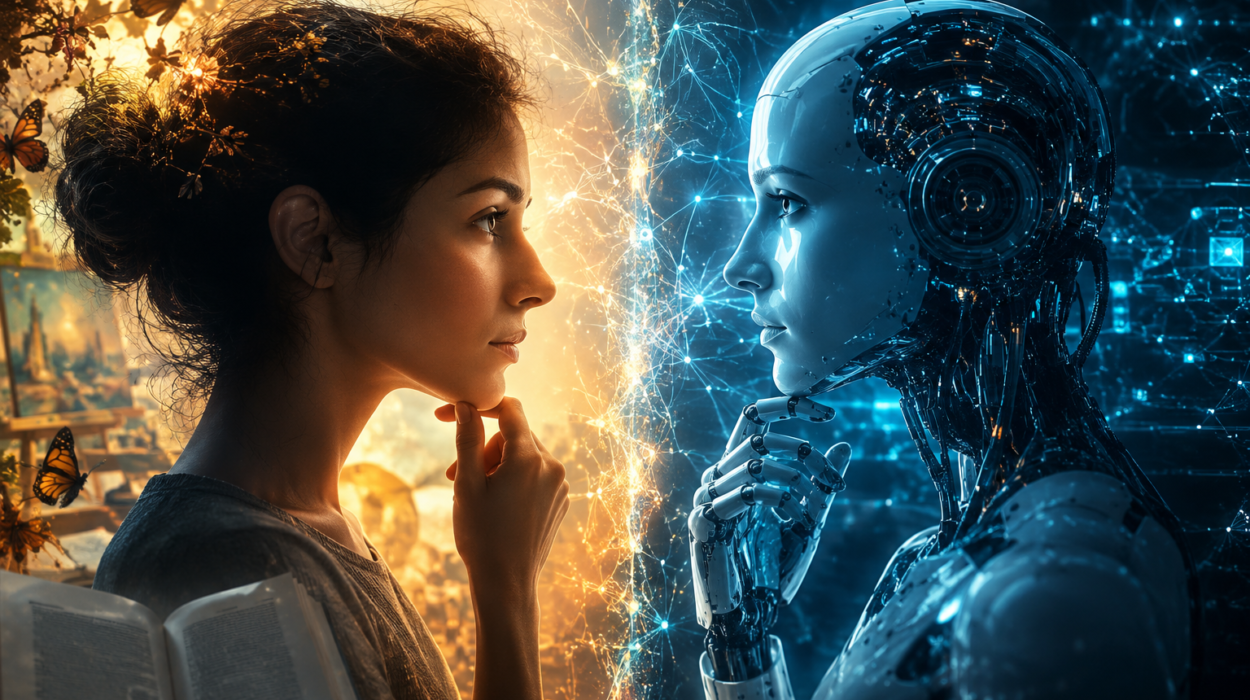
Artificial intelligence is no longer a vision of the distant future. It is already woven into our daily lives in ways many people hardly notice. Every time a smartphone recognizes a face, a navigation app suggests the fastest route, a streaming service recommends a favorite movie, or an online translator instantly converts one language into another, artificial intelligence is quietly at work.
Yet what we see today is only the beginning. Around the world, scientists, engineers, and researchers are developing AI systems that are becoming more capable, more efficient, and more useful every year. These advances are opening exciting possibilities in medicine, education, transportation, agriculture, environmental protection, scientific research, and countless other fields.
The future of artificial intelligence is not simply about building smarter machines. It is about understanding how humans and intelligent technologies can work together to solve some of the world’s greatest challenges. While AI promises remarkable opportunities, it also raises important questions about ethics, privacy, fairness, employment, and safety. The choices humanity makes today will shape how AI influences society for generations to come.
Understanding Artificial Intelligence
Artificial intelligence, often called AI, is a branch of computer science that focuses on creating systems capable of performing tasks that normally require human intelligence. These tasks include recognizing speech, understanding language, identifying images, making predictions, solving problems, learning from experience, and making decisions based on available information.
Unlike traditional computer programs that follow fixed instructions, many modern AI systems improve their performance by analyzing large amounts of data. This ability, known as machine learning, allows AI to recognize patterns and make increasingly accurate predictions over time.
It is important to understand that today’s AI is known as narrow AI or specialized AI. These systems are designed for specific tasks, such as translating languages or recognizing faces. They do not possess human-like consciousness, emotions, or general understanding of the world.
Why AI Is Advancing So Quickly
The rapid progress of artificial intelligence is the result of several scientific and technological developments happening at the same time.
Modern computers have become vastly more powerful than those of previous decades. Cloud computing allows enormous amounts of information to be processed efficiently. The availability of large digital datasets gives AI systems more opportunities to learn. At the same time, researchers continue developing more advanced algorithms that improve how AI analyzes information and solves problems.
Specialized computer hardware designed for AI calculations has also accelerated progress. Powerful processors can train complex AI models much faster than before, allowing researchers to explore increasingly sophisticated approaches.
Together, these advances have transformed AI from a largely experimental technology into one that supports millions of people every day.
AI Will Become a More Helpful Everyday Assistant
One of the most noticeable changes in the future will be AI becoming an even more capable personal assistant.
Instead of responding only to simple commands, future AI systems are expected to better understand conversations, remember ongoing tasks during an interaction, and provide more useful assistance based on context.
Imagine planning an entire vacation by simply describing your preferences. AI could suggest destinations, compare transportation options, estimate travel costs, organize schedules, and translate conversations while traveling.
Students may use AI to explain difficult scientific concepts in personalized ways. Professionals may receive assistance organizing projects, analyzing information, and generating reports. Families could manage household tasks more efficiently with intelligent home systems.
Rather than replacing human thinking, these assistants are expected to help people complete routine tasks more efficiently, leaving more time for creativity and decision-making.
The Future of Healthcare
Healthcare may experience some of the greatest benefits from artificial intelligence.
AI is already helping researchers analyze medical images, identify patterns in health data, and support doctors during diagnosis. In the future, these capabilities are likely to become even more accurate and widespread.
Scientists are developing AI systems that can assist in discovering new medicines by analyzing enormous numbers of chemical compounds much faster than traditional methods. This could reduce the time needed to identify promising drug candidates, although extensive laboratory testing and clinical trials would still be required to ensure safety and effectiveness.
Hospitals may use AI to monitor patients continuously, helping healthcare professionals recognize early warning signs of certain medical conditions. Personalized treatment plans may become more common as AI helps analyze individual medical histories, genetic information, and lifestyle factors.
Importantly, medical experts generally view AI as a tool to assist healthcare professionals rather than replace them. Human doctors will continue making critical medical decisions while using AI to support their expertise.
AI Could Transform Education
Education is another area where artificial intelligence may have a profound impact.
Every student learns differently. Some understand concepts quickly through visual explanations, while others benefit from interactive exercises or repeated practice.
Future AI-powered educational systems may adapt lessons to each student’s learning style and pace. Instead of giving every learner identical material, AI could identify areas where additional support is needed and provide personalized guidance.
Teachers may also benefit. AI could help prepare lesson materials, evaluate assignments, identify students needing extra assistance, and reduce administrative workloads.
Rather than replacing teachers, AI has the potential to allow educators to spend more time mentoring, inspiring, and supporting students.
Scientific Discovery May Accelerate
Artificial intelligence is becoming an increasingly valuable tool for scientific research.
Modern scientific experiments often generate enormous amounts of data that would take humans years to analyze manually. AI can identify patterns within these datasets much more quickly.
Astronomers use AI to search for distant galaxies and detect unusual signals from space. Climate scientists analyze environmental data to improve climate models. Biologists use AI to study proteins and genetic information. Physicists employ AI to analyze data from particle accelerators.
Future AI systems may help researchers generate new scientific hypotheses, design experiments, and analyze results more efficiently.
However, scientific discoveries will still require careful verification through experiments and peer review. AI can assist scientists, but evidence remains the foundation of science.
Smarter Transportation Systems
Transportation is likely to become safer and more efficient through AI.
Modern vehicles already use AI for features such as automatic emergency braking, lane-keeping assistance, adaptive cruise control, and collision warnings.
Future transportation systems may coordinate traffic more intelligently, reducing congestion and improving fuel efficiency.
Self-driving vehicles continue to be an active area of research. While significant progress has been made, fully autonomous driving in all environments remains a complex scientific and engineering challenge. Researchers continue working to improve safety, reliability, and decision-making under diverse road conditions.
AI may also optimize public transportation, shipping routes, aviation systems, and railway operations, helping reduce delays and improve efficiency.
Artificial Intelligence and Climate Change
The future of AI may also contribute to addressing environmental challenges.
Researchers are using AI to improve weather forecasting, monitor forests, detect illegal deforestation, optimize renewable energy systems, and improve energy efficiency.
Power grids may use AI to better balance electricity generated from solar panels and wind turbines. Farmers may use AI to monitor soil conditions, reduce water consumption, and improve crop management.
Scientists are also using AI to analyze satellite images that help track melting glaciers, rising sea levels, wildfires, and changing ecosystems.
Although AI itself requires significant computing resources, researchers are actively working to develop more energy-efficient AI technologies.
AI in Space Exploration
Space agencies are increasingly using artificial intelligence to support exploration beyond Earth.
Future robotic spacecraft may rely on AI to make decisions when communication with Earth is delayed. Rovers exploring distant planets could independently identify scientifically interesting rocks, navigate difficult terrain, and prioritize observations.
Astronomers use AI to process enormous amounts of telescope data, helping identify exoplanets, galaxies, and other astronomical objects that might otherwise remain unnoticed.
As future telescopes become even more powerful, AI will likely become essential for managing the tremendous volume of information collected from the universe.
AI and Creativity
Artificial intelligence is becoming increasingly capable of generating text, images, music, computer code, and videos.
These systems do not create ideas through human emotions or personal experiences. Instead, they generate content by recognizing patterns learned from large collections of existing data.
In the future, AI may become a valuable creative partner.
Writers may use AI to organize ideas and edit drafts.
Artists may explore new visual styles.
Musicians may experiment with melodies and harmonies.
Architects may rapidly generate multiple building concepts.
Designers may test creative possibilities more efficiently.
Human imagination will remain central, while AI provides additional tools for exploration and experimentation.
The Future of Work
One of the most discussed questions about AI concerns employment.
Throughout history, technological advances have changed the nature of work. Mechanization transformed agriculture. Industrial machines reshaped manufacturing. Computers changed office work.
Artificial intelligence is expected to continue this pattern.
Some repetitive and predictable tasks may become increasingly automated. At the same time, entirely new careers are likely to emerge in AI development, robotics, cybersecurity, data science, AI safety, ethics, and many other fields.
Jobs emphasizing creativity, critical thinking, communication, leadership, scientific research, emotional understanding, and complex decision-making are expected to remain highly valuable.
The future workforce will likely require continuous learning as technology evolves.
AI and Human Collaboration
Many experts believe the future is not about humans competing against AI but about humans collaborating with AI.
Doctors working alongside AI may diagnose diseases more accurately.
Scientists may analyze research faster.
Engineers may design safer structures.
Teachers may personalize education.
Farmers may improve crop production.
Business professionals may make better-informed decisions.
In these situations, AI serves as an assistant that enhances human abilities rather than replacing human judgment.
The most successful future may come from combining human creativity, empathy, ethics, and experience with AI’s speed, precision, and analytical capabilities.
Ethical Challenges
As artificial intelligence becomes more powerful, ethical questions become increasingly important.
AI systems should be designed to treat people fairly and avoid discrimination. Researchers work to reduce biases that may appear in training data.
Privacy is another major concern. AI often relies on large amounts of information, making responsible data protection essential.
Transparency also matters. People should understand when AI is making recommendations and how important decisions are reached whenever possible.
Accountability remains crucial. Humans—not AI systems—must ultimately remain responsible for decisions with significant consequences.
Developing trustworthy AI requires cooperation among scientists, governments, businesses, educators, and society.
AI Safety
Researchers around the world are actively studying AI safety.
The goal is to ensure that advanced AI systems behave reliably, follow intended instructions, and remain aligned with human values and legal requirements.
Safety research includes improving system reliability, reducing harmful errors, preventing misuse, and developing methods to evaluate AI behavior before deployment.
International cooperation is becoming increasingly important as AI technologies continue advancing across many countries.
Artificial General Intelligence
One of the biggest questions about the future involves Artificial General Intelligence (AGI).
AGI refers to a hypothetical form of AI that could perform a wide range of intellectual tasks at a level comparable to or beyond humans. Unlike today’s specialized AI, an AGI would be capable of learning and applying knowledge across many different domains.
At present, AGI has not been achieved.
Scientists and researchers continue debating whether it is possible, how it might be developed, and when it could emerge. Predictions vary widely, and there is currently no scientific consensus regarding a timeline.
Because of this uncertainty, discussions about AGI remain largely theoretical while researchers continue advancing existing AI technologies.
The Importance of Responsible Development
The future benefits of artificial intelligence will depend not only on scientific breakthroughs but also on responsible development.
Governments are developing regulations to address AI safety, privacy, intellectual property, and accountability.
Technology companies are investing in research to improve reliability and reduce harmful outputs.
Universities continue studying ethical frameworks for AI development.
International organizations encourage cooperation so that AI technologies can benefit humanity while minimizing risks.
Responsible innovation will be essential as AI becomes more deeply integrated into society.
Will AI Replace Humans?
This question appears frequently, but the answer is more complex than many headlines suggest.
Artificial intelligence excels at processing large amounts of information, recognizing patterns, and performing specialized tasks rapidly.
Humans, however, possess qualities that extend beyond current AI capabilities. People demonstrate emotional understanding, moral reasoning, cultural awareness, creativity shaped by lived experience, and the ability to navigate complex social situations.
Rather than replacing humanity, AI is more likely to reshape how people work, learn, communicate, and solve problems.
The future will depend on how wisely humans choose to design, regulate, and use these powerful technologies.
A Future Built Together
Artificial intelligence is one of the most significant technological developments in human history. Like electricity, the internet, and the computer before it, AI has the potential to transform nearly every aspect of society. It offers opportunities to improve healthcare, expand educational access, accelerate scientific discovery, strengthen environmental protection, and make everyday life more efficient.
At the same time, AI is not a magic solution to every problem. It requires careful oversight, scientific research, ethical responsibility, and thoughtful governance. The technology itself is neither inherently good nor inherently harmful. Its impact depends on the choices people make about how it is developed and applied.
The future of artificial intelligence is therefore not a story written by machines alone. It is a story written by scientists, engineers, educators, healthcare professionals, policymakers, businesses, communities, and individuals working together. By combining human wisdom with the remarkable capabilities of AI, humanity has the opportunity to build a future that is more innovative, more connected, and better equipped to address the challenges of an ever-changing world.