Imagine typing a single sentence:
“A tiny red fox reading a book under a glowing tree at sunset.”
Only a few moments later, a brand-new image appears. The fox has never existed. The tree was never photographed. No artist sat down to paint the scene. Yet the picture looks detailed, creative, and surprisingly realistic.
To many people, this feels almost magical.
But behind that apparent magic lies an extraordinary combination of mathematics, computer science, artificial intelligence, and billions of examples that have taught an AI system how images relate to language.
Today, AI image generation has become one of the most exciting advances in modern technology. It allows people to create illustrations, concept art, educational graphics, scientific visualizations, product designs, and imaginative scenes simply by describing them with words.
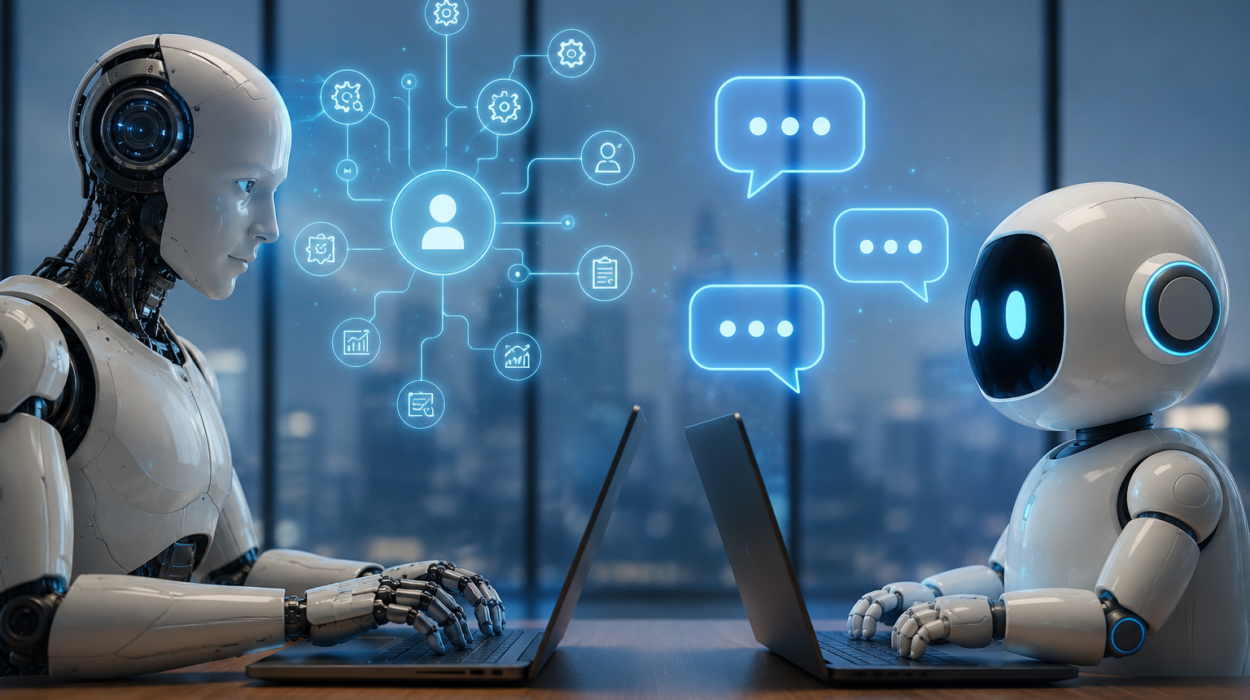
One of the best-known ways people interact with this technology is through ChatGPT. Although ChatGPT is primarily known for understanding and generating text, it can also help users create images by working with an AI image-generation model. When a user describes what they want, ChatGPT interprets the request and sends instructions to the image-generation system, which creates a completely new image.
Understanding how this process works reveals one of the most fascinating achievements in modern artificial intelligence.
ChatGPT Does Not Draw Like a Human Artist
When people hear that ChatGPT can create images, they sometimes imagine an invisible digital artist holding a virtual paintbrush.
That is not what happens.
Humans usually draw by imagining an object and carefully placing lines, colors, shadows, and textures on a blank canvas.
AI works differently.
Instead of consciously deciding where every brushstroke should go, an AI image model generates images by applying mathematical calculations learned from enormous collections of image-and-text examples during training.
It does not “see” the picture in its mind before creating it.
It performs billions of numerical operations that gradually produce an image matching the user’s description.
The result may look artistic, but underneath it is a highly sophisticated computational process.
ChatGPT and the Image Generator Work Together
ChatGPT itself is a large language model.
Its main strength is understanding human language.
When you type a prompt such as:
“Create a watercolor painting of a castle on floating islands during sunrise.”
ChatGPT first interprets what you mean.
It identifies important ideas.
It understands relationships between objects.
It recognizes artistic styles.
It interprets colors, lighting, perspective, mood, composition, and other descriptive details.
Once the request is understood, ChatGPT works with an AI image-generation model that creates the actual image.
In other words, ChatGPT acts as the language expert, while the image model acts as the visual creator.
This collaboration allows people to communicate naturally instead of learning complicated graphics software.
Everything Begins With Your Prompt
Every generated image starts with a prompt.
A prompt is simply a description written in natural language.
It can be extremely short.
“A blue butterfly.”
Or highly detailed.
“A realistic snowy mountain village at sunrise, wooden cabins covered with fresh snow, gentle smoke rising from chimneys, golden morning light, frozen river reflecting the sky, highly detailed.”
The more clearly a scene is described, the more information the AI has available when generating the image.
Modern AI systems can interpret many different kinds of instructions.
Users can describe objects.
People.
Animals.
Landscapes.
Historical settings.
Scientific diagrams.
Artistic styles.
Camera angles.
Lighting conditions.
Colors.
Textures.
Weather.
Emotions.
Even complex combinations of these ideas.
Learning From Millions or Billions of Examples
One of the biggest questions people ask is:
How does the AI know what a fox looks like?
Or a castle?
Or the Moon?
The answer lies in training.
Before an AI image generator can create pictures, it undergoes an extensive learning process using very large collections of images paired with descriptive text. During this training, the model learns statistical relationships between visual patterns and language.
For example, across many training examples, the model learns that images described as “cat” often share certain visual characteristics, while images labeled “tree” share different ones.
The AI is not memorizing every picture.
Instead, it learns mathematical representations of visual concepts.
Over time, it develops an understanding of how countless objects, materials, colors, lighting conditions, artistic styles, and scenes relate to words.
This learning process requires enormous computing resources and can take weeks or months.
Images Become Mathematics
Humans see photographs.
Computers see numbers.
Every digital image consists of tiny colored squares called pixels.
Each pixel contains numerical values representing colors.
For a computer, an image is ultimately a huge collection of numbers arranged in a grid.
Artificial intelligence learns mathematical patterns hidden within these numbers.
Instead of thinking:
“This is a tree.”
The AI processes numerical relationships that correspond to trunks, branches, leaves, shadows, textures, and colors.
Everything becomes mathematics.
That mathematics allows entirely new images to be generated later.
Understanding Language
Creating a beautiful picture requires more than recognizing objects.
The AI must understand relationships between words.
Consider these two prompts:
“A cat chasing a dog.”
“A dog chasing a cat.”
The same two animals appear in both descriptions.
But their relationship changes completely.
Modern language models understand these differences.
They identify which object performs an action, which receives it, and how the scene should be arranged.
Similarly, the prompt:
“A bird sitting on a tree.”
Differs from:
“A tree sitting on a bird.”
Language understanding helps ensure the generated image matches the intended meaning rather than simply including all mentioned objects.
Turning Words Into Meaning
Inside the AI, words are converted into mathematical representations called embeddings.
Embeddings capture relationships between concepts.
For example, words such as “puppy,” “dog,” and “wolf” occupy nearby regions within this mathematical space because they share related meanings.
Likewise, “ocean,” “beach,” and “waves” are closely connected.
These mathematical relationships help AI understand context.
The system recognizes that:
“A snowy mountain”
Is different from:
“A tropical mountain.”
It understands that:
“Ancient castle”
Suggests something different from:
“Modern skyscraper.”
The richer this mathematical understanding becomes, the more accurately the AI can generate images matching human descriptions.
Starting With Random Noise
One of the most fascinating aspects of many modern AI image generators is where the process begins.
Surprisingly, the first image often looks like meaningless visual static—random colored noise similar to television interference.
At first glance, there is absolutely nothing recognizable.
No fox.
No castle.
No mountain.
Just random pixels.
The AI then gradually transforms this random noise into a coherent picture.
Step by step, the random patterns become organized.
Shapes emerge.
Colors become meaningful.
Objects take form.
Lighting develops.
Textures appear.
Eventually, the finished image matches the user’s prompt.
This gradual refinement process is a defining feature of many state-of-the-art image-generation systems.
The Science of Diffusion Models
Many modern image generators use a family of AI systems known as diffusion models.
The basic idea is inspired by reversing a process.
Imagine taking a clear photograph.
Now slowly add more and more random visual noise until the picture becomes completely unrecognizable.
A diffusion model learns how to reverse that process.
Instead of destroying an image, it learns how to remove noise little by little until a meaningful image appears.
During training, the model repeatedly practices predicting how to reconstruct images from noisy versions.
Later, when generating a new image, it starts with random noise and progressively refines it into a scene that matches the user’s prompt.
Although the mathematics behind diffusion models is highly sophisticated, the basic concept is surprisingly intuitive: transform randomness into structure through many carefully learned steps.
Building Objects Piece by Piece
The image does not appear all at once.
Instead, different elements gradually become clearer.
Large shapes often emerge first.
The general layout develops.
Major objects become recognizable.
Then finer details appear.
Eyes.
Hair.
Leaves.
Clouds.
Fabric textures.
Reflections.
Shadows.
Tiny decorative features.
Each stage improves the image.
After many refinement steps, the final result becomes highly detailed.
Understanding Artistic Styles
Modern image-generation models can produce artwork in many different styles because they have learned statistical characteristics associated with those styles during training.
Users may request watercolor paintings.
Oil paintings.
Pencil sketches.
Digital illustrations.
Pixel art.
Ink drawings.
Paper cutouts.
Low-poly designs.
Photorealistic images.
The AI does not copy an individual artwork.
Instead, it generates a new image that reflects the requested visual characteristics while creating original pixel arrangements.
This ability makes AI useful for artists, educators, designers, researchers, and storytellers.
Lighting Makes Images Feel Real
One reason AI-generated images often look convincing is their ability to simulate lighting.
The system has learned statistical patterns associated with sunlight, shadows, reflections, clouds, indoor lighting, sunsets, moonlight, and many other conditions.
When a prompt requests:
“Golden sunset.”
The AI generates warm lighting.
Long shadows.
Orange highlights.
Soft atmospheric colors.
Likewise, a prompt requesting:
“Stormy afternoon.”
May produce darker clouds.
Cooler colors.
Reduced visibility.
Wet surfaces.
Lighting dramatically changes the emotional atmosphere of an image.
Perspective and Composition
A good image depends not only on what appears but also on how everything is arranged.
Modern AI systems often generate coherent compositions because they have learned statistical relationships involving perspective, balance, scale, and spatial organization.
A prompt specifying:
“Close-up portrait.”
Produces a composition different from:
“Wide landscape.”
Similarly:
“Bird’s-eye view.”
Creates an entirely different perspective from:
“Ground-level photograph.”
These visual decisions contribute significantly to realism.
Can ChatGPT Edit Existing Images?
In addition to generating entirely new pictures, AI image systems can often modify existing images.
Depending on the available tools, users may ask the AI to remove objects, change backgrounds, adjust lighting, replace colors, improve image quality, or add new elements while preserving much of the original picture.
This process relies on similar AI techniques but begins with an existing image instead of random noise.
The model analyzes both the original image and the user’s instructions before generating the edited result.
Why AI Sometimes Makes Mistakes
Although AI image generation has improved dramatically, it is not perfect.
Images may occasionally contain anatomical errors.
Hands might have incorrect numbers of fingers.
Objects may blend together unnaturally.
Small text inside images can appear distorted or nonsensical.
Complex spatial relationships may sometimes be inconsistent.
These errors occur because AI predicts visual patterns statistically rather than reasoning about the world exactly as humans do.
Researchers continue improving models to reduce these limitations.
Does ChatGPT Understand the Picture?
Not in the human sense.
Humans understand images through perception, memory, reasoning, and lived experience.
Current AI systems process images mathematically.
They recognize statistical patterns rather than possessing conscious visual understanding.
When an AI generates a picture of a cat sitting on a chair, it is not imagining a real cat.
It is calculating pixel arrangements that match patterns associated with cats, chairs, and sitting.
The result may appear highly realistic even though the underlying process differs fundamentally from human perception.
Safety and Responsible Image Generation
Powerful image-generation technology also creates new responsibilities.
AI systems are designed with safety measures intended to reduce harmful or misleading uses. These measures can include restrictions on generating certain kinds of content, helping protect privacy, reducing the risk of creating deceptive imagery, and limiting outputs that could facilitate abuse.
Researchers continue studying ways to make AI-generated images more transparent, reliable, and beneficial.
Responsible development is an active area of computer science, ethics, and public policy.
How Image Generation Is Changing the World
AI-generated images are already transforming many industries.
Teachers create educational illustrations.
Scientists visualize complex ideas.
Architects explore design concepts.
Game developers prototype characters.
Filmmakers plan scenes.
Businesses produce marketing graphics.
Doctors create medical visualizations.
Engineers communicate technical designs.
Artists experiment with new creative workflows.
Rather than replacing human creativity, AI often serves as a collaborative tool that helps people explore ideas more quickly.
Human imagination still guides the process by deciding what should be created, refined, and shared.
The Future of AI Image Generation
Image-generation technology continues advancing rapidly.
Researchers are working to produce higher-resolution images, improve accuracy, reduce visual errors, better follow complex instructions, and provide users with greater creative control.
Future systems may generate increasingly realistic scientific simulations, educational content, interactive virtual environments, architectural designs, and artistic experiences.
At the same time, society continues discussing important questions about copyright, authenticity, transparency, fairness, and the ethical use of AI-generated media.
Balancing innovation with responsibility will remain an important challenge.
More Than Digital Art
At first glance, AI image generation may seem like a machine creating beautiful pictures. In reality, it represents one of the most sophisticated achievements in modern artificial intelligence. Behind every generated image are advances in mathematics, statistics, computer science, machine learning, and language understanding, all working together to transform written ideas into visual creations.
When you describe a scene to ChatGPT, it does not paint with a brush or imagine the picture as a person would. Instead, it interprets your words, represents their meaning mathematically, and works with an AI image-generation model that gradually transforms random visual noise into a coherent image through learned statistical patterns. The result is a completely new creation generated from computation rather than copied from an existing photograph or artwork.
This remarkable process demonstrates how far artificial intelligence has progressed. Yet it also highlights the enduring importance of human creativity. Every AI-generated image begins not with the machine, but with a human idea. Curiosity, imagination, storytelling, and artistic vision remain at the heart of the creative process, while AI provides a powerful new tool for turning those ideas into vivid visual reality.