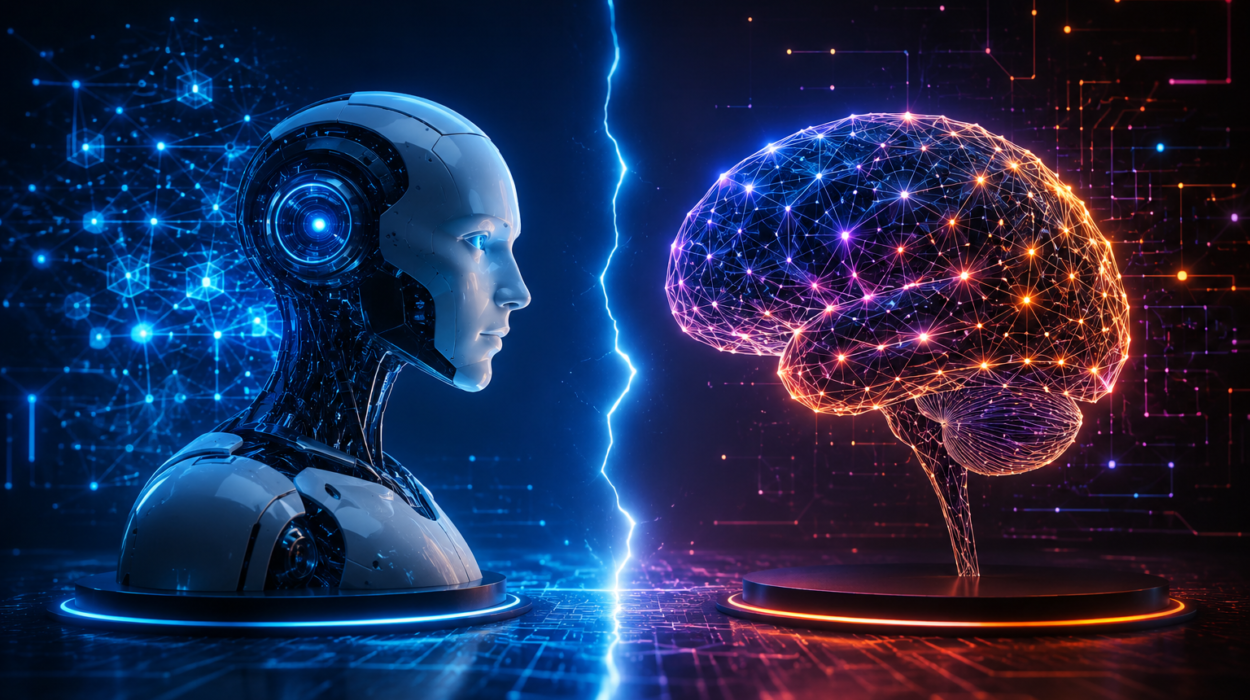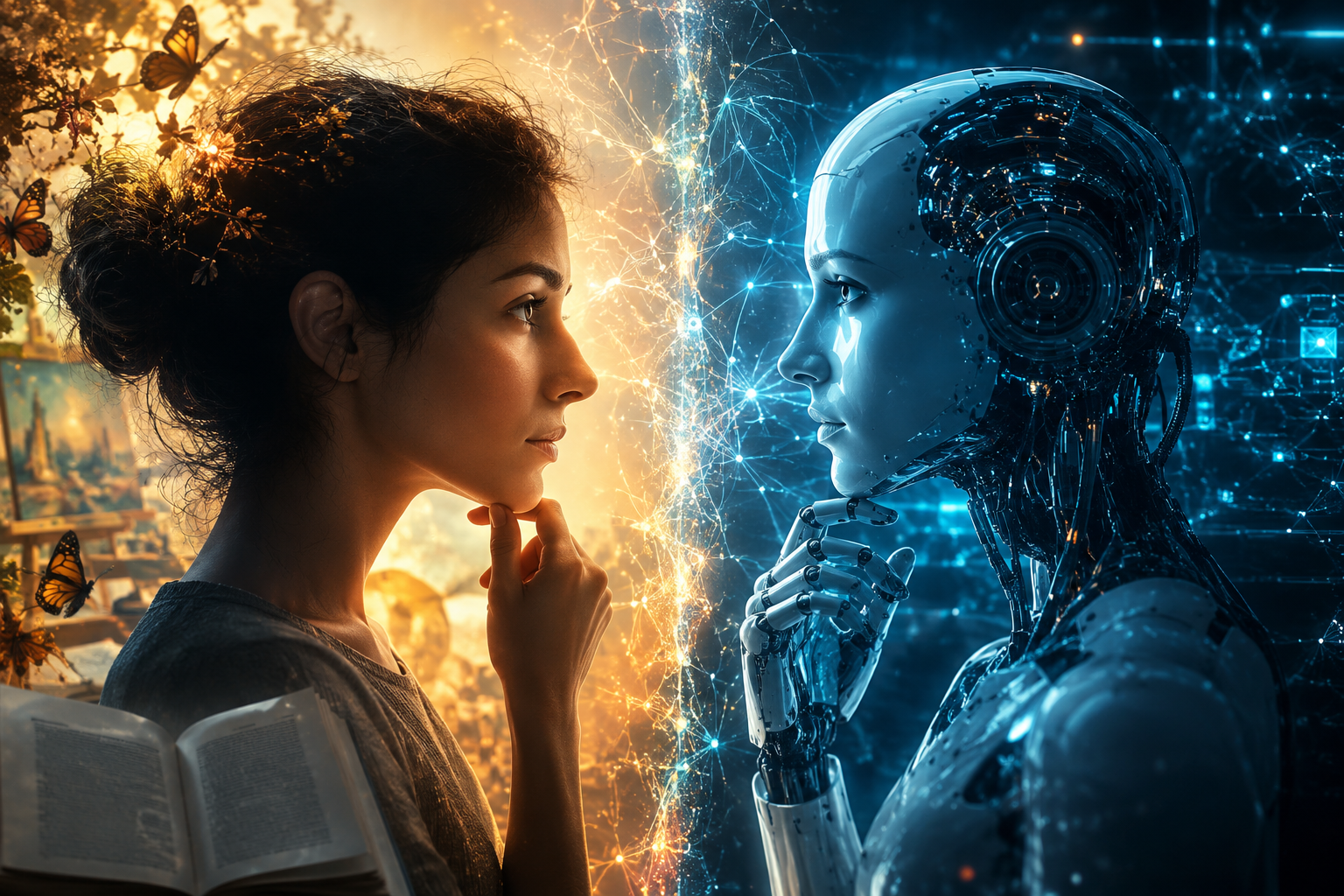
Imagine sitting across from two problem-solvers. One is a human being, capable of dreaming, feeling, learning from life, and making decisions shaped by experience and emotion. The other is an artificial intelligence system, able to analyze enormous amounts of information in seconds, recognize patterns hidden within vast datasets, and generate responses with astonishing speed.
At first glance, they might appear surprisingly similar. Both can answer questions. Both can solve certain problems. Both can create written text, recognize images, and even play complex games.
But beneath the surface, they are profoundly different.
The comparison between Artificial Intelligence (AI) and human intelligence is one of the most fascinating scientific discussions of our time. As AI becomes increasingly capable, people naturally wonder whether machines are beginning to think like humans—or whether human intelligence remains something fundamentally unique.
The answer is more complex than either extreme suggests. AI has become extraordinarily powerful in specific tasks, yet human intelligence possesses qualities that current AI does not. Understanding these similarities and differences helps us appreciate both the remarkable achievements of artificial intelligence and the extraordinary capabilities of the human mind.
What Is Human Intelligence?
Human intelligence is the ability to learn, understand, reason, solve problems, communicate, adapt, and make decisions across an enormous variety of situations.
It is shaped not only by knowledge but also by experience, memory, emotions, culture, imagination, relationships, and physical interaction with the world.
Humans begin learning from the moment they are born. Babies gradually recognize faces, understand language, imitate behavior, and explore their surroundings through touch, movement, and observation.
As people grow, they develop creativity, empathy, curiosity, moral judgment, humor, and self-awareness.
These abilities work together, allowing humans to navigate an unpredictable world.
Human intelligence is flexible.
A person who learns to ride a bicycle can also write poetry, comfort a friend, cook dinner, invent new technology, and appreciate music—all without needing separate brains for each task.
What Is Artificial Intelligence?
Artificial Intelligence refers to computer systems designed to perform tasks that usually require aspects of human intelligence.
Modern AI can recognize speech, translate languages, analyze medical images, generate artwork, answer questions, recommend products, and perform many other specialized tasks.
Unlike humans, AI does not possess a biological brain.
Instead, it uses mathematical models, algorithms, and data to identify patterns and generate outputs.
Many of today’s most advanced AI systems rely on machine learning and deep learning, where computers improve their performance by analyzing large amounts of data rather than following only fixed instructions.
Although AI can sometimes appear intelligent, its intelligence differs fundamentally from human intelligence.
Different Origins
One of the greatest differences between AI and humans lies in how intelligence develops.
Human intelligence evolved through millions of years of biological evolution.
The human brain contains roughly 86 billion neurons connected through trillions of synapses. These networks develop continuously throughout life as people experience the world.
Artificial Intelligence, by contrast, is created by engineers and scientists.
Its “knowledge” comes from mathematical training on data rather than living experiences.
Humans learn through conversations, mistakes, emotions, physical interactions, and personal memories.
AI learns by adjusting mathematical parameters during computational training.
These are entirely different processes.
Learning Is Not the Same
Both humans and AI can learn, but they do so in different ways.
Children often understand new ideas after only a few examples.
A child who sees a dog several times quickly learns to recognize dogs of many different breeds.
AI usually requires much larger amounts of carefully prepared data before achieving similar performance.
Humans also learn through curiosity.
A child asks endless questions because they genuinely want to understand.
AI does not become curious.
It has no internal desire to learn unless humans design systems to optimize specific objectives.
Furthermore, humans learn from emotions.
Embarrassment may discourage repeating mistakes.
Joy encourages exploration.
Fear improves survival.
AI has no emotional experiences influencing its learning.
Understanding Versus Pattern Recognition
One of the most important scientific distinctions involves understanding.
Humans generally build mental models of the world.
People understand that objects continue existing even when hidden from view.
They recognize cause and effect.
They connect ideas across many different experiences.
Modern AI primarily identifies statistical patterns.
For example, a language model predicts likely word sequences based on patterns learned during training.
An image-recognition system identifies visual features associated with particular objects.
These abilities can produce remarkably impressive results.
However, statistical pattern recognition is not necessarily equivalent to genuine understanding.
Researchers continue debating how closely future AI systems might approach deeper forms of reasoning.
Speed and Memory
When it comes to speed, AI often outperforms humans dramatically.
An AI system can analyze millions of documents in minutes.
It can search enormous databases almost instantly.
It performs repetitive calculations without becoming tired.
Human brains cannot compete with computers in raw computational speed.
However, speed alone does not equal intelligence.
Humans excel at integrating knowledge from diverse experiences, interpreting ambiguous situations, and making judgments when information is incomplete.
Human memory also differs significantly.
People forget details but often retain meaningful experiences and concepts.
AI systems store information differently, using mathematical representations rather than biological memory.
Creativity
Creativity is often viewed as one of humanity’s defining abilities.
Artists paint original masterpieces.
Scientists develop revolutionary theories.
Composers write symphonies.
Inventors imagine technologies that never existed before.
AI can also generate impressive creative works.
It produces paintings, poems, music, stories, and designs.
Yet its creativity arises from identifying patterns learned from existing examples and combining them in novel ways.
Human creativity is deeply connected to lived experience, emotion, imagination, culture, personal goals, and conscious intention.
Scientists continue debating whether AI-generated creativity should be considered fundamentally different from human creativity.
Emotions
Perhaps the clearest difference involves emotions.
Humans experience happiness, sadness, fear, anger, love, excitement, disappointment, pride, and countless other emotional states.
These emotions influence memory, decision-making, motivation, and relationships.
Artificial Intelligence does not experience emotions.
It may generate text describing happiness.
It can recognize emotional expressions in speech or facial images.
It can simulate empathy in conversation.
But simulation is not the same as subjective experience.
Current AI does not feel joy when solving a problem.
It does not experience grief after losing someone.
It has no inner emotional life.
Consciousness
Consciousness remains one of science’s greatest mysteries.
Humans possess subjective awareness.
People experience thoughts, sensations, dreams, memories, and personal identity.
Researchers continue investigating how consciousness arises from brain activity.
Artificial Intelligence has shown no scientific evidence of consciousness.
AI processes information.
It generates responses.
It performs computations.
But there is no evidence that it possesses self-awareness or subjective experience.
An AI may describe consciousness because it has learned language about consciousness, not because it experiences it.
Common Sense
Humans develop extensive common-sense knowledge through everyday life.
People understand that water makes objects wet.
They know dropped glasses often break.
They expect winter to be colder than summer.
They infer countless unstated facts during ordinary conversations.
Building this kind of flexible common-sense reasoning has proven surprisingly difficult for AI.
Although modern systems perform much better than earlier generations, they may still misunderstand unusual situations or produce incorrect conclusions when facing unfamiliar contexts.
Researchers consider common-sense reasoning one of AI’s major ongoing challenges.
Adaptability
Human intelligence is remarkably adaptable.
A person can suddenly move to another country, learn a new language, begin a different career, and adapt to unfamiliar environments.
AI systems are generally much narrower.
A chess-playing AI cannot automatically become a medical diagnostic system.
Each capability usually requires specialized training and design.
Although newer AI models handle broader ranges of tasks than earlier systems, they remain far less flexible than human intelligence.
Decision-Making
Humans rarely base decisions solely on logic.
Ethics, relationships, emotions, experience, and personal values all contribute.
A doctor deciding how to treat a patient considers medical evidence alongside compassion, communication, and individual circumstances.
AI can assist by analyzing medical information rapidly.
However, final decisions often require ethical judgment that extends beyond statistical prediction.
For this reason, experts generally recommend using AI to support human decision-making rather than replace it in high-stakes situations.
Communication
Language represents another fascinating comparison.
Humans communicate using words, facial expressions, gestures, tone of voice, shared experiences, and cultural understanding.
Much of communication involves reading emotions and interpreting subtle social signals.
AI can generate fluent language and answer questions effectively.
However, it lacks genuine social experiences.
It has never attended a birthday party, experienced childhood friendships, or felt nervous before an important interview.
Its language abilities come from learning statistical relationships within text rather than living those experiences.
Physical Experience
Humans experience the world through their bodies.
They see colors.
They hear music.
They smell flowers.
They taste food.
They feel heat, cold, pain, and touch.
These sensory experiences shape intelligence from infancy onward.
Most AI systems lack direct physical experience.
Although robots equipped with sensors can interact with their environments, their sensory processing remains fundamentally different from biological perception.
Human intelligence is deeply connected to the body in ways that AI currently does not share.
Reliability
AI often performs repetitive tasks with exceptional consistency.
It never becomes bored while analyzing thousands of images.
It does not lose concentration after long calculations.
It can work continuously without needing sleep.
Humans become tired.
They lose focus.
They make accidental mistakes.
However, AI also has weaknesses.
It may confidently produce incorrect information.
It can fail when encountering situations outside its training.
It may inherit biases present in its data.
Human experts remain essential for evaluating AI outputs, especially in important applications.
AI Excels in Certain Areas
Artificial Intelligence has become extraordinarily powerful in specific domains.
It can analyze medical scans rapidly.
It detects patterns in enormous scientific datasets.
It predicts weather using complex models.
It assists with language translation.
It helps discover new materials and medicines.
It processes information at scales impossible for individual humans.
These strengths make AI an invaluable scientific and technological tool.
Humans Excel in Others
Human intelligence remains unmatched in many areas.
People demonstrate empathy.
They build trust.
They create cultures.
They develop moral systems.
They inspire others.
They understand humor, irony, and social context.
Humans combine logic with emotion, experience, imagination, and ethical reasoning.
These qualities remain central to education, leadership, healthcare, parenting, diplomacy, and countless other aspects of society.
Can AI Become Smarter Than Humans?
The answer depends on what “smarter” means.
For narrow, specialized tasks, AI already surpasses humans in several areas.
It can calculate faster.
It remembers enormous datasets.
It defeats world champions in certain strategic games.
It identifies subtle visual patterns in some medical images.
However, no existing AI matches the broad flexibility of human intelligence across all domains.
Researchers continue exploring whether Artificial General Intelligence (AGI)—a system capable of learning and reasoning across many different tasks like humans—can eventually be developed.
Whether AGI is achievable remains an open scientific question.
Working Together
Perhaps the most productive comparison is not AI versus humans but AI alongside humans.
Doctors use AI to analyze medical images while providing compassionate patient care.
Scientists use AI to process enormous datasets while developing new theories.
Teachers employ AI tools to personalize learning while inspiring curiosity.
Engineers design safer systems with AI assistance.
Artists experiment with AI-generated ideas while expressing uniquely human perspectives.
In these partnerships, each contributes different strengths.
AI offers speed, scale, and computational power.
Humans provide judgment, creativity, ethics, empathy, and purpose.
The Future Relationship
Artificial Intelligence will almost certainly become even more capable in the coming decades.
It may assist in solving some of humanity’s greatest challenges, including improving healthcare, advancing scientific research, developing cleaner energy technologies, managing complex transportation systems, and supporting education around the world.
At the same time, society must carefully address questions involving fairness, privacy, transparency, accountability, and the responsible use of increasingly powerful AI systems.
The goal should not be to imitate humans perfectly or replace them entirely.
Instead, the greatest opportunity lies in creating technologies that expand human potential while respecting human values.
The Remarkable Difference
Artificial Intelligence and human intelligence are often compared because they sometimes perform similar tasks. Yet beneath those similarities lie fundamentally different forms of intelligence.
AI is built from mathematics, algorithms, computing power, and data. It excels at analyzing patterns, processing vast amounts of information, and carrying out specialized tasks with extraordinary speed and consistency.
Human intelligence emerges from a living brain shaped by evolution, personal experience, emotions, relationships, culture, and conscious awareness. It combines reasoning with empathy, imagination, morality, curiosity, and creativity in ways that current AI does not replicate.
Rather than seeing this relationship as a competition, it is more accurate to view it as a partnership. AI is one of the most powerful tools humanity has ever created, but it remains a tool created by human minds. Every breakthrough in artificial intelligence reflects decades of human curiosity, scientific discovery, engineering skill, and collaboration.
As AI continues to evolve, the most important intelligence guiding its future will not be artificial—it will be the wisdom, responsibility, and imagination of the people who choose how this remarkable technology is used.