Artificial Intelligence has become one of the most exciting scientific and technological fields of our time. Every day, millions of people use AI without even realizing it. When a smartphone unlocks by recognizing your face, a streaming service recommends your next favorite movie, an online translator converts one language into another, or a navigation app suggests the fastest route home, Artificial Intelligence is quietly working in the background.
But within the world of AI, two terms appear again and again: Machine Learning and Deep Learning.
Many people use these terms as if they mean the same thing. They do not. While they are closely related, they represent different approaches to teaching computers how to learn from data.
Understanding the difference between Machine Learning and Deep Learning is important because these technologies are driving many of today’s biggest innovations. They power medical discoveries, scientific research, self-driving cars, virtual assistants, recommendation systems, and much more.
Although both technologies help computers make intelligent decisions, they learn in different ways, require different amounts of data, and solve problems differently.
To understand their differences, it helps to begin with Artificial Intelligence itself.
Artificial Intelligence Comes First
Artificial Intelligence, or AI, is the broad field of computer science that focuses on creating systems capable of performing tasks that usually require human intelligence.
These tasks include recognizing speech, understanding language, solving problems, identifying objects, translating text, predicting outcomes, and making decisions.
Machine Learning and Deep Learning are not separate from AI.
Instead, they are specialized branches within Artificial Intelligence.
You can imagine AI as a large tree.
Machine Learning is one of its major branches.
Deep Learning is a smaller branch that grows from Machine Learning.
Every Deep Learning system is a form of Machine Learning, and every Machine Learning system belongs to the broader field of Artificial Intelligence. However, not every Machine Learning system uses Deep Learning.
Understanding this relationship makes the differences much easier to appreciate.
What Is Machine Learning?
Machine Learning is a method that allows computers to improve their performance by learning patterns from data rather than following only fixed instructions written by programmers.
Traditional computer programs rely entirely on explicit rules.
For example, imagine writing software to identify apples.
Using traditional programming, you would need to describe every possible feature of an apple: its color, size, shape, texture, and countless variations. This quickly becomes impossible because real apples vary enormously.
Machine Learning approaches the problem differently.
Instead of writing every rule manually, you provide the computer with many examples of apples and many examples of objects that are not apples.
The algorithm studies these examples, discovers statistical patterns, and gradually learns how to recognize apples on its own.
In other words, programmers provide examples rather than detailed instructions.
This ability to learn from experience makes Machine Learning remarkably powerful.
What Is Deep Learning?
Deep Learning is a specialized form of Machine Learning inspired loosely by the organization of neurons in the human brain.
It uses mathematical models called artificial neural networks.
Despite the name, these artificial neurons are very different from biological brain cells. They are mathematical functions rather than living structures.
Deep Learning systems contain many interconnected layers of these artificial neurons.
Each layer analyzes information differently.
The earliest layers identify simple patterns.
Later layers combine these simpler patterns into increasingly complex ones.
For example, when identifying a human face in a photograph, the first layers might detect edges and colors.
The next layers recognize shapes.
Higher layers identify eyes, noses, mouths, and facial structures.
Eventually, the system recognizes an entire face.
This layered learning process is what gives Deep Learning its name.
The word “deep” refers to the large number of computational layers inside the neural network.
Learning Patterns in Different Ways
Although both technologies learn from data, they approach learning differently.
Machine Learning often depends on human experts to identify which characteristics of the data are likely to be important.
These characteristics are called features.
Suppose scientists want to build a Machine Learning system that identifies flowers.
Human experts might tell the computer to examine petal length, petal width, color, leaf shape, and other measurable features.
The algorithm then learns relationships among these features.
Deep Learning usually eliminates much of this manual feature selection.
Instead, the neural network automatically discovers useful features directly from raw data.
This ability to learn its own representations is one of Deep Learning’s greatest strengths.
It often finds subtle patterns that humans might overlook.
The Role of Data
One of the biggest differences between Machine Learning and Deep Learning is the amount of data they typically require.
Machine Learning often performs well with relatively modest datasets, especially when experts carefully select meaningful features.
Deep Learning generally requires much larger datasets.
Because neural networks contain enormous numbers of adjustable mathematical parameters, they need abundant examples to learn effectively.
Modern image recognition systems may be trained using millions of photographs.
Large language models learn from vast collections of text containing billions or even trillions of words.
Without sufficient data, Deep Learning systems may struggle to perform well.
Computing Power Matters
Machine Learning algorithms can often run successfully on ordinary computers.
Many problems can be solved efficiently using standard processors.
Deep Learning is much more computationally demanding.
Training large neural networks requires tremendous processing power.
Specialized hardware such as Graphics Processing Units (GPUs) and Tensor Processing Units (TPUs) dramatically accelerate the enormous mathematical calculations involved.
Without these technological advances, many modern Deep Learning breakthroughs would not have been possible.
The rapid improvement of computer hardware has played a major role in AI’s recent success.
Training Time
Machine Learning models often train relatively quickly.
Depending on the problem, training may take minutes, hours, or days.
Deep Learning models usually require much longer training periods.
Large neural networks sometimes need days, weeks, or even months of continuous computation using powerful computer clusters.
The increased training time reflects the greater complexity of Deep Learning systems.
However, once trained, many Deep Learning models can produce predictions very quickly.
Performance on Different Types of Problems
Machine Learning excels when data is structured and clearly organized.
Examples include financial records, medical measurements, weather observations, customer information, or manufacturing statistics.
These datasets often consist of rows and columns containing numerical or categorical values.
Deep Learning performs especially well with unstructured data.
Images, videos, speech recordings, handwritten text, natural language, and complex sensor data contain intricate patterns that traditional Machine Learning may struggle to capture.
Deep Learning’s layered neural networks make it particularly effective for these challenging tasks.
Image Recognition
Image recognition illustrates one of the clearest differences.
Earlier Machine Learning systems often required engineers to design algorithms that measured edges, textures, colors, corners, or shapes.
Researchers spent enormous effort deciding which visual features the computer should examine.
Deep Learning transformed this process.
Modern neural networks automatically discover useful visual features directly from millions of images.
As a result, image recognition accuracy improved dramatically.
Today, Deep Learning helps identify diseases in medical scans, recognize wildlife in conservation research, inspect manufactured products, analyze satellite imagery, and support autonomous vehicles.
Speech Recognition
Human speech presents another complex challenge.
Voices vary enormously.
People speak with different accents, speeds, emotions, and background noise.
Traditional Machine Learning achieved useful results but often required carefully engineered features extracted from sound recordings.
Deep Learning significantly improved speech recognition by learning directly from raw audio signals.
This advancement helped make voice assistants, automatic subtitles, speech-to-text systems, and language translation far more accurate than earlier technologies.
Natural Language Understanding
Human language is one of the most complicated forms of information.
Words change meaning depending on context.
Grammar varies across languages.
Expressions often carry implied meanings.
Deep Learning has revolutionized Natural Language Processing, enabling systems to summarize documents, answer questions, translate languages, assist writers, generate computer code, and engage in conversations.
Large language models rely heavily on Deep Learning architectures capable of learning complex relationships among words and sentences.
These systems do not understand language in the same way humans do, but they identify sophisticated statistical patterns that allow them to produce remarkably fluent responses.
Medical Applications
Both Machine Learning and Deep Learning contribute significantly to healthcare.
Machine Learning helps analyze patient records, predict disease risks, estimate treatment outcomes, and identify health trends.
Deep Learning excels at interpreting complex medical images such as X-rays, CT scans, MRI images, retinal photographs, and pathology slides.
Researchers also use Deep Learning to assist drug discovery, protein structure prediction, and biomedical research.
In nearly all cases, these technologies support healthcare professionals rather than replace them.
Medical expertise, ethical judgment, and patient care remain essential human responsibilities.
Self-Driving Vehicles
Autonomous driving demonstrates how both technologies work together.
Machine Learning analyzes traffic patterns, predicts vehicle behavior, and supports decision-making.
Deep Learning processes camera images, recognizes pedestrians, identifies road signs, detects traffic lights, and understands complex driving environments.
Modern autonomous vehicle systems combine multiple AI approaches rather than relying on a single technique.
This integration allows vehicles to interpret highly dynamic real-world conditions.
Recommendation Systems
Recommendation systems also use both Machine Learning and Deep Learning.
Streaming platforms recommend movies based on viewing history.
Online stores suggest products.
Music services personalize playlists.
Social media platforms prioritize content.
Earlier recommendation systems often relied heavily on Machine Learning algorithms.
Modern platforms increasingly combine Machine Learning with Deep Learning to analyze user behavior, preferences, language, images, and viewing patterns more effectively.
Why Deep Learning Became So Popular
Deep Learning experienced extraordinary growth during the twenty-first century for several important reasons.
Computers became much faster.
Powerful GPUs became widely available.
The internet generated enormous amounts of digital data.
Researchers developed improved neural network architectures.
Cloud computing made large-scale training more accessible.
Together, these advances enabled Deep Learning systems to solve problems that had previously seemed impossible.
Image recognition, speech recognition, language generation, and scientific discovery all benefited enormously from these developments.
Are Bigger Models Always Better?
Deep Learning often involves extremely large models.
However, larger models are not automatically superior.
Training massive neural networks requires considerable computational resources, energy, and financial investment.
For many practical applications, smaller Machine Learning models remain more efficient, easier to interpret, and less expensive to deploy.
Choosing between Machine Learning and Deep Learning depends on the specific problem rather than simply selecting the most complex technology.
Researchers carefully evaluate the advantages and limitations of each approach before developing AI systems.
Understanding the Decisions
One challenge associated with Deep Learning involves explainability.
Many Machine Learning algorithms provide relatively transparent reasoning.
Researchers can often understand which variables influenced a prediction.
Deep Learning models are usually much more difficult to interpret.
Because they contain millions or billions of mathematical parameters interacting across many layers, explaining exactly why a particular prediction occurred can be challenging.
Scientists continue developing methods to improve AI transparency, especially in critical fields such as healthcare, finance, law, and scientific research.
Energy and Environmental Considerations
Training very large Deep Learning models consumes substantial computational resources and electricity.
Researchers increasingly recognize the importance of improving energy efficiency.
Developing smaller, faster, and more efficient AI models has become an active area of research.
Machine Learning often requires less computational power and may therefore be more environmentally efficient for many applications.
Balancing performance with sustainability represents an important goal for the future of AI.
Can Deep Learning Replace Machine Learning?
Deep Learning has achieved remarkable success, but it has not replaced Machine Learning.
Instead, the two approaches complement one another.
Many real-world systems combine multiple Machine Learning techniques with Deep Learning components.
Some problems simply do not require large neural networks.
Others benefit enormously from them.
Scientists select the most appropriate methods based on available data, computational resources, interpretability requirements, and the nature of the task.
The goal is not to use the newest technology but to use the most suitable one.
The Future of Intelligent Learning
Research continues advancing rapidly in both Machine Learning and Deep Learning.
Scientists are developing algorithms that learn more efficiently from smaller datasets.
Researchers are improving explainability, fairness, robustness, and energy efficiency.
New techniques aim to combine the strengths of traditional Machine Learning with the flexibility of Deep Learning.
Future AI systems may become better at reasoning, adapting to unfamiliar situations, learning continuously, and collaborating safely with humans.
These advances could accelerate scientific discovery, improve healthcare, strengthen education, optimize transportation, and support solutions to complex global challenges.
Machine Learning and Deep Learning Together
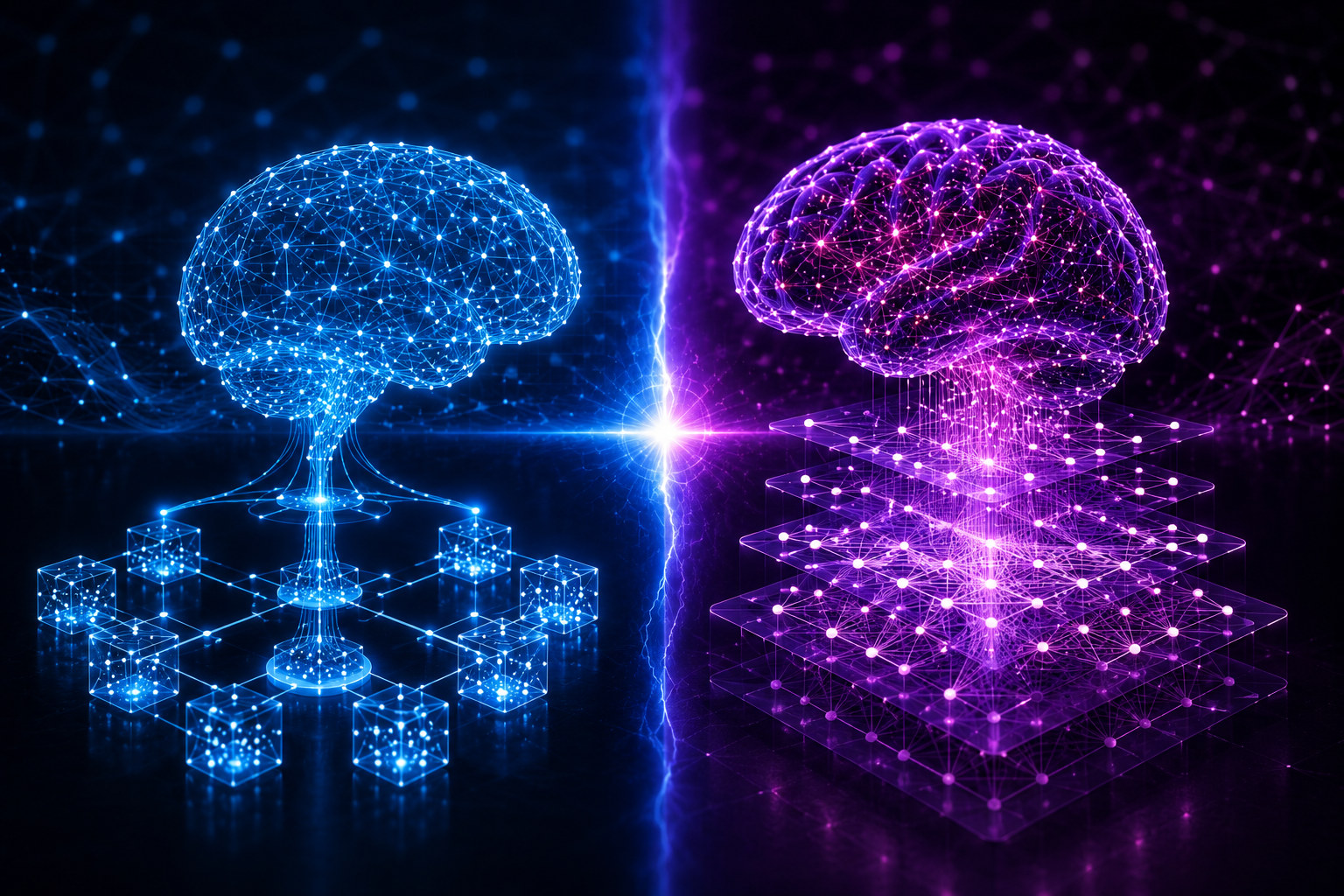
Although people often compare Machine Learning and Deep Learning as competing technologies, they are better understood as partners within the broader field of Artificial Intelligence.
Machine Learning introduced the revolutionary idea that computers could improve by learning from data rather than following only fixed instructions. Deep Learning expanded that idea by allowing computers to discover increasingly complex patterns through multilayered neural networks.
Machine Learning remains highly effective for many structured data problems, offering efficiency, interpretability, and lower computational demands. Deep Learning excels when dealing with vast amounts of complex, unstructured information such as images, speech, video, and natural language.
Neither approach is universally superior. Each has strengths, limitations, and ideal applications. Together, they have transformed modern computing and opened new possibilities in science, medicine, engineering, education, and countless other fields.
As researchers continue refining these technologies, the distinction between Machine Learning and Deep Learning will remain important—not because one will replace the other, but because understanding both allows us to appreciate how intelligent systems are built. They represent different paths toward the same goal: enabling computers to learn from experience, solve meaningful problems, and assist humanity in understanding and shaping the world more effectively.