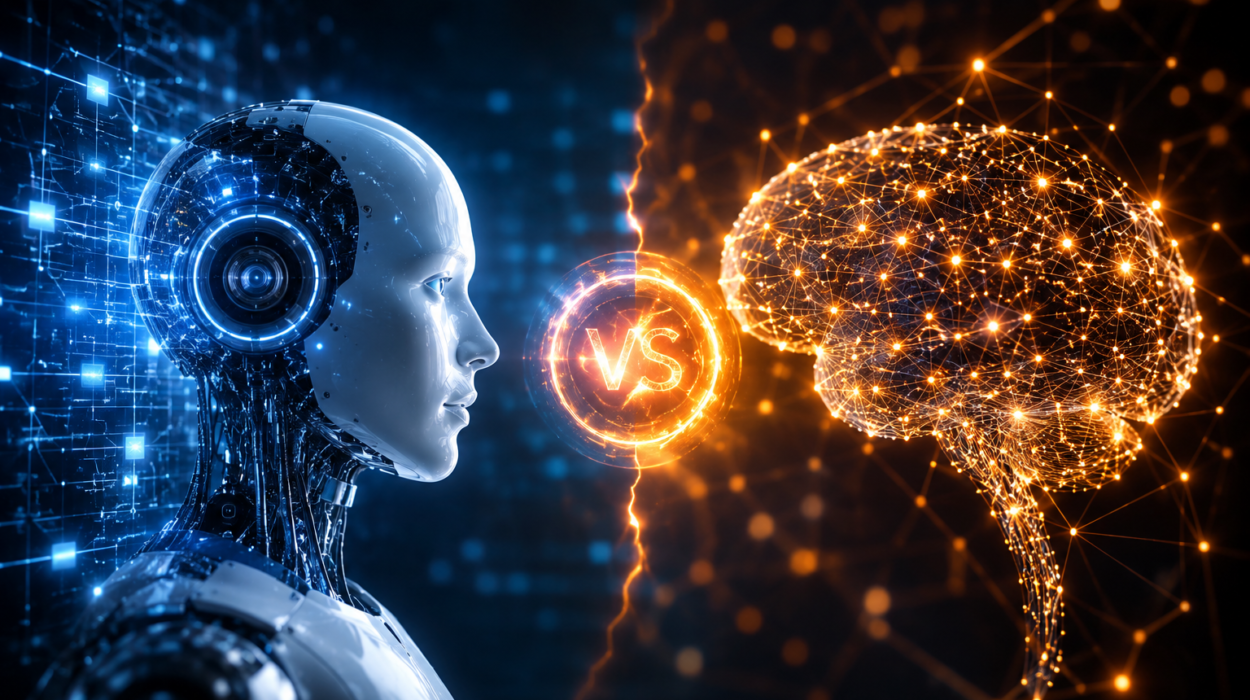
Imagine meeting a machine that can learn almost anything you can. It can solve a difficult math problem in the morning, compose a beautiful piece of music in the afternoon, diagnose a rare disease in the evening, and then learn an entirely new skill the next day without needing to be redesigned. It can adapt to unfamiliar situations, understand complex ideas, and apply knowledge from one field to another.
This is the vision behind Artificial General Intelligence, often shortened to AGI.
Unlike the artificial intelligence systems we use today, AGI is not designed for just one specific task. Instead, it refers to a hypothetical form of AI that could perform a wide range of intellectual tasks at a level comparable to, or potentially beyond, that of humans.
AGI is one of the most exciting and debated ideas in computer science. Some researchers believe it could become one of humanity’s greatest technological achievements. Others argue that it remains a distant goal with many scientific challenges still unsolved. While no one knows exactly when—or even if—AGI will be achieved, the idea has inspired decades of research and continues to shape conversations about the future of technology.
Understanding AGI begins with understanding the difference between today’s AI and the intelligence humans naturally possess.
Understanding Artificial Intelligence Today
Artificial Intelligence, or AI, already plays an important role in everyday life.
It recommends movies, translates languages, recognizes faces in photographs, helps doctors analyze medical images, answers questions, and assists people with writing, programming, and research.
These systems can perform impressive tasks, but they all share an important limitation.
They are designed for particular purposes.
An AI that plays chess cannot automatically drive a car.
A medical diagnosis system cannot suddenly become an expert historian.
A language model cannot independently perform scientific experiments in the physical world.
Each system specializes in certain kinds of tasks.
This type of AI is known as narrow AI or weak AI.
Despite the name, narrow AI can be extraordinarily powerful. In some areas, it already performs better than humans. However, its abilities are limited to the domains for which it has been developed and trained.
What Makes Human Intelligence Different?
Human intelligence is remarkably flexible.
A child who learns to ride a bicycle can later learn to drive a car.
Someone who studies mathematics can also enjoy painting, learn a new language, cook dinner, and solve unexpected problems in daily life.
Humans constantly transfer knowledge from one situation to another.
They reason.
They adapt.
They learn from very few examples.
They understand context.
They make long-term plans.
They combine logic with creativity, emotion, and social understanding.
Even when facing completely unfamiliar situations, people often find ways to learn and adapt.
This flexibility is one of the defining characteristics of general intelligence.
Defining Artificial General Intelligence
Artificial General Intelligence refers to a theoretical type of AI capable of performing the broad range of intellectual tasks that humans can perform.
Instead of being limited to one skill, an AGI system would be able to learn many different skills.
It could solve unfamiliar problems.
It could reason across multiple subjects.
It could apply existing knowledge in new situations.
It could improve its understanding through experience.
Importantly, AGI is not simply a larger or faster version of today’s AI.
It represents a fundamentally broader capability.
Rather than mastering one task, AGI would possess general-purpose intelligence.
Why Is It Called “General”?
The word “general” is the key.
Today’s AI is specialized.
General intelligence means the ability to perform successfully across many different kinds of intellectual activities.
For example, imagine asking the same system to write a novel, solve an engineering problem, teach biology, learn an unfamiliar board game, explain quantum physics to a child, compose music, and help design a spacecraft.
A genuine AGI would not need to be rebuilt for each of these tasks.
Instead, it would learn and adapt much as humans do when encountering new challenges.
This ability to transfer knowledge between unrelated fields distinguishes AGI from existing AI systems.
The Origins of the Idea
The concept of intelligent machines has fascinated humanity for centuries.
Ancient myths described artificial beings brought to life through craftsmanship or magic.
As modern computing emerged during the twentieth century, scientists began wondering whether machines could eventually perform human-like reasoning.
The field of Artificial Intelligence formally began in 1956 during a famous research workshop in the United States.
Many early researchers believed that creating human-level intelligence might require only a few decades of work.
Reality proved far more complicated.
Although computers became dramatically faster, intelligence itself turned out to be one of the most difficult scientific problems ever studied.
Researchers made tremendous progress in specialized AI, but general intelligence remained elusive.
Today, AGI continues to be an active area of research and debate rather than an established technology.
Is AGI the Same as Consciousness?
One of the biggest misunderstandings about AGI is the belief that it automatically implies consciousness.
These are not the same thing.
Consciousness refers to subjective experience—the awareness of thoughts, emotions, sensations, and one’s own existence.
Scientists and philosophers still do not fully understand how consciousness arises in humans or other animals.
Artificial General Intelligence refers to broad intellectual ability.
An AGI could, in principle, perform many intelligent tasks without necessarily possessing conscious experiences.
Whether consciousness would emerge in highly advanced AI remains unknown.
At present, there is no scientific evidence that existing AI systems are conscious.
Can Today’s AI Become AGI?
Modern AI has achieved extraordinary successes.
Large language models generate human-like text.
Image-generation systems create realistic artwork.
Computer vision recognizes objects.
Speech recognition converts spoken language into text.
Robots perform increasingly sophisticated tasks.
Despite these advances, today’s AI still differs fundamentally from the proposed idea of AGI.
Current systems often struggle when faced with situations outside their training.
They may produce convincing but incorrect answers.
They lack consistent reasoning across all domains.
They do not possess comprehensive understanding of the world.
Researchers continue working to overcome these limitations, but no existing AI system is universally recognized as AGI.
Learning Like Humans
One reason AGI is so challenging is that humans learn differently from current AI.
Children require surprisingly little information to learn many concepts.
A child may recognize an elephant after seeing only a few pictures.
Current AI often requires enormous datasets containing millions or billions of examples.
Humans also understand cause and effect.
They reason about physical reality.
They ask questions out of curiosity.
They build mental models of the world.
Developing machines with similarly flexible learning abilities remains one of AI’s greatest scientific challenges.
Memory and Reasoning
General intelligence depends on more than storing information.
People connect memories.
They compare ideas.
They solve unfamiliar puzzles.
They revise beliefs when new evidence appears.
They explain their reasoning.
Many AI researchers believe that future AGI systems will require stronger reasoning abilities, better memory, improved planning, and deeper understanding than current systems possess.
Exactly how these capabilities should be built remains an open research question.
Understanding the Physical World
Humans interact with the physical world from infancy.
Babies learn that objects fall, liquids flow, and people have intentions.
This everyday understanding helps people predict what will happen next.
AI systems often lack this kind of intuitive knowledge.
Teaching machines to understand the physical world—sometimes called common-sense reasoning—remains one of the most difficult challenges in Artificial Intelligence research.
Without common sense, even highly capable AI systems may make surprisingly simple mistakes.
The Role of Language
Language is one of humanity’s greatest achievements.
It allows people to communicate knowledge across generations.
Modern AI systems have become remarkably skilled at processing language.
However, producing fluent language does not necessarily mean possessing general intelligence.
True AGI would likely need not only advanced language abilities but also deep reasoning, planning, perception, memory, and learning that extends beyond language alone.
Language may be one important component of AGI, but it is unlikely to be the entire solution.
Robotics and AGI
Some researchers believe that intelligence develops partly through interaction with the physical environment.
Humans learn by touching objects, moving through space, and observing consequences.
This idea has encouraged research combining robotics with AI.
An intelligent robot capable of learning from experience might develop different abilities than software existing only inside computers.
Whether physical embodiment is necessary for AGI remains an active scientific debate.
How Scientists Measure Progress
Determining whether AGI has been achieved is more difficult than many people expect.
Unlike a chess tournament or image-recognition benchmark, there is no universally accepted test for general intelligence.
Researchers evaluate AI using many different benchmarks involving language, reasoning, mathematics, programming, scientific knowledge, planning, and problem-solving.
However, performing well on many tests does not necessarily demonstrate genuine general intelligence.
Scientists continue discussing how AGI should be defined and measured.
Potential Benefits of AGI
If AGI were successfully developed and responsibly managed, its potential benefits could be extraordinary.
It might accelerate scientific discovery.
It could assist researchers searching for treatments for diseases.
It might help develop cleaner energy technologies.
It could improve education by providing highly personalized learning.
Engineers might use AGI to design safer transportation systems.
Environmental scientists could better understand climate change.
Astronomers might analyze enormous datasets from future telescopes more efficiently.
Because AGI would potentially learn across many disciplines, it could contribute to solving complex global challenges requiring knowledge from multiple fields.
Possible Risks
Alongside potential benefits come significant concerns.
A highly capable AGI could have enormous influence if deployed irresponsibly.
Researchers discuss issues such as safety, security, fairness, privacy, misinformation, and economic disruption.
One major research area involves AI alignment, which focuses on ensuring advanced AI systems behave according to human intentions and values.
Scientists also study methods for making AI systems more transparent, reliable, and controllable.
These questions have become increasingly important as AI capabilities continue advancing.
Will AGI Replace Human Jobs?
No one knows exactly how AGI, if developed, would affect employment.
History shows that technological revolutions often change the nature of work.
Some jobs disappear.
Others evolve.
Entirely new professions emerge.
AGI could automate many cognitive tasks currently performed by humans.
At the same time, it might create new opportunities in science, engineering, education, healthcare, and countless other fields.
The ultimate impact would depend on technological capabilities, public policy, education, economics, and how societies choose to adopt the technology.
Could AGI Become Smarter Than Humans?
Some researchers have proposed that once AGI reaches human-level performance, further improvements might eventually produce intelligence exceeding human capabilities in many areas.
This hypothetical concept is known as Artificial Superintelligence, or ASI.
Unlike AGI, which aims for broad human-like intelligence, ASI would greatly surpass humans across nearly all intellectual tasks.
It could potentially solve scientific problems far beyond current human abilities.
However, ASI remains entirely theoretical.
Neither AGI nor ASI currently exists.
Discussions about superintelligence are therefore speculative and should not be confused with present-day AI technology.
Ethical Questions
The possibility of AGI raises profound ethical questions.
Who should control such powerful technology?
How can societies ensure fairness?
How should privacy be protected?
Who bears responsibility if advanced AI systems make harmful decisions?
How can benefits be shared globally rather than concentrated among a few organizations or countries?
These questions involve not only computer science but also philosophy, law, economics, sociology, psychology, and international cooperation.
Developing AGI responsibly would require careful governance alongside technological progress.
Why AGI Is So Difficult
Despite rapid advances in AI, achieving AGI remains extraordinarily challenging.
Scientists still do not fully understand intelligence itself.
The human brain contains roughly 86 billion neurons connected through an immense network of synapses, giving rise to perception, memory, reasoning, learning, emotion, creativity, and consciousness.
Replicating even part of this flexibility has proven remarkably difficult.
Current AI excels at recognizing statistical patterns.
General intelligence appears to require much more.
It likely depends on combining learning, reasoning, planning, memory, common sense, adaptability, and perhaps capabilities not yet fully understood.
Because intelligence itself remains an active area of scientific research, building AGI remains one of the greatest challenges in modern science.
The Future of Artificial General Intelligence
No one can accurately predict when—or even if—Artificial General Intelligence will become reality.
Some researchers believe it could emerge within the coming decades.
Others argue that major scientific breakthroughs are still needed before such systems become possible.
Still others question whether human-like general intelligence can be recreated in machines at all.
What is certain is that research continues at an extraordinary pace.
Advances in machine learning, neuroscience, robotics, cognitive science, and computer engineering are steadily improving our understanding of intelligence.
Each discovery brings scientists closer to answering one of humanity’s most fascinating questions: Can a machine truly learn, reason, and adapt as broadly as a human?
Why Artificial General Intelligence Matters
Artificial General Intelligence is more than a technological dream. It represents a scientific quest to understand intelligence itself. Pursuing AGI forces researchers to ask deep questions about learning, reasoning, creativity, memory, and the nature of the human mind.
Whether AGI arrives in the near future or remains a distant goal, the research surrounding it is already transforming computer science and expanding our understanding of cognition. It is driving innovations that improve today’s AI systems while encouraging careful discussions about ethics, safety, and humanity’s future.
Perhaps the greatest lesson of AGI is that intelligence is far more complex than simply solving problems or answering questions. Human intelligence is shaped by experience, curiosity, relationships, emotions, imagination, and the ability to understand a constantly changing world. Recreating even a fraction of that flexibility in a machine remains one of the most ambitious scientific challenges ever attempted.
For now, Artificial General Intelligence remains a vision rather than a reality. It stands at the intersection of science, engineering, philosophy, and imagination—a reminder that although modern AI has made remarkable progress, humanity is still exploring one of the deepest mysteries of all: what it truly means to be intelligent.