Few myths from the ancient world have captured the imagination quite like the story of Hades and Persephone. It is a tale of darkness and light, loss and reunion, death and rebirth. For more than two thousand years, poets, artists, scholars, and storytellers have returned to this myth, finding new meanings hidden within its shadows.
At first glance, the story seems simple. A young goddess is taken to the Underworld by its mysterious ruler. Her grieving mother searches desperately for her. The earth itself begins to wither. Eventually a compromise is reached, allowing the goddess to spend part of the year with her mother and part with her husband beneath the earth.
Yet beneath this straightforward narrative lies a story rich with symbolism and emotion. The myth helped ancient Greeks explain the changing seasons. It explored the bonds between parents and children. It reflected ancient ideas about marriage, fate, and divine power. Most importantly, it confronted one of humanity’s deepest mysteries: the relationship between life and death.
Unlike many myths that feature battles, monsters, and heroic quests, the story of Hades and Persephone is intensely personal. Its emotional center is not war but separation. Not conquest but longing. Not victory but transformation.
Over time, interpretations of the myth have changed dramatically. Modern audiences often see it as a romantic story, while ancient Greeks viewed it through a very different cultural lens. Understanding the myth requires examining both the original sources and the society that produced them.
The result is one of the most fascinating stories in all of mythology—a tale that continues to resonate because it speaks to universal human experiences: love, grief, change, and the inevitable passage of time.
The World of the Greek Gods
To understand Hades and Persephone, it is necessary to first understand the world in which they existed.
The ancient Greeks imagined a universe ruled by powerful gods and goddesses. These divine beings controlled the forces of nature, influenced human lives, and governed different aspects of existence.
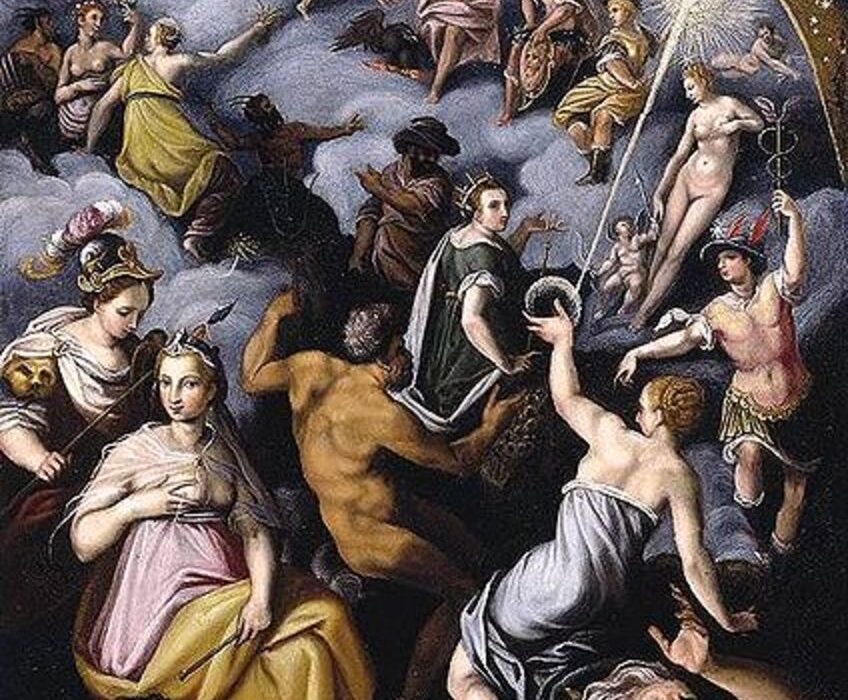
The most famous gods lived on Mount Olympus. Among them were Zeus, ruler of the sky; Hera, goddess of marriage; Athena, goddess of wisdom; Apollo, god of the sun and prophecy; and Artemis, goddess of the hunt.
Yet not all gods dwelled on Olympus.
Far beneath the world of the living lay the Underworld, the realm of the dead. This vast kingdom was ruled by Hades, one of the three brothers who divided the cosmos after defeating the Titans.
According to Greek mythology, Zeus received the sky, Poseidon received the sea, and Hades received the Underworld.
Although modern culture often portrays Hades as a devil-like figure, this image is misleading. Hades was not the embodiment of evil. The Greeks did not have a direct equivalent to the Christian concept of Satan.
Instead, Hades was a ruler. His responsibility was to govern the dead and maintain order in his realm. He was stern, powerful, and often feared, but he was not inherently wicked.
This distinction is essential because it shapes how the myth of Persephone unfolds.
Persephone Before the Underworld
Before becoming Queen of the Dead, Persephone was known primarily as the daughter of Demeter.
Demeter was the goddess of agriculture, grain, fertility, and harvest. To the ancient Greeks, she was among the most important deities because agriculture sustained human life.
Persephone was often associated with youth, flowers, and springtime. Ancient texts sometimes refer to her by the name Kore, meaning “maiden” or “young girl.”
In many artistic depictions, Persephone appears as a radiant figure gathering flowers in a meadow. She embodies innocence, beauty, and the vitality of new life.
The relationship between Demeter and Persephone forms the emotional heart of the myth.
They are not simply mother and daughter. They represent the deep bond between parent and child—a bond so powerful that its disruption affects the entire world.
Ancient audiences would have immediately understood the significance of this connection. Family relationships were central to Greek society, and the pain of separation carried enormous emotional weight.
The tragedy begins precisely because this close relationship is broken.
The Abduction of Persephone
One day, according to the myth, Persephone was gathering flowers in a meadow.
The scene begins peacefully. The young goddess wanders among blooming plants, surrounded by beauty and sunlight.
Then everything changes.
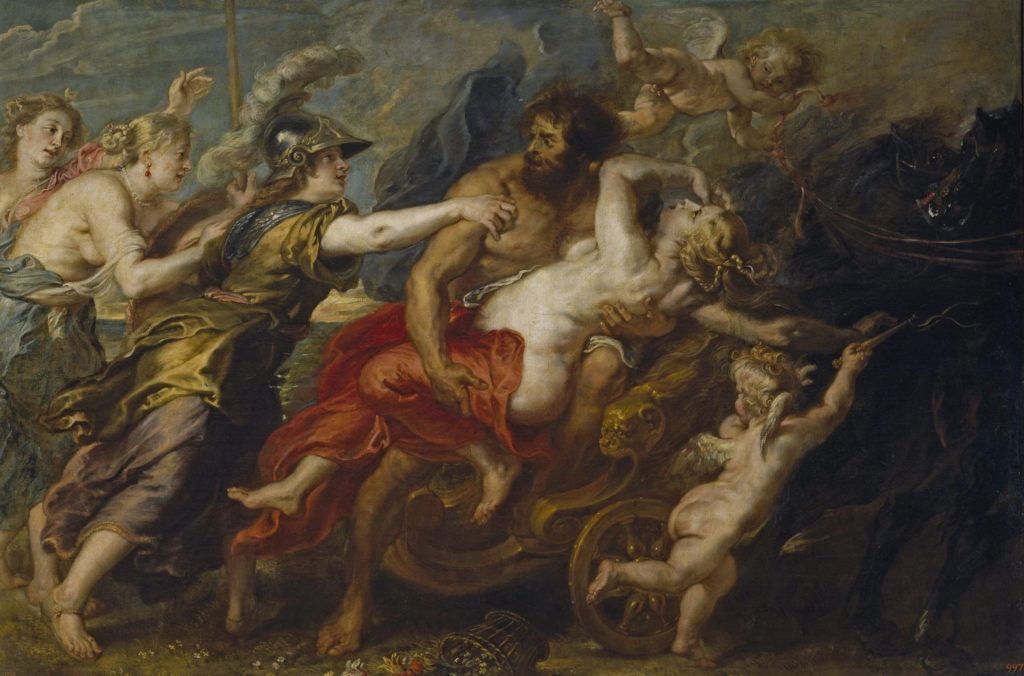
As Persephone reaches for a particularly magnificent flower, the earth suddenly splits open.
From the darkness emerges Hades in his chariot.
In the oldest surviving versions of the myth, Hades seizes Persephone and carries her away to the Underworld.
Her cries echo across the land.
Some gods hear her. Others remain silent.
The meadow closes behind her, and Persephone disappears beneath the earth.
For modern readers, this event is often shocking. In contemporary interpretations, it raises difficult questions about consent, power, and agency.
Ancient audiences viewed the story through a different cultural framework. Marriages in ancient Greece were often arranged by families rather than determined by individual choice. While this does not make the event less disturbing to modern readers, understanding the historical context helps explain how ancient Greeks interpreted the myth.
In many versions, Zeus himself had secretly approved the union between Hades and Persephone.
This detail deepens the tragedy.
Demeter does not merely lose her daughter. She loses her daughter through decisions made by powerful male gods without her knowledge.
The emotional consequences soon become catastrophic.
Demeter’s Search
When Demeter discovers that Persephone has vanished, she is overwhelmed by grief.
Her sorrow becomes one of the most moving elements in Greek mythology.
For days she wanders the earth searching for her daughter.
She questions gods, mortals, and spirits.
She refuses food.
She neglects her divine responsibilities.
The world begins to suffer.
Fields stop producing crops.
Trees cease bearing fruit.
Flowers wither.
Famine spreads across the land.
The suffering of nature reflects the suffering of Demeter herself.
This connection between emotional pain and environmental decline is one of the myth’s most powerful themes.
The earth is not simply a backdrop for human events. It responds directly to the emotions of divine beings.
As Demeter’s grief deepens, the survival of humanity comes into question.
Without harvests, people cannot eat.
Without agriculture, civilization collapses.
Even Zeus begins to realize the seriousness of the situation.
The Revelation
Eventually Demeter learns the truth.
Different versions of the myth describe this discovery in different ways.
In some accounts, the sun god Helios reveals what happened. Because he sees everything beneath the sky, he witnessed the abduction.
Demeter finally learns that Persephone has been taken to the Underworld by Hades.
The revelation brings both clarity and anguish.
Now she knows where her daughter is.
But she also understands how difficult it will be to bring her back.
Demeter’s anger intensifies.
She withdraws even further from her duties.
The earth becomes increasingly barren.
Humanity approaches disaster.
The gods cannot ignore the crisis much longer.
The Underworld Kingdom
While Demeter searches, Persephone resides in the Underworld.
The Greek Underworld was not simply a place of punishment.
It was the destination of nearly all souls after death.
Within its boundaries existed various regions and realms.
Ancient Greeks imagined it as a vast kingdom hidden beneath the earth.
Rivers flowed through its darkness.
Spirits wandered its landscapes.
Judges evaluated the dead.
At its center stood the palace of Hades.
This palace was not a fiery prison.
Instead, it was often described as a magnificent royal residence.
There Persephone gradually assumed a new role.
She was no longer merely the daughter of Demeter.
She was becoming Queen of the Underworld.
This transformation is crucial to understanding the myth.
Persephone’s story is not only about loss.
It is also about change.
The young maiden evolves into a powerful goddess with authority over one of the most mysterious realms in existence.
The Pomegranate Seeds
The turning point of the story arrives through one of mythology’s most famous symbols.
Zeus eventually intervenes and orders that Persephone be returned to her mother.
Hades agrees.
However, before Persephone leaves, she eats several pomegranate seeds.
The exact number varies among different versions of the myth.
In Greek mythology, consuming food in the Underworld creates a powerful bond with that realm.
Because Persephone has eaten the seeds, she cannot permanently leave.
A compromise becomes necessary.
Part of each year she will remain with Hades in the Underworld.
The rest she will spend with Demeter in the world above.
This solution resolves the immediate crisis but ensures that separation will continue forever.
The pomegranate becomes a symbol of fate, transformation, and the irreversible consequences of certain choices.
Its small seeds carry enormous significance.
They connect life and death, freedom and obligation, loss and return.
The Return of Spring
When Persephone emerges from the Underworld and reunites with Demeter, joy returns to the world.
Flowers bloom.
Fields become fertile.
Trees grow green once more.
The earth awakens.
The Greeks used this myth to explain the seasonal cycle.
During the months when Persephone remains with Demeter, the world flourishes.
During the months when she descends to the Underworld, Demeter mourns her absence.
Plants die back.
The land grows cold and barren.
Winter arrives.
Thus the changing seasons become expressions of divine emotion.
Spring represents reunion.
Summer represents abundance.
Autumn marks transition.
Winter reflects grief.
This interpretation transformed a natural phenomenon into a deeply human story.
Every seasonal cycle became a reminder of separation and return.
Hades: More Than a Villain
Modern retellings often struggle with Hades.
Some portray him as a cruel villain.
Others transform him into a misunderstood romantic hero.
The ancient sources present a more complex picture.
Hades is powerful, distant, and intimidating.
Yet he is not typically portrayed as malicious.
Unlike gods who frequently deceive, punish, or manipulate mortals, Hades appears relatively restrained.
He governs his realm.
He enforces its laws.
He maintains cosmic order.
In many myths, Hades is surprisingly consistent and fair.
His fearsome reputation stems largely from his association with death.
People feared the Underworld because they feared mortality itself.
Consequently, they feared its ruler.
This distinction matters because it reveals how the Greeks viewed death.
Death was not evil.
It was inevitable.
Hades embodied that inevitability.
He represented a reality no living person could escape.
Persephone’s Transformation
One of the most fascinating aspects of the myth is Persephone’s development.
At the beginning of the story, she is a young maiden gathering flowers.
By the end, she is Queen of the Underworld.
This transformation is dramatic.
Persephone gains authority, power, and status.
In later myths, she appears not as a passive figure but as a commanding goddess.
Heroes entering the Underworld often treat her with respect equal to that shown to Hades.
She becomes a mediator between life and death.
She embodies both springtime growth and underworld sovereignty.
This dual identity makes Persephone unique among Greek deities.
She belongs simultaneously to two worlds.
She is associated with life and death, fertility and mortality, light and darkness.
Few mythological figures embody such profound contrasts.
The Symbolism of the Myth
The story of Hades and Persephone operates on multiple symbolic levels.
At its most basic level, it explains the seasons.
At a deeper level, it reflects the agricultural cycles upon which ancient societies depended.
Seeds disappear underground before producing new life.
Plants die and return.
Harvests follow predictable rhythms.
Persephone’s descent mirrors the burial of seeds in the earth.
Her return mirrors their emergence during spring.
The myth also explores human experiences of change and transition.
Childhood gives way to adulthood.
Families experience separation.
People leave familiar environments and enter unfamiliar ones.
Life constantly involves endings and beginnings.
Persephone’s journey captures these universal experiences.
Her story resonates because transformation is a fundamental part of being human.
Death and Rebirth
Perhaps the most profound theme in the myth is the relationship between death and renewal.
Ancient agricultural societies observed that life often emerges from apparent death.
Seeds must be buried.
Plants wither before growing again.
Winter precedes spring.
The myth reflects this pattern.
Persephone disappears into the realm of death.
Yet her return brings new life to the world.
The story suggests that endings and beginnings are interconnected.
Death is not necessarily the opposite of life.
Instead, the two exist within a larger cycle.
This idea became enormously influential in ancient religious thought.
Many mystery religions associated Persephone with hopes for renewal beyond death.
Her annual return symbolized the possibility that darkness might eventually give way to light.
The Eleusinian Mysteries
The myth of Demeter and Persephone played a central role in one of the most important religious traditions of ancient Greece.
These sacred rituals were known as the Eleusinian Mysteries.
Centered near the city of Eleusis, the ceremonies attracted participants from across the Greek world.
The rituals were secret, and many details remain unknown today.
However, scholars know that Demeter and Persephone occupied central positions within the tradition.
Participants believed the mysteries offered spiritual insights concerning life, death, and the afterlife.
The myth provided hope.
Just as Persephone returned from the Underworld, perhaps human beings could experience some form of renewal after death.
The popularity of these rituals demonstrates how deeply the story resonated with ancient audiences.
It addressed questions that remain relevant today.
What happens after death?
Can loss be overcome?
Does hope exist beyond suffering?
Modern Interpretations
In recent decades, the story of Hades and Persephone has experienced a remarkable revival.
Novels, films, television series, and online communities have embraced the myth.
Many modern interpretations emphasize romance.
Others focus on Persephone’s personal growth and empowerment.
Some reinterpret the relationship between Hades and Persephone in ways that differ significantly from ancient sources.
These adaptations reflect changing cultural values.
Contemporary audiences often prioritize individual choice, mutual affection, and personal agency.
As a result, modern versions frequently reshape aspects of the myth to align with those ideals.
This process is not unique to Hades and Persephone.
Myths evolve continually.
Each generation finds new meanings within ancient stories.
The enduring popularity of the myth demonstrates its remarkable flexibility and emotional power.
Why the Story Endures
Thousands of years have passed since the myth first emerged.
Empires have risen and fallen.
Languages have changed.
Religions have transformed.
Yet the story survives.
Part of its endurance comes from its emotional depth.
Almost everyone understands separation.
Almost everyone has experienced loss.
Almost everyone has faced change.
The myth gives these experiences cosmic significance.
It transforms personal emotions into universal forces.
A mother’s grief becomes winter.
A reunion becomes spring.
A young woman’s transformation becomes a symbol of life’s journey.
The story also confronts mysteries that remain unresolved.
Love.
Death.
Growth.
Time.
The relationship between darkness and hope.
These themes never lose relevance because they are woven into the human experience itself.
Conclusion
The story of Hades and Persephone is far more than a simple tale of gods and goddesses. It is one of the most profound and emotionally resonant myths ever created.
At its heart lies a story of separation and reunion, grief and healing, darkness and light. Through the experiences of Hades, Persephone, and Demeter, the ancient Greeks explored questions that continue to matter today. Why must loved ones part? How do people endure loss? Can beauty emerge from suffering? What connections exist between endings and new beginnings?
The myth offered explanations for the changing seasons, reflected agricultural realities, and provided spiritual comfort concerning death and renewal. It transformed natural cycles into a deeply human narrative filled with emotion and meaning.
Hades emerges not merely as a ruler of the dead but as a guardian of an essential realm. Persephone evolves from a youthful maiden into a powerful queen who bridges two worlds. Demeter embodies the enduring strength of maternal love and the pain of separation.
Together, their story creates a myth that continues to speak across centuries.
In every spring flower, the ancient Greeks saw Persephone’s return. In every winter landscape, they remembered Demeter’s sorrow. Through these recurring cycles, the myth became a reflection of life itself—a reminder that loss and renewal are inseparable, that darkness is never permanent, and that even after the longest winter, spring eventually comes again.