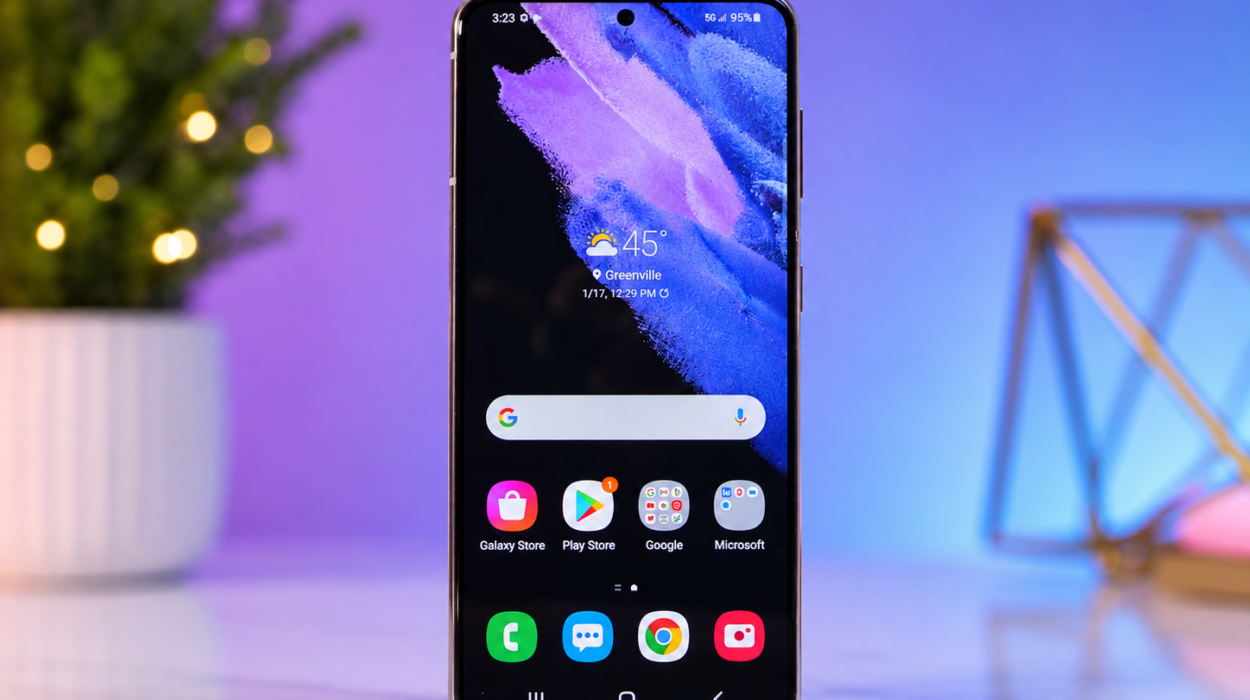
Every time you stream a movie, make a video call, play an online game, or navigate using GPS, you rely on a mobile network working quietly behind the scenes. Over the years, these networks have evolved dramatically, making communication faster, smarter, and more reliable. The latest major step in this journey is 5G, the fifth generation of mobile network technology.
For many people, 5G simply means faster internet on a smartphone. While that is certainly true, it is only a small part of the story. In reality, 5G represents one of the most significant advances in wireless communication ever developed. It is designed not only to connect people but also to connect billions of devices, support new technologies, and enable innovations that were previously impossible.
From self-driving cars and smart factories to remote surgery and immersive virtual reality, 5G has the potential to transform industries and reshape the way we live and work. Understanding what 5G is—and what it is not—helps us appreciate why it is considered such an important technological milestone.
What Is 5G?
5G stands for fifth-generation wireless cellular technology. It is the newest global standard for mobile communication, developed to replace and improve upon previous generations such as 4G LTE.
Like earlier mobile networks, 5G allows smartphones and other wireless devices to connect to the internet and communicate with one another using radio waves. However, it has been engineered to deliver much higher data speeds, significantly lower delays, greater network capacity, and improved reliability.
In simple terms, 5G enables more devices to communicate at the same time while transferring data much faster and responding almost instantly.
Rather than being just a faster version of 4G, 5G introduces new technologies and network architectures that expand what wireless communication can achieve.
The Evolution of Mobile Networks
The story of 5G becomes easier to understand by looking at how mobile technology has evolved over the decades.
The first generation, or 1G, introduced analog voice calls during the 1980s. Mobile phones became portable, but communication quality was limited, and data services did not exist.
The arrival of 2G in the early 1990s marked the transition to digital communication. Voice calls became clearer, text messaging became popular, and basic mobile data services appeared.
The third generation, 3G, transformed mobile phones into internet-connected devices. People could browse websites, send emails, and make video calls, although speeds remained relatively slow compared to today’s standards.
The introduction of 4G LTE changed mobile internet completely. Streaming high-definition video, social media, cloud services, online gaming, and mobile apps became part of everyday life thanks to dramatically higher data speeds.
Now, 5G builds upon these achievements by offering not only faster internet but also entirely new capabilities designed for the connected world of the future.
How Does 5G Work?
Like previous mobile networks, 5G uses radio waves to transmit information between devices and cellular base stations.
When you use your smartphone, it communicates wirelessly with the nearest cell tower. That tower then connects your request to the broader telecommunications network and eventually to the internet.
Although this basic concept remains the same, 5G introduces many technological improvements.
One important advancement is the use of a wider range of radio frequencies. Different frequency bands provide different advantages. Some travel long distances and cover large areas, while others offer extremely high speeds over shorter distances.
5G networks intelligently combine these frequency bands to balance speed, coverage, and capacity.
Another major innovation involves advanced antenna technologies that improve signal quality and allow networks to serve many users simultaneously.
The Three Main Frequency Bands
5G operates across three broad categories of radio frequencies.
Low-band 5G uses frequencies similar to existing cellular networks. These signals travel long distances and easily pass through buildings, providing excellent coverage. However, their speeds are generally only modestly faster than advanced 4G networks.
Mid-band 5G provides an effective balance between coverage and speed. It delivers significantly faster performance than 4G while maintaining good geographic coverage. Many countries consider mid-band frequencies the foundation of their nationwide 5G deployments.
High-band 5G, often called millimeter wave (mmWave), operates at much higher frequencies. These signals can deliver extremely high data rates but travel only short distances and are more easily blocked by walls, buildings, trees, and even heavy rain. As a result, mmWave is typically deployed in stadiums, airports, downtown areas, and other locations with high user density.
Modern 5G networks often combine multiple frequency bands to provide the best possible user experience.
What Makes 5G Different from 4G?
Although both technologies provide mobile internet access, 5G introduces several important improvements over 4G LTE.
The most noticeable difference is speed. Under ideal conditions, 5G can achieve download speeds several times faster than typical 4G networks. Actual speeds depend on network deployment, available spectrum, signal strength, and device capabilities.
Another major improvement is latency.
Latency refers to the time it takes for information to travel from one device to another and back again. Lower latency means quicker responses.
With 4G, latency typically ranges from several tens of milliseconds. Well-designed 5G networks can reduce this delay dramatically, making interactions feel almost instantaneous.
Capacity is another important advantage.
As cities become increasingly connected, millions of smartphones, tablets, sensors, and smart devices compete for network resources. 5G is specifically designed to handle this growing demand while maintaining reliable performance.
Why Is Low Latency So Important?
Many modern technologies require immediate communication.
Imagine controlling a robotic arm performing delicate surgery from thousands of miles away. Even a small communication delay could become significant.
Similarly, autonomous vehicles continuously exchange information about traffic conditions, road hazards, and nearby vehicles. Faster communication allows quicker decision-making.
Virtual reality and augmented reality applications also depend on low latency. Delays between user movement and displayed images can reduce realism and even cause motion sickness.
By reducing communication delays, 5G enables these technologies to operate more effectively.
Massive Device Connectivity
Today’s mobile networks primarily connect smartphones.
Tomorrow’s networks must connect nearly everything.
Homes increasingly contain smart speakers, thermostats, security cameras, appliances, lighting systems, and wearable devices.
Factories deploy thousands of connected sensors monitoring machinery.
Agricultural fields use wireless sensors to monitor soil moisture, temperature, and crop health.
Cities install connected traffic lights, parking sensors, environmental monitors, and public safety systems.
5G is designed to support this enormous number of connected devices without overwhelming the network.
The Technology Behind 5G
Several advanced technologies help make 5G possible.
One important innovation is Massive MIMO, which stands for Multiple Input Multiple Output.
Traditional antennas communicate using relatively few antenna elements.
Massive MIMO uses dozens or even hundreds of antennas working together. This allows networks to send and receive multiple streams of data simultaneously, improving both speed and capacity.
Another important technology is beamforming.
Instead of broadcasting signals equally in every direction, beamforming focuses wireless energy toward individual devices.
This targeted approach improves signal quality, increases efficiency, and reduces interference.
Network slicing is another innovation introduced with 5G.
Rather than operating as one large network serving everyone equally, network slicing allows operators to create multiple virtual networks optimized for different applications.
For example, one slice might prioritize emergency communications, another could support autonomous vehicles, while another focuses on consumer mobile internet.
Faster Download Speeds
Perhaps the most widely recognized benefit of 5G is faster data transfer.
Large files that once required several minutes to download may now take only seconds under favorable conditions.
High-definition movies can begin streaming almost instantly.
Software updates complete more quickly.
Cloud storage synchronizes faster.
Video conferencing becomes smoother.
Although maximum theoretical speeds receive significant attention, actual performance depends on many factors, including network congestion, device compatibility, signal quality, and available radio spectrum.
Better Video Streaming
Video accounts for a large portion of today’s internet traffic.
As video quality continues improving—from HD to 4K and even 8K—the amount of data required also increases.
5G provides greater bandwidth, making it easier to stream high-resolution content with fewer interruptions.
Buffering becomes less common, especially in areas where many people are using mobile data simultaneously.
This improved experience benefits entertainment, education, live broadcasting, and business communication alike.
Cloud Gaming
Cloud gaming allows players to stream games directly from powerful remote servers rather than relying entirely on local hardware.
Instead of downloading large games or owning expensive gaming equipment, users receive interactive video streams while sending control inputs back to the servers.
Because every button press requires an immediate response, low latency is essential.
5G’s reduced communication delays make cloud gaming more responsive and enjoyable.
Virtual Reality and Augmented Reality
Virtual reality creates immersive digital environments.
Augmented reality overlays digital information onto the real world.
Both technologies require enormous amounts of data while demanding extremely low latency.
High-speed wireless communication provided by 5G allows these experiences to become more realistic and accessible.
Future applications include education, engineering, architecture, healthcare, tourism, manufacturing, and entertainment.
Smart Cities
Cities around the world are becoming increasingly connected.
Traffic lights communicate with transportation systems.
Environmental sensors monitor air quality.
Public transportation provides real-time updates.
Smart streetlights adjust brightness automatically.
Waste collection systems detect when containers become full.
Parking systems guide drivers toward available spaces.
These technologies rely on reliable wireless communication connecting thousands or even millions of devices.
5G provides the capacity needed to support these large-scale smart city deployments.
Healthcare and 5G
Healthcare is expected to benefit significantly from 5G technology.
Doctors can conduct high-quality telemedicine consultations.
Medical imaging files transfer rapidly between hospitals.
Connected medical devices continuously monitor patients.
Ambulances transmit patient information before arriving at emergency departments.
Researchers are also exploring remote robotic surgery, although such systems require extremely reliable communication and extensive safeguards.
Rather than replacing healthcare professionals, 5G enhances their ability to provide timely and informed care.
Manufacturing and Industry
Modern factories increasingly rely on automation.
Robots assemble products.
Sensors monitor equipment health.
Artificial intelligence analyzes production efficiency.
Wireless communication enables machines to exchange information continuously.
Because production interruptions can be costly, industrial networks require exceptional reliability.
Private 5G networks are becoming attractive for manufacturers seeking secure, flexible, and highly responsive wireless communication inside factories.
Agriculture
Agriculture is also embracing digital technologies.
Connected sensors measure soil moisture, nutrient levels, and weather conditions.
Autonomous tractors navigate fields using satellite positioning and wireless communication.
Drones inspect crops and identify areas requiring irrigation or pest control.
Livestock monitoring systems track animal health.
5G supports the rapid exchange of information needed for precision agriculture, helping improve productivity while reducing resource consumption.
Transportation
Transportation systems are becoming increasingly connected.
Vehicles communicate with navigation services.
Traffic management systems monitor road conditions.
Public transportation shares real-time arrival information.
Researchers continue developing connected and autonomous vehicles capable of exchanging information with nearby infrastructure and other vehicles.
Although fully autonomous transportation depends on many technologies beyond wireless communication, 5G can provide important support by enabling faster and more reliable data exchange.
Internet of Things
One of the biggest goals of 5G is supporting the Internet of Things, often abbreviated as IoT.
The Internet of Things refers to physical objects equipped with sensors, processors, and communication capabilities that allow them to exchange information over networks.
These connected devices include household appliances, wearable fitness trackers, industrial equipment, environmental sensors, agricultural systems, medical devices, and much more.
As billions of IoT devices come online, efficient wireless communication becomes increasingly important.
5G is specifically designed to accommodate this massive growth.
Is 5G Safe?
The safety of radio-frequency exposure has been extensively studied for decades.
5G uses non-ionizing radio waves, similar to those used by earlier mobile technologies, Wi-Fi, radio broadcasting, and television transmissions.
Non-ionizing radiation does not carry enough energy to remove electrons from atoms or directly damage DNA in the way ionizing radiation, such as X-rays or gamma rays, can.
International organizations and national health authorities establish exposure limits based on scientific research. Mobile networks, including 5G, are designed to operate within these established safety guidelines.
Research continues as wireless technologies evolve, but current scientific evidence does not demonstrate adverse health effects from radio-frequency exposure below internationally recognized safety limits.
Common Misconceptions About 5G
Since its introduction, 5G has been surrounded by numerous misconceptions.
Some people mistakenly believe 5G is completely different from previous cellular technologies. In reality, it represents the latest stage in the ongoing evolution of mobile communication.
Others assume 5G works only with millimeter-wave frequencies. In fact, most global 5G deployments rely heavily on low-band and mid-band spectrum.
There is also a common belief that 5G instantly provides maximum speed everywhere. Actual performance varies depending on network infrastructure, available spectrum, user density, and geographic location.
Understanding these facts helps separate scientific evidence from misinformation.
Challenges of Building 5G Networks
Deploying 5G infrastructure is a major engineering challenge.
High-frequency signals often require many more cell sites than previous generations because they cover shorter distances.
Telecommunication companies must install new antennas, upgrade existing towers, expand fiber-optic networks, and modernize core network infrastructure.
Spectrum allocation also requires careful coordination among governments, regulators, and network operators.
Building nationwide coverage takes years of investment and planning.
The Future Beyond 5G
Although 5G is still expanding globally, researchers have already begun exploring future wireless technologies.
Concepts associated with sixth-generation, or 6G, networks include even faster communication, advanced artificial intelligence integration, improved sensing capabilities, and support for emerging technologies that have yet to become commonplace.
However, 5G will remain the foundation of global mobile communication for many years as its infrastructure continues expanding and new applications emerge.
Why 5G Matters
5G is much more than another mobile network upgrade. It represents a technological platform designed for an increasingly connected world.
Its combination of higher speeds, lower latency, greater reliability, and support for massive numbers of connected devices enables innovations across healthcare, transportation, manufacturing, education, agriculture, entertainment, and countless other fields.
While faster smartphone downloads may be the most visible benefit today, the true impact of 5G lies in the opportunities it creates for the future. As networks continue to expand and developers build new applications around its capabilities, 5G is expected to play a central role in shaping the next generation of digital technology, helping people, devices, and industries communicate more efficiently than ever before.