Imagine asking a digital assistant, “What’s the weather today?” Within seconds, it tells you the forecast. Now imagine asking, “Help me plan a three-day trip to the mountains, create a budget, suggest hiking trails, and write an email requesting vacation leave.” Instead of giving a simple answer, it understands the request, organizes the information, creates a detailed plan, and even adjusts its suggestions when you ask follow-up questions.
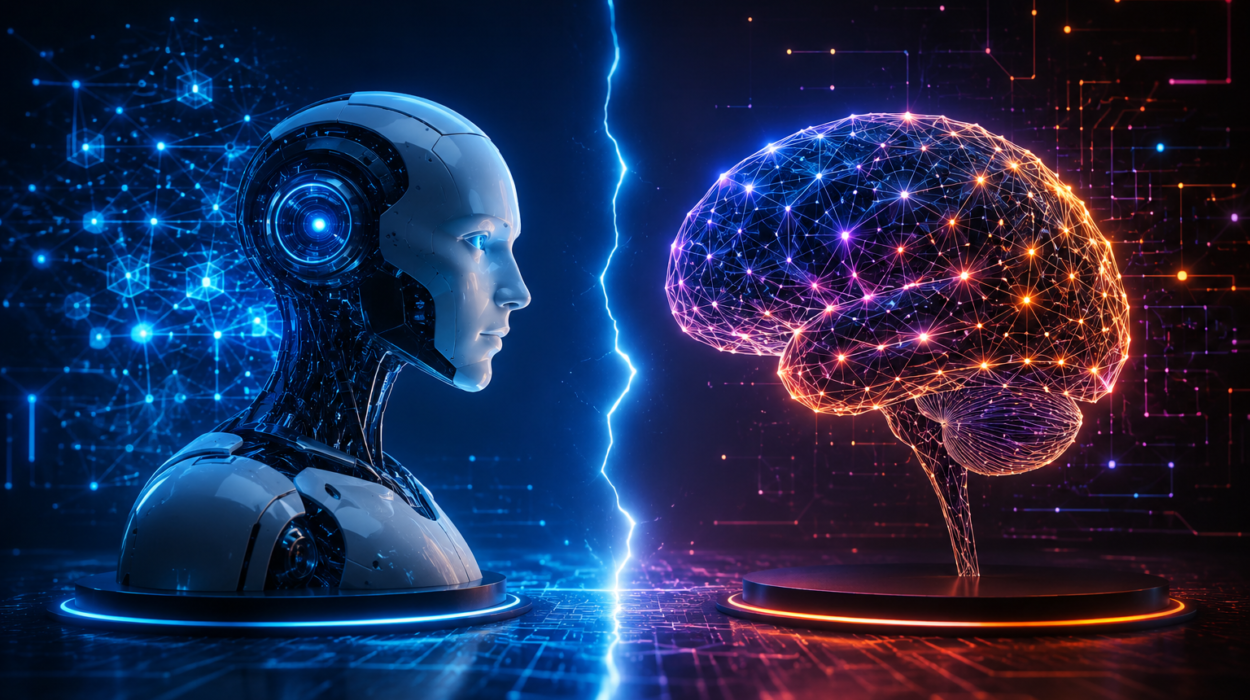
Although both systems may seem similar at first, they represent two very different generations of technology.
For many years, virtual assistants could perform basic tasks like setting alarms, answering simple questions, or playing music. Today, a new generation of AI assistants can hold natural conversations, summarize long documents, generate images, write computer code, analyze data, and help solve complex problems.
Understanding the difference between traditional virtual assistants and modern AI assistants helps explain one of the biggest technological shifts of the twenty-first century.
What Is a Traditional Virtual Assistant?
A traditional virtual assistant is a software program designed to perform predefined tasks based on commands from a user.
These assistants became popular in smartphones, smart speakers, and other connected devices. They allowed people to interact with computers using spoken language instead of keyboards or touchscreens.
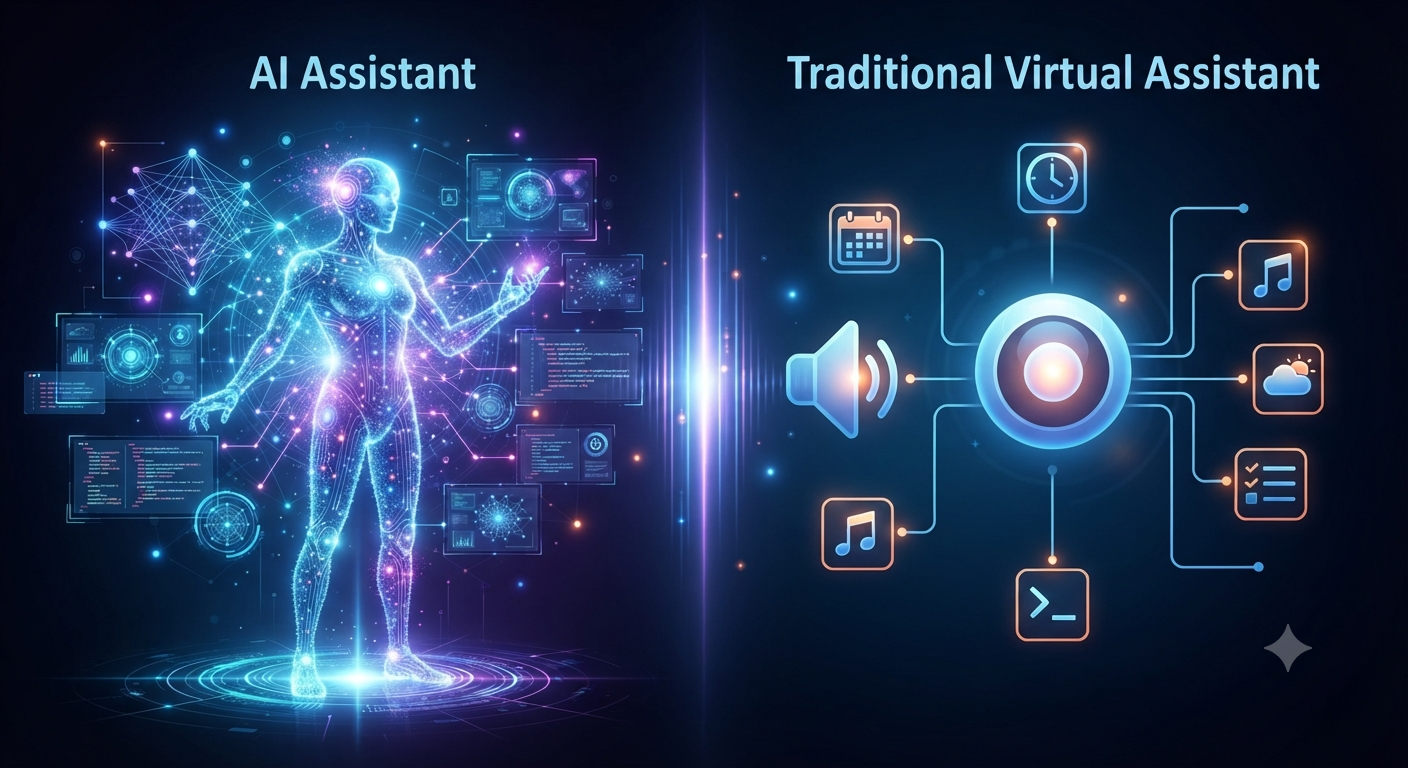
Traditional virtual assistants could perform many useful everyday functions. They could set reminders, create calendar events, send messages, make phone calls, provide weather forecasts, answer simple factual questions, play music, control smart home devices, and perform internet searches.
Behind the scenes, these systems relied heavily on carefully programmed rules, structured databases, and specialized software designed for specific tasks.
While they often appeared intelligent, their capabilities were usually limited to functions developers had specifically designed.
What Is an AI Assistant?
An AI assistant is a much more advanced type of software that uses modern Artificial Intelligence, particularly machine learning, deep learning, and large language models, to understand language, reason through problems, generate original content, and adapt to a wide variety of tasks.
Unlike traditional assistants that mainly execute commands, AI assistants can engage in extended conversations, explain complicated ideas, summarize research papers, generate computer programs, analyze spreadsheets, draft reports, translate languages, brainstorm creative ideas, and answer follow-up questions while maintaining context.
Rather than functioning as simple command interpreters, AI assistants act more like flexible problem-solving tools.
Although today’s AI assistants are not conscious and do not truly understand information in the human sense, they can produce remarkably useful responses by recognizing patterns learned from vast amounts of data.
The Evolution of Digital Assistance
The journey from traditional virtual assistants to AI assistants reflects decades of advances in computer science.
Early digital assistants focused primarily on automation.
Users gave specific commands.
The software matched those commands to predefined actions.
For example, saying “Set an alarm for seven o’clock” triggered a programmed routine.
As computing power increased and machine learning improved, researchers developed systems capable of recognizing speech more accurately, understanding more natural language, and learning statistical relationships from enormous datasets.
The emergence of large language models dramatically expanded what digital assistants could accomplish.
Instead of responding only to specific commands, AI assistants began generating complete paragraphs, solving reasoning problems, creating software code, and assisting with increasingly complex tasks.
This shift represents one of the most significant developments in modern computing.
How Traditional Virtual Assistants Work
Traditional virtual assistants generally operate by recognizing user commands and matching them with predefined actions.
When someone asks for the weather, the assistant identifies keywords, retrieves weather information from an online service, and presents the result.
If a user requests a timer, the assistant activates the device’s timer function.
Many traditional assistants combine speech recognition with databases, search engines, and application programming interfaces that retrieve information from external services.
Although these systems may use certain AI techniques, their overall behavior is often limited to specific functions developers have anticipated.
Unexpected questions or complicated requests frequently lead to confusion or generic responses.
How AI Assistants Work
Modern AI assistants rely on sophisticated machine learning models trained using enormous collections of text, images, computer code, and other forms of information.
Instead of relying mainly on predefined rules, they identify statistical patterns that help predict useful responses.
When a person asks a question, the AI analyzes the request, considers the surrounding conversation, identifies relevant patterns learned during training, and generates a response.
Some AI assistants can also use external tools such as search engines, calculators, programming environments, databases, or productivity software to improve their performance.
This combination of learned knowledge and tool use allows AI assistants to perform far more varied tasks than traditional virtual assistants.
Understanding Natural Language
One of the biggest differences between the two technologies lies in language understanding.
Traditional virtual assistants generally expect commands expressed in relatively predictable ways.
For example, users might say, “Play jazz music,” or “Set a reminder.”
If the wording changes significantly, recognition may become less reliable.
AI assistants are designed to understand language much more flexibly.
People can ask long, conversational questions.
They can change topics naturally.
They can ask follow-up questions without repeating previous information.
The assistant often maintains conversational context, making interactions feel much closer to speaking with another person.
This capability comes from advances in Natural Language Processing (NLP) and large language models.
Conversations Feel Different
A conversation with a traditional virtual assistant often resembles interacting with a menu.
Each request is largely independent.
The assistant performs one task before waiting for the next command.
AI assistants can maintain context across multiple exchanges.
Suppose someone asks for help writing a report.
The assistant drafts an introduction.
The user then requests a shorter version.
Later, they ask for a more formal tone.
Finally, they request a summary.
The AI remembers the earlier conversation and adjusts its responses accordingly.
This ability creates a smoother and more productive experience.
Knowledge and Information
Traditional virtual assistants often retrieve information directly from search engines or structured databases.
They usually provide short factual answers.
AI assistants can explain concepts in greater depth.
They can summarize scientific articles, compare historical events, discuss programming techniques, explain mathematical ideas, and organize information into coherent narratives.
However, users should remember that AI-generated information can sometimes contain errors. For important decisions involving medicine, law, finance, or safety, information should always be verified using authoritative sources and qualified professionals.
Creativity
Perhaps the most striking difference between AI assistants and traditional virtual assistants is creativity.
Traditional assistants rarely generate original content.
They primarily retrieve existing information or execute commands.
AI assistants can create new material.
They write stories.
They compose poems.
They generate marketing ideas.
They produce software code.
They create lesson plans.
They design presentations.
They brainstorm scientific hypotheses.
They even generate images, music, and videos when combined with specialized AI models.
Although this creativity results from learned statistical patterns rather than human imagination, the outputs can be surprisingly sophisticated.
Learning and Adaptation
Traditional virtual assistants improve mainly through software updates created by developers.
Their capabilities expand when programmers add new features.
AI assistants also receive updates, but the underlying machine learning models enable greater flexibility in handling unfamiliar requests.
Instead of requiring explicit programming for every possible situation, they often generalize from patterns learned during training.
This allows them to solve many tasks they were never specifically programmed to perform.
Problem Solving
Traditional assistants excel at straightforward tasks.
They can schedule meetings, send messages, or answer simple questions efficiently.
AI assistants tackle more complicated challenges.
They can help debug computer programs, analyze research papers, organize business strategies, generate educational materials, explain scientific theories, and assist with long-term planning.
They do not merely execute commands.
They often participate in collaborative problem-solving.
Productivity
Modern workplaces increasingly rely on AI assistants to improve productivity.
Employees use them to draft emails, summarize meetings, organize projects, analyze data, generate reports, translate documents, and automate repetitive writing tasks.
Traditional virtual assistants remain useful for scheduling appointments, setting reminders, and managing calendars.
Rather than replacing these earlier functions, AI assistants build upon them while adding much broader capabilities.
Education
Education provides an excellent example of the growing differences between these technologies.
A traditional virtual assistant might answer a question such as, “What is photosynthesis?”
An AI assistant can explain photosynthesis at different educational levels, generate quizzes, summarize textbooks, suggest experiments, answer follow-up questions, and adapt explanations based on the student’s existing knowledge.
Instead of acting solely as an information source, it becomes an interactive learning partner.
Business Applications
Businesses increasingly integrate AI assistants into customer service, software development, research, marketing, and internal knowledge management.
AI systems can draft documents, summarize customer feedback, analyze contracts, assist programmers, and support decision-making.
Traditional virtual assistants continue serving valuable roles in communication, scheduling, and office automation.
Many organizations now combine both technologies depending on the specific task.
Scientific Research
Scientists also benefit from AI assistants.
Researchers use them to summarize scientific literature, organize references, analyze experimental data, generate computer code, and assist with hypothesis development.
Traditional assistants provide useful organizational support, such as managing calendars and reminders.
AI assistants contribute directly to many aspects of scientific workflow, although human researchers remain responsible for interpreting evidence, designing experiments, and evaluating conclusions.
Personal Assistance
For everyday users, AI assistants offer a much wider range of support.
They help plan vacations, explain recipes, compare products, prepare interviews, organize study schedules, translate conversations, create workout plans, and draft personal letters.
Traditional assistants still excel at quick device-based tasks such as controlling smart home systems, setting alarms, or initiating phone calls.
Both technologies continue serving important but increasingly different purposes.
Accuracy
Neither technology is perfect.
Traditional virtual assistants generally produce reliable results when performing predefined actions.
AI assistants, while far more flexible, sometimes generate incorrect or misleading information because they predict responses based on learned patterns rather than verifying every statement against reality.
Researchers continue improving factual accuracy through better training methods, retrieval systems, external knowledge sources, and human evaluation.
Users should remain thoughtful and verify important information independently.
Privacy Considerations
Both traditional virtual assistants and AI assistants process user information to perform requested tasks.
Depending on the service, this may involve voice recordings, text conversations, search history, or other data.
Technology companies increasingly provide privacy controls, allowing users to manage stored information.
Understanding privacy policies and choosing appropriate settings remain important parts of responsible technology use.
Ethical Challenges
The rapid growth of AI assistants has introduced new ethical questions.
How should AI-generated content be identified?
How can developers reduce bias?
Who is responsible if an AI produces harmful advice?
How should personal information be protected?
How can misinformation be minimized?
These questions involve not only computer science but also ethics, law, psychology, education, economics, and public policy.
Traditional virtual assistants face some of these issues as well, but the broader capabilities of AI assistants make ethical considerations even more important.
Can AI Assistants Replace Humans?
AI assistants are powerful tools, but they are not replacements for human intelligence.
They lack emotions.
They do not possess consciousness.
They have no personal experiences.
They cannot independently establish goals or values.
Human judgment remains essential in medicine, education, scientific research, engineering, law, journalism, government, and countless other fields.
The greatest value of AI assistants comes from collaboration.
Humans provide creativity, empathy, ethical reasoning, cultural understanding, and critical thinking.
AI contributes speed, information processing, and computational assistance.
Together, they often achieve more than either could alone.
The Future of Digital Assistants
The distinction between traditional virtual assistants and AI assistants will likely continue evolving.
Future assistants may become more personalized, more accurate, and better integrated into everyday devices.
They may assist with lifelong education, scientific discovery, environmental monitoring, healthcare, accessibility, and countless other applications.
Researchers are also working to improve reasoning, transparency, factual reliability, multilingual communication, and safety.
Traditional virtual assistants are likely to remain useful for quick device control and routine automation, while AI assistants continue expanding into more complex forms of collaboration.
Which One Is Better?
The answer depends on the task.
If someone wants to turn on smart lights, set a timer, or check tomorrow’s weather, a traditional virtual assistant often completes the job quickly and efficiently.
If someone needs help writing a research paper, analyzing business data, learning a new programming language, planning a project, or exploring scientific concepts, an AI assistant usually offers far greater flexibility.
Rather than competing directly, these technologies increasingly complement one another.
Traditional virtual assistants specialize in efficient task execution.
AI assistants specialize in understanding language, generating knowledge-based responses, and assisting with complex thinking.
A New Chapter in Human–Computer Interaction
The evolution from traditional virtual assistants to AI assistants marks one of the most significant changes in the history of computing. Early virtual assistants taught computers to respond to spoken commands and automate everyday tasks. Modern AI assistants go much further, helping people communicate, create, learn, solve problems, and explore ideas through natural conversation.
Despite their impressive capabilities, AI assistants are still tools created by humans. They do not think, feel, or understand the world as people do. Their strengths come from advanced algorithms, powerful computing systems, and extensive training on large datasets—not from consciousness or human-like awareness.
As Artificial Intelligence continues to advance, the relationship between humans and digital assistants will likely become even more collaborative. Traditional virtual assistants will continue handling routine actions efficiently, while AI assistants will increasingly serve as partners in education, creativity, research, business, and daily life. Together, they represent not only the evolution of digital technology but also a new way for people to interact with information, solve complex challenges, and expand what is possible in an increasingly connected world.