Imagine asking a computer to explain black holes, write a story, translate a language, summarize a long report, solve a math problem, or even help you write computer code. Instead of responding with a few pre-programmed sentences, it gives detailed, natural, and often remarkably useful answers in everyday language.
Just a few years ago, this would have seemed almost impossible. Today, it has become a reality thanks to a technology known as the Large Language Model, often abbreviated as LLM.
Large language models have become one of the most significant breakthroughs in artificial intelligence. They power many modern AI assistants, writing tools, search experiences, programming assistants, educational applications, and scientific research tools. Although they often appear conversational and knowledgeable, their abilities are based on mathematics, statistics, and enormous amounts of training data—not human thoughts or consciousness.
To understand what a large language model really is, it helps to begin with a simple question: how do computers learn to work with human language?
Understanding Human Language Is Surprisingly Difficult
Language is something humans use naturally from early childhood.
We recognize words, understand meanings, detect humor, notice emotions, interpret context, and adjust our speech depending on the situation. We can understand incomplete sentences, recognize sarcasm, and even guess what someone means when they make a mistake.
For computers, however, language is incredibly complex.
Words often have multiple meanings.
The same sentence can mean different things depending on context.
Grammar varies across languages.
People invent new expressions constantly.
Understanding all these subtleties requires far more than looking up words in a dictionary.
For decades, scientists searched for better ways to teach computers how to process language. Early systems relied on carefully written grammatical rules and dictionaries, but they struggled with the enormous complexity and flexibility of human communication.
The arrival of machine learning—and later, large language models—transformed this challenge.
What Is a Large Language Model?
A large language model is an artificial intelligence system trained to understand and generate human language by learning statistical patterns from vast collections of text.
Instead of storing fixed answers, an LLM learns relationships between words, phrases, sentences, and ideas. During training, it analyzes billions or even trillions of words from books, articles, websites, scientific papers, and other written materials, depending on the model and its training data.
By studying these patterns, the model becomes able to predict what word or sequence of words is most likely to come next in a given context.
Although this sounds simple, predicting the next word repeatedly allows the model to produce paragraphs, answer questions, summarize documents, write code, translate languages, and perform many other language-related tasks.
In essence, an LLM is a highly sophisticated pattern-recognition system designed for language.
Why Is It Called “Large”?
The word “large” refers to several aspects of these models.
First, they are trained using enormous amounts of text.
Second, they contain extremely large mathematical structures with millions, billions, or even hundreds of billions of adjustable parameters. Parameters are numerical values that the model learns during training. They capture statistical relationships within language.
Third, training these models requires enormous computing resources. Powerful computer clusters equipped with specialized processors perform countless mathematical calculations over weeks or months.
Finally, these models can often perform a wide variety of language tasks without requiring separate software for each individual task.
Their scale is one of the reasons they have become so capable.
What Does “Language Model” Mean?
A language model is a system that estimates the probability of words appearing in sequence.
Imagine reading the sentence:
“The Sun rises in the…”
Most people would naturally expect the next word to be “east.”
A language model works in a similar way.
It predicts which words are most likely to come next based on the context provided.
Modern language models perform this prediction repeatedly, one piece of text at a time. As each new word is generated, it becomes part of the context for predicting the next one.
This continuous prediction process enables the model to produce coherent paragraphs, conversations, stories, and explanations.
How Large Language Models Learn
Training a large language model is one of the most computationally intensive processes in modern artificial intelligence.
During training, the model receives vast amounts of text.
It does not memorize every sentence.
Instead, it gradually adjusts its internal mathematical parameters so that its predictions become increasingly accurate.
A simple way to imagine this process is to think of someone reading millions of books while trying to guess each missing word before seeing it. Every mistake helps improve future predictions.
Over time, the model becomes better at recognizing grammar, sentence structure, vocabulary, factual relationships, writing styles, and many patterns found in language.
This process is called training.
After training is complete, the model can generate responses to new prompts that it has never seen before.
The Role of Neural Networks
Large language models are built using artificial neural networks.
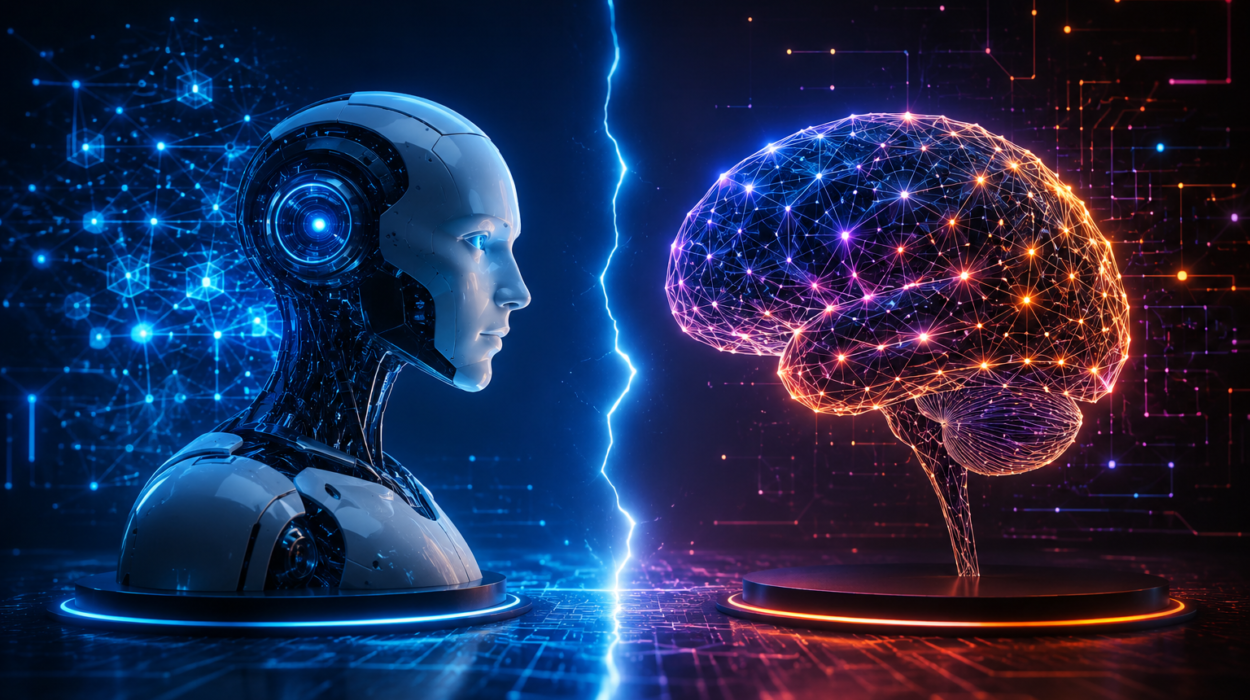
These are mathematical systems inspired loosely by the organization of neurons in the human brain, although they work very differently from biological brains.
Artificial neural networks consist of layers of interconnected mathematical operations.
As information passes through these layers, the network learns increasingly complex relationships.
Early layers may recognize simple language patterns.
Later layers combine these into richer representations involving grammar, meaning, context, and broader relationships among ideas.
Modern LLMs often contain dozens or even hundreds of processing layers working together.
The Transformer Revolution
One of the most important breakthroughs in AI came with the introduction of an architecture known as the Transformer.
Before transformers, many language models struggled to handle long pieces of text because they processed words in relatively limited ways.
Transformers introduced a mechanism called attention, allowing the model to consider relationships between many different words within a sentence or document simultaneously.
Rather than focusing only on nearby words, attention enables the model to determine which parts of the text are most relevant for understanding the current context.
This innovation dramatically improved language understanding and generation.
Nearly all modern large language models are based on transformer architectures or closely related designs.
Tokens Instead of Words
Large language models do not always process complete words.
Instead, they work with smaller units called tokens.
A token may represent a whole word, part of a word, punctuation mark, or even a single character, depending on the language and the model’s tokenization system.
Breaking text into tokens makes language processing more flexible.
It allows the model to handle unfamiliar words, different languages, numbers, and specialized terminology more efficiently.
When you type a prompt, the model first converts your text into tokens before performing mathematical calculations.
How an LLM Generates a Response
When you ask an LLM a question, several steps occur almost instantly.
Your text is converted into tokens.
The model analyzes the relationships among those tokens.
It calculates probabilities for many possible next tokens.
One token is selected according to the model’s prediction process.
The new token becomes part of the context.
The cycle repeats until the response is complete.
This entire process usually takes only fractions of a second despite involving billions of mathematical operations.
Does an LLM Understand Language Like Humans?
This is one of the most fascinating questions in artificial intelligence.
Large language models can produce responses that often appear thoughtful, creative, and intelligent.
However, their internal processes differ fundamentally from human understanding.
Humans experience emotions.
They perceive the physical world.
They possess personal memories.
They develop intentions.
They understand meaning through lived experience.
Large language models do not have these characteristics.
They recognize statistical patterns in language rather than experiencing the world directly.
Although their responses may resemble human conversation, this does not mean they possess consciousness or subjective awareness.
Researchers continue studying the nature of intelligence, language, and cognition to better understand these differences.
What Can Large Language Models Do?
Large language models are remarkably versatile because language connects many different forms of knowledge.
They can answer questions, explain scientific concepts, summarize books and articles, translate between languages, write essays, draft emails, generate computer code, assist with research, create stories and poems, help students learn, analyze documents, and support customer service.
Many also assist scientists, doctors, engineers, teachers, journalists, and business professionals with routine language-based tasks.
Their usefulness comes from their ability to adapt to many different requests without requiring entirely separate software for each one.
Large Language Models in Education
Education has become one of the most promising areas for LLMs.
Students can ask questions whenever they become confused.
Teachers can generate lesson materials.
Language learners receive explanations and conversation practice.
Researchers can summarize scientific literature more efficiently.
Writing assistants help improve grammar, clarity, and organization.
Despite these benefits, educators emphasize that students should use LLMs responsibly.
Learning requires active thinking, critical analysis, and problem-solving—skills that cannot be replaced simply by receiving answers.
LLMs in Scientific Research
Scientists increasingly use large language models to assist with research.
LLMs can summarize published papers, organize information, help draft reports, generate programming code, analyze documentation, and identify relevant literature.
Researchers are also combining language models with specialized scientific software to accelerate discoveries in biology, chemistry, medicine, astronomy, and many other disciplines.
Importantly, scientists verify AI-generated information carefully because language models may occasionally produce incorrect or outdated statements.
Human expertise remains essential.
LLMs in Business
Businesses use large language models in many ways.
Customer support systems answer routine questions.
Writers receive assistance drafting documents.
Programmers use coding assistants.
Legal professionals summarize lengthy documents.
Healthcare organizations organize medical records while following privacy regulations.
Financial institutions analyze reports.
Marketing teams generate content ideas.
These applications often improve efficiency by reducing repetitive language-based tasks.
Why Do LLMs Sometimes Make Mistakes?
Large language models are powerful but imperfect.
One reason is that they predict likely text rather than verifying every statement against reality.
As a result, they may occasionally generate information that sounds convincing but is inaccurate. This phenomenon is commonly called a hallucination in AI research.
Mistakes can occur because training data may contain errors, because the model lacks sufficient information about a topic, or because statistical prediction alone cannot guarantee factual correctness.
For this reason, important information should always be verified using reliable sources, especially in medicine, law, finance, engineering, and scientific research.
Do Large Language Models Memorize Everything?
Not exactly.
During training, LLMs learn statistical relationships rather than storing every sentence exactly as written.
Most of their abilities arise from recognizing patterns instead of retrieving entire documents.
However, researchers carefully study the possibility that models may reproduce portions of their training data under certain circumstances.
Developers therefore employ various techniques to reduce unwanted memorization and improve privacy protections.
Are Large Language Models Intelligent?
The answer depends on how intelligence is defined.
Large language models display impressive capabilities in language-related tasks.
They can reason through many problems, identify patterns, explain concepts, and adapt their responses to different situations.
However, they do not possess consciousness, emotions, desires, personal experiences, or independent goals.
Many scientists describe current LLMs as powerful tools for language processing rather than human-like minds.
Research continues into how intelligence should be understood and measured.
Ethical Challenges
As large language models become more capable, important ethical questions arise.
How should personal data be protected?
How can harmful biases be reduced?
How should AI-generated content be identified?
Who is responsible when AI produces incorrect information?
How can society prevent misuse while encouraging innovation?
Researchers, governments, educators, technology companies, and civil society organizations continue working together to address these questions.
Responsible development requires balancing technological progress with fairness, transparency, accountability, privacy, and public trust.
How LLMs Continue Improving
Large language models improve through advances in several areas.
Researchers develop more efficient training methods.
Higher-quality datasets reduce errors.
Better reasoning techniques increase reliability.
Improved safety systems help prevent harmful outputs.
New evaluation methods measure factual accuracy, fairness, and robustness more carefully.
Scientists are also exploring ways to combine language models with external tools such as calculators, databases, search systems, and scientific software, enabling them to provide more accurate and useful assistance.
The Future of Large Language Models
Large language models are evolving rapidly.
Future systems may become more accurate, more efficient, and better at understanding complex instructions. They may work more seamlessly with images, audio, video, robotics, and scientific instruments, enabling new forms of human-computer collaboration.
Researchers are also focusing on making LLMs more transparent, reducing factual errors, improving multilingual capabilities, lowering energy consumption during training, and ensuring that these systems are developed responsibly.
At the same time, many scientific questions remain open. Researchers continue investigating how language models reason, how they represent knowledge internally, and how their reliability can be improved for critical applications.
Why Large Language Models Matter
Large language models represent one of the most important advances in the history of artificial intelligence because they have dramatically expanded what computers can do with human language. Instead of following only fixed instructions, they can generate text, answer questions, summarize information, assist with writing, explain ideas, and support countless language-based tasks across education, science, healthcare, business, and everyday life.
Yet their greatest significance lies not in replacing human intelligence but in extending it. Large language models do not think, feel, or understand the world as people do. They rely on mathematical patterns learned from vast amounts of text. Human judgment, creativity, ethics, experience, and critical thinking remain essential for interpreting, evaluating, and applying the information these systems provide.
As research continues, large language models will likely become even more capable and useful. Their future impact will depend not only on advances in computer science but also on how wisely humanity chooses to develop, regulate, and use this remarkable technology. When guided by scientific evidence, transparency, and responsible innovation, large language models have the potential to become powerful partners in learning, discovery, communication, and creativity for people around the world.